<?xml version="1.0" encoding="UTF-8"?><rss version="2.0"
	xmlns:content="http://purl.org/rss/1.0/modules/content/"
	xmlns:wfw="http://wellformedweb.org/CommentAPI/"
	xmlns:dc="http://purl.org/dc/elements/1.1/"
	xmlns:atom="http://www.w3.org/2005/Atom"
	xmlns:sy="http://purl.org/rss/1.0/modules/syndication/"
	xmlns:slash="http://purl.org/rss/1.0/modules/slash/"
	>

<channel>
	<title>Featured Archives - Chemistry Hall</title>
	<atom:link href="https://chemistryhall.com/category/featured/feed/" rel="self" type="application/rss+xml" />
	<link>https://chemistryhall.com/category/featured/</link>
	<description>From Research Highlights to Education</description>
	<lastBuildDate>Sun, 05 May 2024 00:04:10 +0000</lastBuildDate>
	<language>en-US</language>
	<sy:updatePeriod>
	hourly	</sy:updatePeriod>
	<sy:updateFrequency>
	1	</sy:updateFrequency>
	
	<item>
		<title>Why Do Chemicals React? Kinetics and Thermodynamics</title>
		<link>https://chemistryhall.com/why-do-chemicals-react-kinetics-thermodynamics/</link>
					<comments>https://chemistryhall.com/why-do-chemicals-react-kinetics-thermodynamics/#comments</comments>
		
		<dc:creator><![CDATA[C. Hall]]></dc:creator>
		<pubDate>Sat, 10 Apr 2021 23:01:39 +0000</pubDate>
				<category><![CDATA[Education and Concepts]]></category>
		<category><![CDATA[Featured]]></category>
		<category><![CDATA[general chemistry]]></category>
		<guid isPermaLink="false">https://chemistryhall.com/?p=39259</guid>

					<description><![CDATA[<p>Chemistry is the science of change. But why do chemical reactions take place? Why do chemicals react with each other? The answer is in thermodynamics and kinetics. These two are arguably the most important concepts to grasp in chemistry. But sometimes, even after several years of basic chemistry education, it is not easy to form...&#160;<a href="https://chemistryhall.com/why-do-chemicals-react-kinetics-thermodynamics/">[Read&#160;More]</a></p>
<p>The post <a href="https://chemistryhall.com/why-do-chemicals-react-kinetics-thermodynamics/">Why Do Chemicals React? Kinetics and Thermodynamics</a> appeared first on <a href="https://chemistryhall.com">Chemistry Hall</a>.</p>
]]></description>
										<content:encoded><![CDATA[
<p>Chemistry is the science of change. But why do chemical reactions take place? Why do chemicals react with each other?</p>


<p>The answer is in <strong>thermodynamics </strong>and <strong>kinetics</strong>. These two are arguably the most important <a href="https://chemistryhall.com/basic-chemistry-concepts/">concepts</a> to grasp in chemistry.</p>


<p>But sometimes, even after several years of basic chemistry education, it is not easy to form a clear picture on how they govern reactivity!</p>


<h3 class="wp-block-heading">Tutorial Review: Contents and Introduction</h3>


<p>In this tutorial, we will try to introduce and summarize what these two concepts are, and their implications in chemical reactivity. This is obviously an introduction, intended for chemistry students of all levels. </p>


<p>For sure, there are more comprehensive explanations out there, and if you want one, go grab any of the <a href="https://chemistryhall.com/best-chemistry-textbook/" target="_blank" rel="noreferrer noopener">best-known general chemistry books</a>, or a more specific <a href="https://chemistryhall.com/best-organic-chemistry-textbook/">organic chemistry textbook</a>. However, we have found that there are not many short explanations out there available for the general scientific public. This is somehow worrying, since, without a basic understanding of thermodynamics and kinetics, there is no way to understand the basic principles of reactivity.  And without understanding reactivity, you are missing out on the most important part of chemistry.</p>


<p>But if you really want to dive on physical chemistry concepts as such, unfortunately you will find that most books can be impenetrable without a basic understanding of maths, physics and chemistry itself. </p>


<p>This is what we want to fix with this short tutorial. To give you <strong>a general overview on why chemical compounds react</strong>. We want to break the gate-keeping that has always been going on with physical organic chemistry!</p>


<p>As mentioned, this is intended to be brief. We will start off with the basic definitions, and hopefully make you go all the way through to understanding free-energy profiles of catalytic reactions.</p>


<p>Interested yet? Keep reading!</p>


<ul><li><em>A quick disclaimer: Since my background is in <a href="https://chemistryhall.com/basic-organic-chemistry-concepts/">organic chemistry</a>, I will base the explanations on simple organic chemical reactions, but most of the general principles apply to any kind of chemical reactivity.</em></li><li><em>For most energy diagrams, the energy values are orientative, made up in order to explain the concepts. </em></li></ul>


<span id="more-39259"></span>


<h2 class="wp-block-heading">Thermodynamics: The Energetic Stability of Molecules</h2>


<blockquote class="wp-block-quote is-layout-flow wp-block-quote-is-layout-flow"><p><strong><a href="https://en.wikipedia.org/wiki/Thermodynamics" target="_blank" rel="noreferrer noopener">Thermodynamics</a></strong> is the branch of physics that deals with heat, work and temperature, and their relation to energy, radiation, and physical properties of matter.</p></blockquote>


<p>That is the definition of thermodynamics. As you can see, it is an incredibly broad concept. Let&#8217;s forget about it for now. How does thermodynamics dictate why do chemicals react?</p>


<p>Well, imagine every different molecule having an associated value for energy. </p>


<p>Some molecules will have larger energies and some others lower energies. Then consider that every chemical system has the tendency to go towards the point of lowest energy possible, in effect, the <strong><em>most stable</em></strong> point. This means that a molecule with high energy (less stable) will have a tendency (or &#8220;will want to react&#8221;) to transform into another molecule with lower energy (more stable). </p>


<p>Why is that? Because the process of going from a high energy state to a lower energy state releases energy, or heat, in what is called an exothermic process. This is what we call a <strong>thermodynamically-favored process</strong>, and it is basically what the <a href="https://en.wikipedia.org/wiki/Laws_of_thermodynamics" target="_blank" rel="noreferrer noopener">laws of thermodynamics</a> are telling us.</p>


<h3 class="wp-block-heading">Thermodynamic Stability in Energy Diagrams</h3>


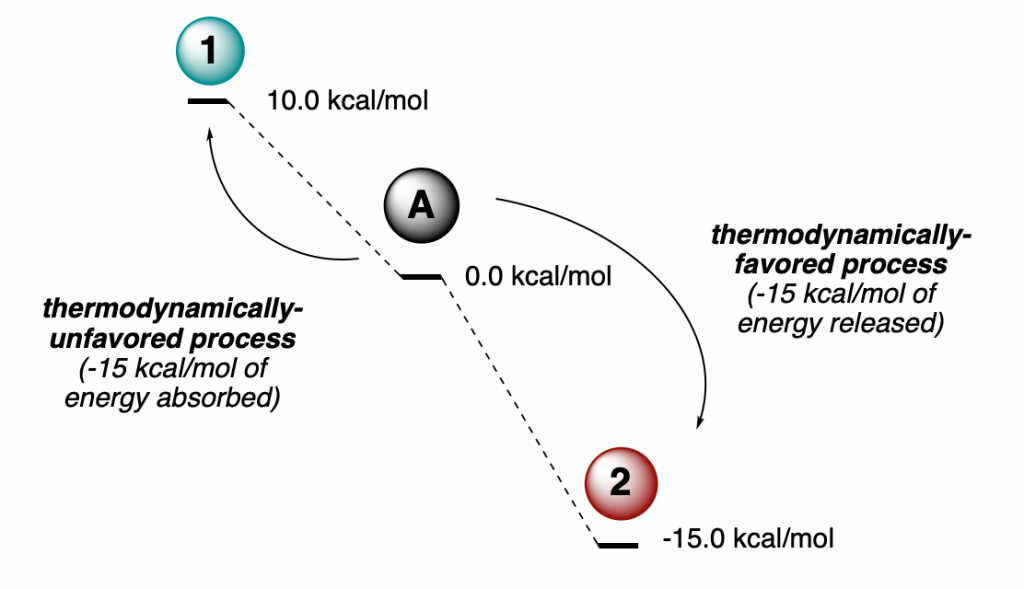
<p>This is easier than it might sound. The image below illustrates what you just read. Molecule A can react in two ways: Absorbing heat it can be transformed into <strong>1</strong>. Alternatively, it can evolve into <strong>2 </strong>by releasing energy, in a thermodynamically-favorable manner. Of course, if these were the only two possible scenarios, all molecules of <strong>A</strong> would react to give <strong>2</strong>, and stay there forever. But the picture is usually not that simple, and we will come back to this later.</p>


<div class="wp-block-image"><figure class="aligncenter size-large is-resized"><img fetchpriority="high" decoding="async" src="https://chemistryhall.com/wp-content/uploads/2020/08/image-3-1024x589.png" alt="why do chemicals react by thermodynamics" class="wp-image-39263" width="564" height="324" srcset="https://chemistryhall.com/wp-content/uploads/2020/08/image-3-1024x589.png 1024w, https://chemistryhall.com/wp-content/uploads/2020/08/image-3-300x173.png 300w, https://chemistryhall.com/wp-content/uploads/2020/08/image-3-768x442.png 768w, https://chemistryhall.com/wp-content/uploads/2020/08/image-3.png 1112w" sizes="(max-width: 564px) 100vw, 564px" /><figcaption>General representation of two possible energetic pathways of a molecule.</figcaption></figure></div>


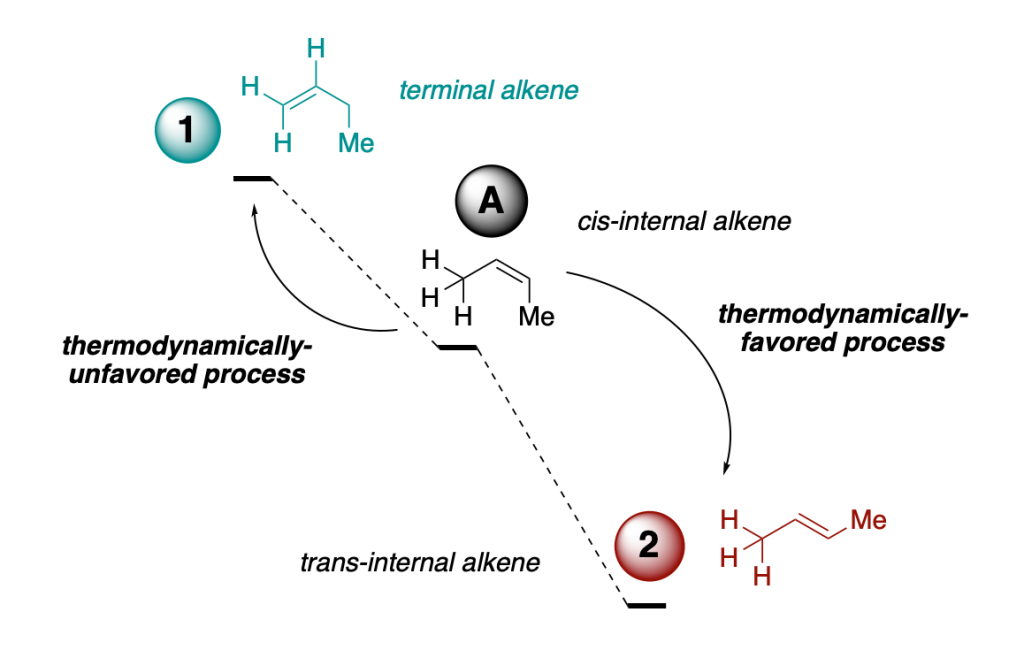
<p>You might be looking at the picture above and still not get what we mean by higher or lower energy. Let me redraw it in a way you will probably have seen elsewhere, or been taught in school/college:</p>


<div class="wp-block-image"><figure class="aligncenter size-large is-resized"><img decoding="async" src="https://chemistryhall.com/wp-content/uploads/2020/08/image-4-1024x658.png" alt="thermodynamics of alkenes" class="wp-image-39265" width="545" height="349" srcset="https://chemistryhall.com/wp-content/uploads/2020/08/image-4-1024x658.png 1024w, https://chemistryhall.com/wp-content/uploads/2020/08/image-4-300x193.png 300w, https://chemistryhall.com/wp-content/uploads/2020/08/image-4-768x493.png 768w, https://chemistryhall.com/wp-content/uploads/2020/08/image-4.png 1158w" sizes="(max-width: 545px) 100vw, 545px" /><figcaption>Thermodynamic stability of isomers of the same alkene.</figcaption></figure></div>


<p>The scheme above resembles what you are always taught in introductory organic chemistry courses: more substituted isomers of alkenes are more stable (A and 2 vs. 1) and <em>trans</em> isomers are more stable than <em>cis</em> isomers (2 vs A).</p>


<p>What does this means? It means that, given the appropriate circumstances or conditions, both 1 and A would like to react to give 2. But we now that less stable alkenes such as 1 are perfectly inert, and can be handled and stored without worries. So, what is the deal here?</p>


<p>The answer is <strong>kinetics </strong>and<strong> activation barriers.</strong></p>


<h2 class="wp-block-heading">Kinetics: The Barriers of Chemical Reactivity</h2>


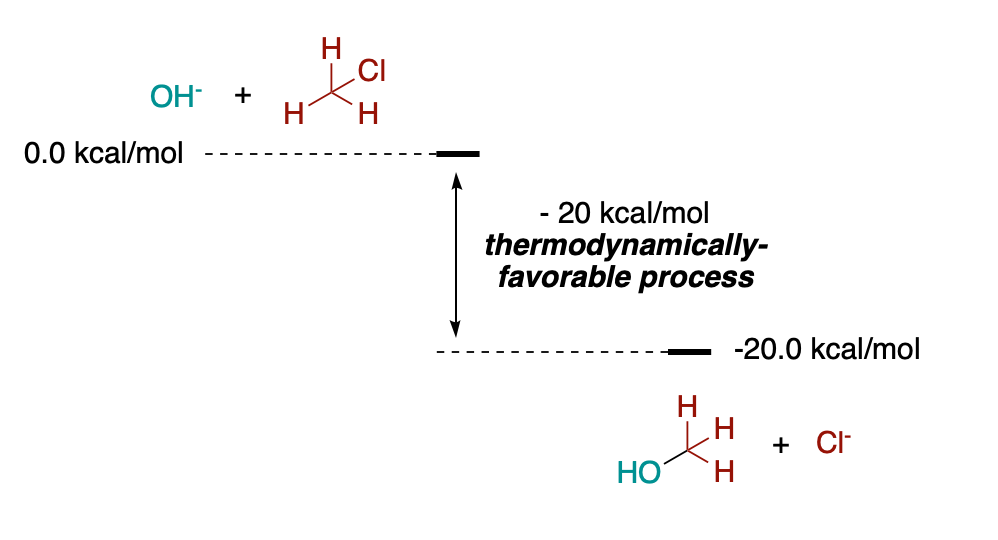
<p>Before diving into kinetics, let me present another quick example of a thermodynamically-favorable process. An energy diagram of an <a href="https://chemistryhall.com/sn1-vs-sn2-what-is-steric-hindrance/">Sn2 substitution reaction</a> in this case.</p>


<div class="wp-block-image"><figure class="aligncenter size-large is-resized"><img decoding="async" src="https://chemistryhall.com/wp-content/uploads/2020/08/image-6.png" alt="thermodynamics sn2" class="wp-image-39269" width="525" height="283" srcset="https://chemistryhall.com/wp-content/uploads/2020/08/image-6.png 998w, https://chemistryhall.com/wp-content/uploads/2020/08/image-6-300x162.png 300w, https://chemistryhall.com/wp-content/uploads/2020/08/image-6-768x416.png 768w" sizes="(max-width: 525px) 100vw, 525px" /><figcaption>Thermodynamics of an energetically-favorable substitution reaction.</figcaption></figure></div>


<p>As you can see, if we set the zero in energy for a hydroxyde anion plus a chloromethane molecule (in energy diagrams you always set an energy for the whole system, not individual molecules), the total energy of the products of the corresponding Sn2 reaction (<em>tert</em>-butyl alcohol and a chloride anion) will be lower (about<em> </em>20 kcal/mol lower!).</p>


<p>What does this mean? That the reaction is thermodynamically favorable, and in principle it will not take place the other way around.</p>


<p><strong>But does this mean that, mixing hydroxide with chloromethane at any temperature will lead to the immediate formation of <em>tert</em>-butyl alcohol and chloride? Of course not! </strong>The rate at which the reaction proceeds will depend directly on the temperature, and if the temperature is low enough, the reaction will not take place at all, even though the process is thermodynamically favorable.</p>


<p>Why is that? <strong>Kinetics</strong> is the answer.</p>


<h3 class="wp-block-heading">What Are Chemical Reaction Kinetics?</h3>


<blockquote class="wp-block-quote is-layout-flow wp-block-quote-is-layout-flow"><p><strong>Chemical </strong>or <strong>reaction kinetics</strong> is the branch of physical chemistry that studies the <strong>rates </strong>(or speeds) of chemical reactions. </p></blockquote>


<p>In summary, thermodynamics determines in what direction a chemical reaction proceeds, and kinetics determines the speed or rate at which that process occurs. </p>


<p>Of course, in the last scheme of the previous section, there was something missing. In a chemical reaction, reactant A does not simply transform into product B. Reactions take place through what we call <a href="https://en.wikipedia.org/wiki/Transition_state_theory" target="_blank" rel="noreferrer noopener">transition states</a>.</p>


<p><strong>Transition states</strong> are intermediate structures between reactants and products of a chemical reaction step. They are usually higher in energy (less stable) than both the reactants and the products, and the energy difference between the reactants and the transition states, also known as activation energy, is the barrier necessary to overcome for a thermodynamically-favorable reaction to take place.</p>


<h3 class="wp-block-heading">Why Do Chemicals React? Thermodynamics and Kinetics Combined</h3>


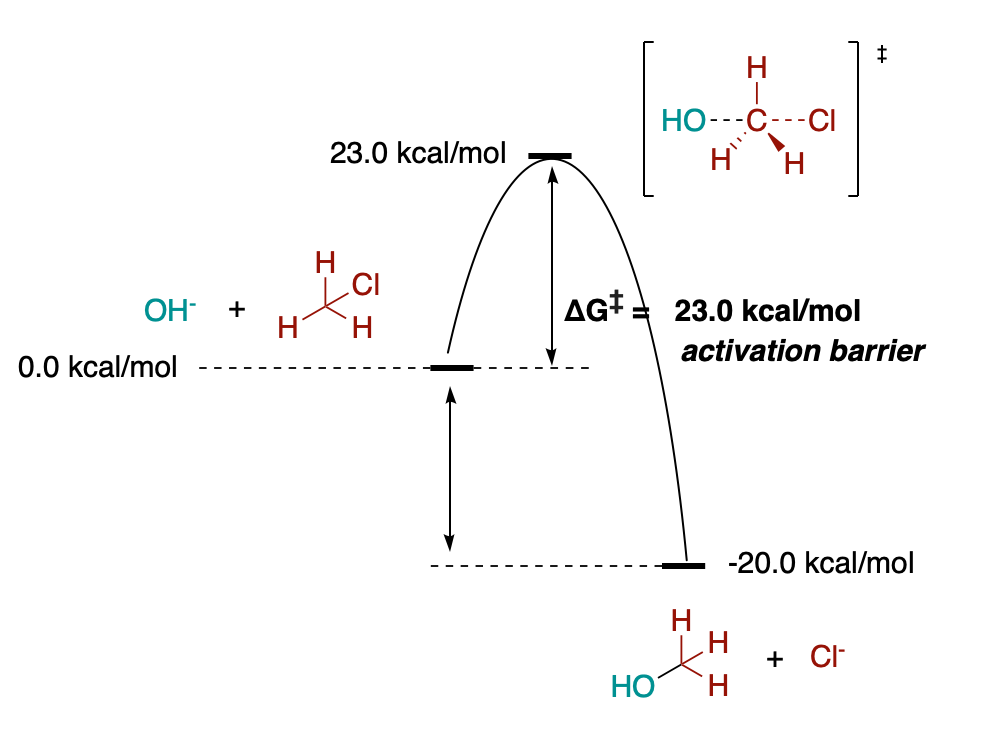
<p>See below a now complete version of the free-energy diagram of the Sn2 substitution reaction. As you can see, the process is thermodynamically favorable, but a barrier or activation energy of 23.0 kcal/mol has to be overcome in order to reach the products.</p>


<div class="wp-block-image"><figure class="aligncenter size-large is-resized"><img decoding="async" src="https://chemistryhall.com/wp-content/uploads/2020/08/image-7.png" alt="sn2 free energy profile" class="wp-image-39270" width="516" height="382" srcset="https://chemistryhall.com/wp-content/uploads/2020/08/image-7.png 992w, https://chemistryhall.com/wp-content/uploads/2020/08/image-7-300x222.png 300w, https://chemistryhall.com/wp-content/uploads/2020/08/image-7-768x568.png 768w" sizes="(max-width: 516px) 100vw, 516px" /><figcaption>Free-energy profile of an Sn2 substitution reaction.</figcaption></figure></div>


<p>The larger the activation energy, the lower the speed or rate of a reaction at any given temperature. Usually, we set a limit of barriers of around 25 kcal/mol for reactions to proceed at a significant rate (this is, in several hours or days) at 25 ºC. Easy enough to remember.</p>


<h3 class="wp-block-heading">Stability vs Inertness</h3>


<p>No matter how thermodynamically favorable a process is, if the barriers to reach the corresponding transition are too high (say, higher than 30-40 kcal/mol), that chemical reaction is not going to take place under regular conditions. </p>


<p>This allows us to make a clarification between <strong>stability and inertness</strong> as properties of chemicals.</p>


<p><strong>Stability</strong> is a thermodynamic concept, while <strong>inertness </strong>is a kinetic concept. </p>


<ul><li>A compound is <strong>stable</strong>, if it is relatively low in energy (compared to the molecules to which it may interconvert into). The opposite would be <strong>unstable</strong>, high in energy.</li></ul>


<ul><li>On the other hand, we say that a compound is kinetically <strong>inert</strong> if in order to react it has to overcome large activation barriers.</li></ul>


<p>A compound can be both unstable <strong>and</strong> inert. That is why we can handle and store thermodynamically unstable primary alkenes such as 1-propene without them isomerizing to more-stable secondary alkenes such as <em>cis- </em>or <em>tran</em>s-2-propene (see the first two schemes).</p>


<p>But we can <em>trick </em>kinetics! <strong>Catalysts </strong>can be used to lower the activation energy of chemical transformations, allowing them to proceed more rapidly, or simply to proceed at all!</p>


<ul><li><em>Note: <strong>Theoretically</strong>, no matter how high the activation</em> <em>energy of a process might be, we say that it is always taking place at a certain rate. However, if the energy barriers are higher than, say, 50 kcal/mol, the rate or speed of the reaction would be so low that it would take many many years before we can detect a significant conversion.</em></li></ul>


<h2 class="wp-block-heading">Catalysis: Lowering the Barrier!</h2>


<p>Now that we know why chemicals react,  let me explain how we chemists try to override the system and make activation barriers lower. </p>


<p>A <strong>catalyst </strong>is a chemical entity (a molecule, a salt, a coordination complex&#8230;) which speeds up a chemical reaction. It also can unlock new reactivity pathways and make reactions work that would not be possible otherwise.</p>


<p>Let&#8217;s take a specific classical example. The <strong>electrophilic aromatic substitution</strong> of benzene with molecular bromine (Br–Br). This reaction is traditionally carried out using a Lewis acid as catalyst, such as iron tribromide. </p>


<p>But let us imagine first a catalyst-free version of the process, which I am certain can occur if you mix together benzene and bromine, and heat it up enough.</p>


<h3 class="wp-block-heading">How Thermal, Catalyst-Free Reactions Occur</h3>


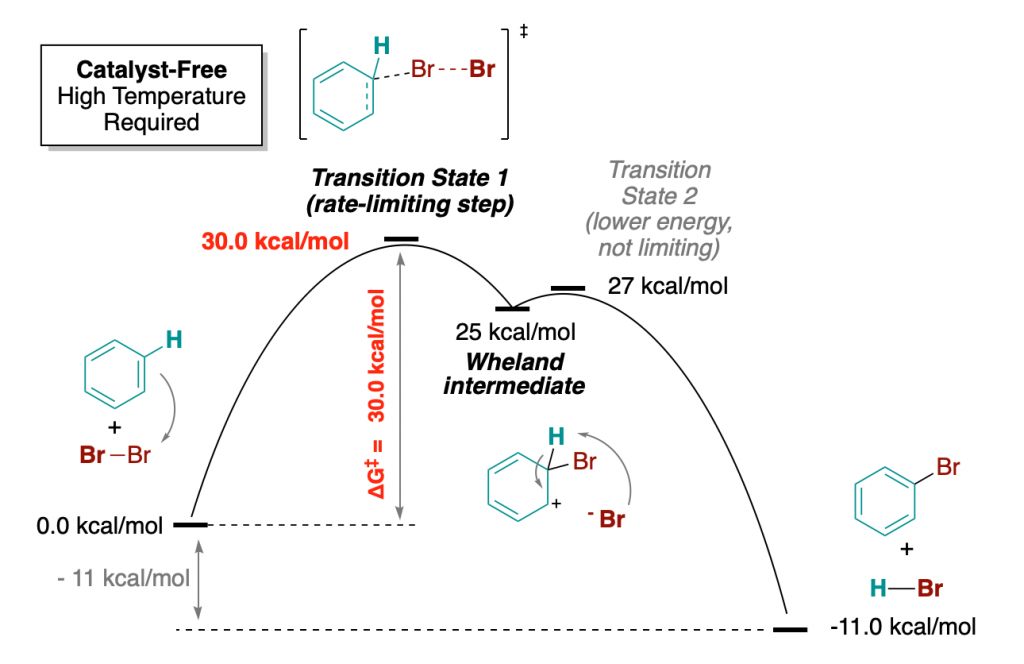
<p>The first step of this reaction is the formation of the well-known <strong>Wheland intermediate</strong>. An intermediate (<a href="http://www.chem.ucla.edu/~harding/IGOC/I/intermediate.html" target="_blank" rel="noreferrer noopener">not to be confused with a transition state</a>, which rather connects intermediates together) is a reactive chemical species which is formed in one of the steps in the middle of a chemical reaction of A leading to B, as <em>intermediate point</em>.  For benzene to be transformed into bromobenzene, it has to pass through this intermediate species. Intermediates can rarely be isolated, since <strong>they usually are both thermodynamically unstable and kinetically reactive</strong>.</p>


<p>In any case, the reactants have to overcome a high activation barrier of 30 kcal/mol. Once the temperature is enough for this to take place, the rest of the process has lower activation barriers, and takes place downhill to give reaction products in an overall thermodynamically favorable process (exothermic by -11 kcal/mol).</p>


<div class="wp-block-image"><figure class="aligncenter size-large is-resized"><img decoding="async" src="https://chemistryhall.com/wp-content/uploads/2020/08/image-8-1024x664.png" alt="electrophilic aromatic substitution free energy" class="wp-image-39274" width="546" height="354" srcset="https://chemistryhall.com/wp-content/uploads/2020/08/image-8-1024x664.png 1024w, https://chemistryhall.com/wp-content/uploads/2020/08/image-8-300x194.png 300w, https://chemistryhall.com/wp-content/uploads/2020/08/image-8-768x498.png 768w, https://chemistryhall.com/wp-content/uploads/2020/08/image-8.png 1290w" sizes="(max-width: 546px) 100vw, 546px" /><figcaption>Thermal or catalyst-free electrophilic aromatic substitution.</figcaption></figure></div>


<p>But we can speed things up with a catalyst!</p>


<h3 class="wp-block-heading">Lewis Acid-Catalyzed Electrophilic Aromatic Substitutions</h3>


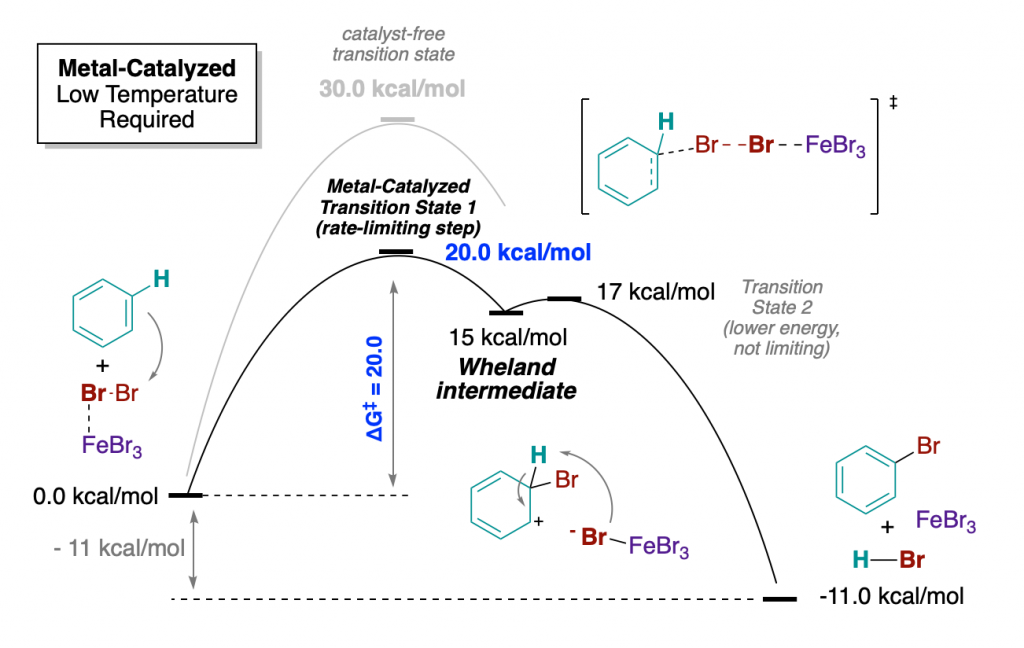
<p>By adding a catalyst to the mixture, we can access new transitions states, which are more stable, and hence lower in energy. And what happens when the transition state of the rate-limiting step of a reaction is lower in energy? That the activation barrier of the whole process is much lower!</p>


<p>This is basically the role of FeBr<sub>3</sub> (the catalyst) of this reaction: stabilizes transition states and intermediates. Now the activation barrier to reach the first transition state is much lower (20 vs 30 kcal/mol), allowing the reaction to take place under mild conditions. </p>


<div class="wp-block-image"><figure class="aligncenter size-large is-resized"><img decoding="async" src="https://chemistryhall.com/wp-content/uploads/2020/08/image-9-1024x648.png" alt="why reactions occur under catalysis" class="wp-image-39275" width="548" height="347" srcset="https://chemistryhall.com/wp-content/uploads/2020/08/image-9-1024x648.png 1024w, https://chemistryhall.com/wp-content/uploads/2020/08/image-9-300x190.png 300w, https://chemistryhall.com/wp-content/uploads/2020/08/image-9-768x486.png 768w, https://chemistryhall.com/wp-content/uploads/2020/08/image-9.png 1302w" sizes="(max-width: 548px) 100vw, 548px" /><figcaption>Free-energy profile of a metal-catalyzed electrophilic aromatic substitution.</figcaption></figure></div>


<p>Also, note that FeBr<sub>3</sub> is recovered unreacted with the products. This is another feature of catalysts: they can be recovered and re-enter another reaction cycle. This is why they are often employed in sub-stoichiometric amounts (this is, less than one mole of catalyst is enough to drive full conversion of one mole of starting material).</p>


<p>But as we have already mentioned, thanks to catalysis we not only can lower activation barriers that would need totally unpractical temperatures. We can also unlock reactions that would take hundreds of years to complete by themselves. We can also achieve completely new selectivities, and develop new chemical processes. </p>


<p>I work in catalysis myself, and I can tell you this is one of the most important, exciting and active fields of chemistry.</p>


<p>This is the end of this tutorial review, and I hope it has helped you to get a clearer picture of why chemical reactions take place and what leads chemicals to react. We certainly covered concepts you have to master if you are <a href="https://chemistryhall.com/how-to-learn-chemistry/">learning chemistry at any level</a>!</p>
<p>The post <a href="https://chemistryhall.com/why-do-chemicals-react-kinetics-thermodynamics/">Why Do Chemicals React? Kinetics and Thermodynamics</a> appeared first on <a href="https://chemistryhall.com">Chemistry Hall</a>.</p>
]]></content:encoded>
					
					<wfw:commentRss>https://chemistryhall.com/why-do-chemicals-react-kinetics-thermodynamics/feed/</wfw:commentRss>
			<slash:comments>4</slash:comments>
		
		
			</item>
		<item>
		<title>How To Learn Chemistry at Any Level</title>
		<link>https://chemistryhall.com/how-to-learn-chemistry/</link>
					<comments>https://chemistryhall.com/how-to-learn-chemistry/#comments</comments>
		
		<dc:creator><![CDATA[C. Hall]]></dc:creator>
		<pubDate>Fri, 31 Jan 2020 07:07:00 +0000</pubDate>
				<category><![CDATA[Education and Concepts]]></category>
		<category><![CDATA[Featured]]></category>
		<category><![CDATA[general chemistry]]></category>
		<guid isPermaLink="false">https://chemistryhall.com/?p=38612</guid>

					<description><![CDATA[<p>Have you ever wanted to learn chemistry, but just didn’t know how to go about doing it? Taking college courses and you don&#8217;t know how to find resources? There is so much to this science that it can be hard to even know where to start! That’s why we put together this guide with recommendations...&#160;<a href="https://chemistryhall.com/how-to-learn-chemistry/">[Read&#160;More]</a></p>
<p>The post <a href="https://chemistryhall.com/how-to-learn-chemistry/">How To Learn Chemistry at Any Level</a> appeared first on <a href="https://chemistryhall.com">Chemistry Hall</a>.</p>
]]></description>
										<content:encoded><![CDATA[
<p>Have you ever wanted to learn chemistry, but just didn’t know how to go about doing it? Taking college courses and you don&#8217;t know how to find resources?</p>


<p>There is so much to this science that it can be hard to even know where to start! That’s why we put together this guide with recommendations for how to learn chemistry, plus tons of useful resources no matter what your level is.</p>


<p><strong>What exactly is this guide?</strong></p>


<p>Obviously you won&#8217;t learn chemistry reading this blog post by itself. This is more of a pedagogical article. However, we will point you towards <strong>tons of resources for learning this science</strong>, no matter if you are just a chemistry enthusiast or a college student.</p>


<p>This is a general introduction for approaching chemistry, from any level.</p>


<p><strong>There is a very specific way of thinking that helps tackling the problems that chemistry has to offer. </strong>We will base our guide upon that cornerstone. </p>


<p>And you will find out what this theme is pretty soon if you keep reading.</p>


<span id="more-38612"></span>


<h2 class="wp-block-heading">An <strong>Introduction to Chemistry</strong></h2>


<p>But first, a
quick introduction to the study of chemistry, what it is, and why you should make
the effort to learn this awesome science.</p>


<h3 class="wp-block-heading"><strong>What Is Chemistry?</strong> </h3>


<p><a href="https://www.acs.org/content/acs/en/education/whatischemistry/everywhere.html">Chemistry</a> can be defined as the study of matter and the changes it undergoes. You’ll sometimes hear it called <a href="https://chemistryhall.com/basic-chemistry-concepts/">the central science</a> because it is the connection between physics and all the other sciences, starting with biology. All that makes it sound abstract and esoteric, but really, chemistry is all around us. It wouldn’t be a stretch to say that it governs every aspect of your life.</p>


<p>Are you sitting inside? You’re surrounded by building
materials that are structurally sound because of how chemistry holds them
together. Reading this outside? Every living plant you see is consuming CO2 and
releasing oxygen in the process of photosynthesis. The food you eat, the
products you use to clean your house, the fuel you put in your car, the very
air you breathe—it’s all chemistry.</p>


<p>What’s really incredible about chemistry is the seemingly
infinite variety of <em>stuff</em> around us and the fact that it’s all just
combinations of around 100 chemical elements. In reality, most of what we
interact with in everyday life is made up of far fewer. When two or more of
these elements are combined in a compound, the properties of the compound can
be amazingly unlike the constituent elements. Would you guess that the table
salt in your kitchen is made up of a chemical weapon and a metal that causes an
explosion when it touches water?</p>


<h3 class="wp-block-heading"><strong>What is Chemistry Used for?</strong></h3>


<p>It should come as no surprise, then, that chemistry is used
for just about anything you can imagine. Life itself relies on chemistry, but
humans have been harnessing it for our own benefit for thousands of years,
knowingly or not. From our first combustion reaction (making fire) to the
latest cutting-edge medical technology, this science has changed our lives in
ways that are mind-blowing.</p>


<p>Long before we knew any scientific concepts that we take for
granted today, we were performing basic chemistry. Some of the most important
examples from the ancient world are processes that we still use today, such metallurgy
and extracting compounds from natural sources, e.g. plants.</p>


<p>Many people consider <a href="https://chemistryhall.com/turn-lead-into-gold-alchemy/">alchemy</a> to be the forerunner of modern chemistry. This is debatable, but regardless, the discipline that tirelessly sought a way to turn lead into gold fell out of favor among intellectuals right about the time when something closer to modern chemistry was beginning to catch on. The earliest publications in chemistry as a proper science date to the 16<sup>th</sup> and early 17<sup>th</sup> centuries.</p>


<div class="wp-block-image"><figure class="aligncenter is-resized"><img decoding="async" src="https://cdn.pixabay.com/photo/2017/10/04/09/56/laboratory-2815641_960_720.jpg" alt="doing experiments in a lab is a great way to learn chemistry " width="483" height="321"/><figcaption>Chemistry research goes from laboratories to industries</figcaption></figure></div>


<p>Now, a few hundred years later, the field has positively exploded, with <a href="https://www.uwlax.edu/chemistry-and-biochemistry/student-resources/different-types-of-chemistry/">numerous subdisciplines</a>. Today, we say that the five major branches of chemistry are general chemistry, organic chemistry, inorganic chemistry, biochemistry, and analytical chemistry. But there are tons of more niche areas of chemistry, too, like physical, materials, and nuclear chemistry, neurochemistry, chemical engineering, medicinal chemistry and pharmacology… The list goes on and on because chemistry is used for everything!</p>


<h3 class="wp-block-heading"><strong>Why Should I Learn Chemistry?</strong></h3>


<p>So, aside from the fact that it is used for practically
everything in life, why should you learn chemistry? There are tons of reasons!</p>


<p>Even if you don’t plan on a career in science, you’ll pick
up a lot of useful skills and knowledge when you learn chemistry. Studying
science helps you understand important issues, like climate change or food
additives, more objectively. Chemistry is also great for developing problem
solving skills.</p>


<p>More specifically, knowledge of chemistry unlocks some of life’s most profound mysteries… like how to make sure your baked goods come out moist and fluffy! Seriously though, it can make many routine tasks—like cooking—easier, and more importantly, it can help keep you safe. Knowing which cleaning products are okay to be used together and which should never be mixed is possible with chemistry, as is understanding how certain medicines work in your body, and much more.</p>


<p>This video sums it up really well:</p>


<figure class="wp-block-embed aligncenter is-type-video is-provider-youtube wp-block-embed-youtube wp-embed-aspect-16-9 wp-has-aspect-ratio"><div class="wp-block-embed__wrapper">
<iframe loading="lazy" title="Why is chemistry important?" width="500" height="281" src="https://www.youtube.com/embed/9XwENG7DmUU?feature=oembed" frameborder="0" allow="accelerometer; autoplay; clipboard-write; encrypted-media; gyroscope; picture-in-picture; web-share" referrerpolicy="strict-origin-when-cross-origin" allowfullscreen></iframe>
</div></figure>


<p>Besides, chemistry is not a profession which seems to be going anywhere soon. <a rel="noreferrer noopener" aria-label="Jobs in chemistry (opens in a new tab)" href="https://chemistryhall.com/first-chemistry-job/" target="_blank">Careers and job</a><a href="https://chemistryhall.com/first-chemistry-job/" target="_blank" rel="noreferrer noopener" aria-label="Jobs in chemistry (opens in a new tab)">s</a><a rel="noreferrer noopener" aria-label="Jobs in chemistry (opens in a new tab)" href="https://chemistryhall.com/first-chemistry-job/" target="_blank"> in chemistry</a>, especially in research, are usually pretty fun, and creativity-driven.</p>


<p>Now that you’re convinced that you want to learn chemistry, how do you do it?</p>


<h2 class="wp-block-heading">How to Learn Chemistry</h2>


<p>I talked with <strong>many</strong> people that have studied chemistry, like myself, and everyone seems to have learnt this science very similarly.</p>


<p>There is a way of reasoning and thinking about chemistry which is common in chemical education.</p>


<p>Chemistry is an empirical science, so it is based on explaining observations, and taking what you extract from those observations to extrapolate and make predictions about other phenomena. </p>


<p>You can explain extremely simple chemistry questions, such as <a href="https://chemistryhall.com/difference-organic-inorganic-compounds/" target="_blank" rel="noreferrer noopener" aria-label="differentiating organic and inorganic compounds (opens in a new tab)">differentiating organic and inorganic compounds</a>, to very complex scenarios with this same methodology.</p>


<p>This way of reasoning is, in my opinion, the best way to tackle chemistry problems. This goes from a kid learning basic science to a professional chemistry PhD working on ground-breaking research.</p>


<h3 class="wp-block-heading">How to Rationalize, Explain and Extrapolate</h3>


<p>To illustrate this, we will use a simple example:</p>


<p>First an observation: We observe that water freezes at a certain temperature (0 ºC at atmospheric pressure). </p>


<p>Then, rationalization/explanation: Thanks to previous knowledge, we can explain this observation in simple terms saying that at lower temperatures, molecules vibrate less, and can pack in a more efficient manner. The way water molecules can pack below 0 ºC, gives it a solid state structure.</p>


<p>We can generalize this to any other substance: Depending on how strong are <a href="https://en.wikipedia.org/wiki/Intermolecular_force" target="_blank" rel="noreferrer noopener" aria-label="intermolecular interactions (opens in a new tab)">intermolecular interactions</a> between each molecule of a given substance, they will be able to pack in a solid state form more easily (at higher temperature).</p>


<p>Then we extrapolate to other systems/molecules: intermolecular forces between hexane molecules are much weaker (dispersion forces) than between water molecules (hydrogen bond). This will make it harder to pack them in a solid state structure, thus making its melting point much lower (-95 ºC, to be exact).</p>



<p>And this turns out to be true, as we can easily validate by determining (or consulting) the melting point of hexane.</p>


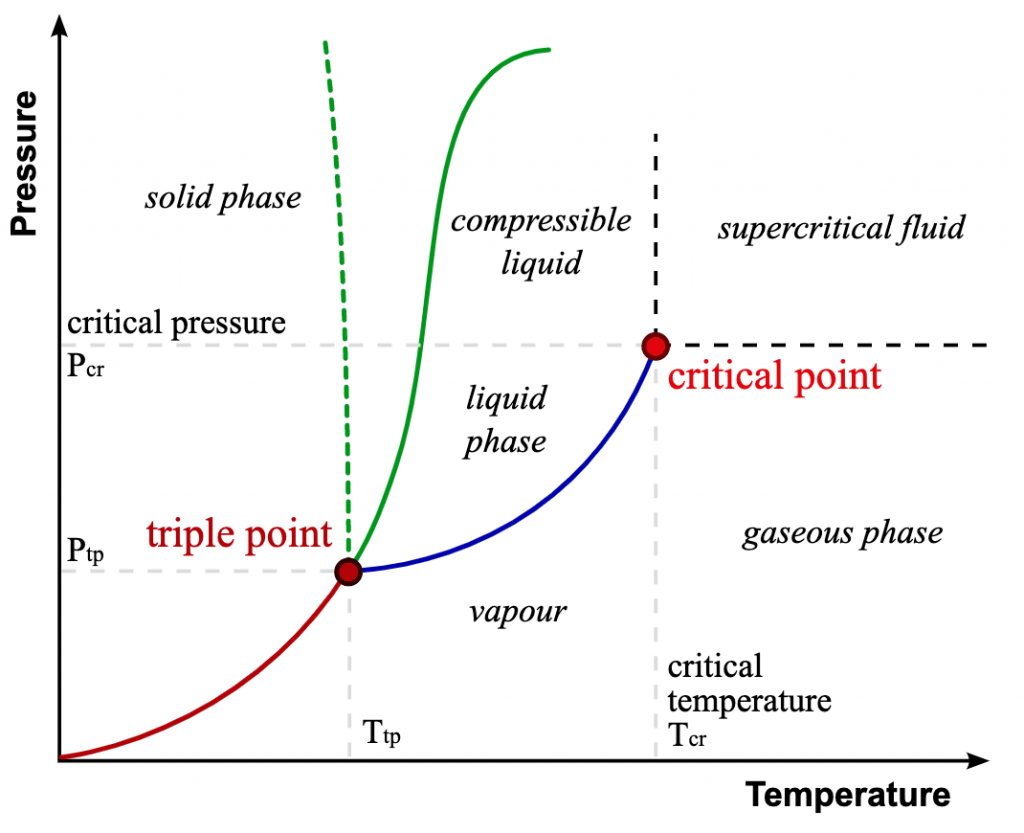
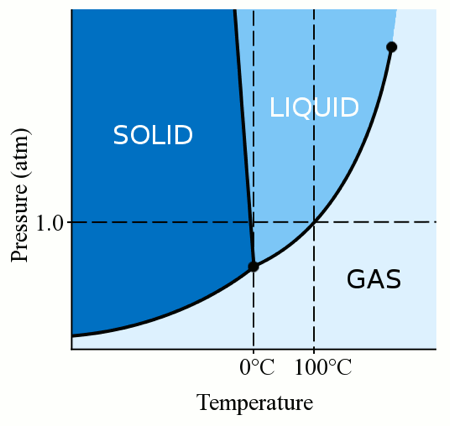
<p>And this can be made as simple as that or as complex as you would like your <a href="https://chemistryhall.com/models-chemistry-wrong/" target="_blank" rel="noreferrer noopener" aria-label="model (opens in a new tab)">model</a> to be.</p>


<div class="wp-block-image"><figure class="aligncenter size-large is-resized"><img decoding="async" src="https://chemistryhall.com/wp-content/uploads/2020/01/image-5-1024x833.png" alt="a phase diagram model" class="wp-image-38891" width="412" height="334" srcset="https://chemistryhall.com/wp-content/uploads/2020/01/image-5-1024x833.png 1024w, https://chemistryhall.com/wp-content/uploads/2020/01/image-5-300x244.png 300w, https://chemistryhall.com/wp-content/uploads/2020/01/image-5-768x624.png 768w, https://chemistryhall.com/wp-content/uploads/2020/01/image-5.png 1070w" sizes="(max-width: 412px) 100vw, 412px" /><figcaption>A phase diagram is a more advanced model used to rationalize phase changes of substances. Credit to Matthieumarechal <em>via </em><a href="https://en.wikipedia.org/wiki/Phase_diagram" target="_blank" rel="noreferrer noopener" aria-label="Wikipedia (opens in a new tab)">Wikipedia</a></figcaption></figure></div>


<p>This way of thinking fits perfectly with chemistry. That&#8217;s why I highly recommend it.</p>


<p>If you already took chemistry courses, you are probably familiar with this reasoning process, even if you didn&#8217;t really notice.</p>


<h2 class="wp-block-heading">Where to Find Any Resource for Learning Chemistry</h2>


<p>So you are already packed with a clear thinking process that you can adopt for tackling chemistry. </p>


<p>What do you need now? </p>


<p>Of course, you need information. Information is everything. You need books, resources and materials to study.</p>


<p>Well, we have good news for you! We live in the age of information technologies, and you can find literally everything anywhere. You can order a textbook from almost anywhere, and even find electronic versions of those books. You can find scientific research articles from home. You can visit Wikipedia and take a quick look about any subject you want. You can Google whatever you want and find tons of resources to learn from&#8230;</p>


<p>One might say, that there&#8217;s too much information out there! More than you can handle!</p>


<p>But I really don&#8217;t think there&#8217;s such a thing as &#8216;too much information&#8217;. Not if you are good at searching through it, and filtering what&#8217;s important. And this is a basic yet overlooked skill in our age. Focus on learning how to process, select and filter! And this not only applies to chemistry, but to every subject out there.</p>


<p>To be completely honest, even in 2020, I don&#8217;t think there is a better way to learn a natural science such as chemistry than starting from a good textbook.</p>


<p>Not get me wrong, there is plenty of info about chemistry. Heck, probably most of the university level course materials can be found in Google.</p>


<p>However, there is nothing like the great and didactical organization of a textbook. You can get one for your level, and when you are done going through most of it, you will be a master on that level. Of course, I encourage you to expand every topic that is not clear enough, or not covered deeply enough. For this purpose, or for a quick outlook, the internet is amazing.</p>


<p>There are <strong>plenty</strong> of different textbooks for any level. Which one is the best for me? What are my options? This is what we will cover next.</p>


<p>We strongly recommend you to navigate this site through the links on each section to check specific details and thorough comparison data.</p>


<h2 class="wp-block-heading"><strong>The Best Books to Learn Chemistry at Any Level </strong></h2>


<p>No matter what your interest or level in this subject may be, there’s a great book out there to help you learn chemistry.  This section won’t be too extensive, but you can find detailed write-ups on all of the books below in other posts. </p>


<h3 class="wp-block-heading">Kids and Casual Learners</h3>


<p>Our recent post on the <a href="https://chemistryhall.com/best-chemistry-gifts/">best chemistry-themed
gifts</a> included three books that are a great fit for older kids or adults who
have a casual interest in the central science.</p>


<p><em>Elements: A Visual Exploration of Every Known Atom in the Universe</em> is visually stunning and chock full of cool information. It contains gorgeous photos and fun facts, and it would be an excellent introduction for people who are curious to learn about the chemical elements that make up our universe.</p>


<p><em>Ask a Science Teacher: 250 Answers to Questions You’ve Always Had About How Everyday Stuff Really Works</em> is a book that is less focused on chemistry specifically, but which has still got tons of fascinating explanations in plain English. It’s a great book to show all the practical ways in which science affects us every day.</p>


<p><em>Chemistry for Everyone: A Helpful Primer for High School or College Chemistry</em> is exactly what it sounds like. It’s definitely the most educational of the books in this section, although it is not intended to replace a complete chemistry course. We would recommend picking this up before taking your first chem class so that you have an idea of what to expect.</p>


<h3 class="wp-block-heading">High School</h3>


<p>We have two favorites when it comes to books for high school
chemistry students. You can read more in our post on <a href="https://chemistryhall.com/best-high-school-chemistry-textbook/">these and
other high school chem textbooks</a>, but here are our top picks in a nutshell:</p>


<p><em>Chemistry: Concepts and Problems: A Self-Teaching Guide</em>
is, of course designed for self-taught students. This makes it ideal if you end
up in a class with a “teacher who doesn’t teach”, as students often report. It’s
based on the programmed learning method for maximum learning effectiveness.</p>


<p><em>Chemistry for Dummies</em> tracks a typical introductory chemistry course, making it suitable for high school and college intro to chem classes. No matter what your current level is, you can learn chemistry with this book.</p>


<p>We also published a separate review for <a href="https://chemistryhall.com/best-chemistry-books-for-self-study/">the best chemistry books for self-study</a>, which can be suitable for anyone, but especially to people at the high-school level.</p>


<h3 class="wp-block-heading">University Level</h3>


<p>At the university level, there are several types of chemistry courses you could be taking, each with its own separate textbook. Or, if you’re curious to learn chemistry but don’t need the credit to graduate, you could use one of these books to teach yourself!</p>


<p>If you’re learning <strong>General Chemistry</strong>, we’ve got a whole post dedicated to <a href="https://chemistryhall.com/best-chemistry-textbook/">the best books for this class</a>. But in the interest of time, our two top picks are Brown’s <em>Chemistry: The Central Science</em> and Tro’s <em>Chemistry: A Molecular Approach</em>. Both are top-notch textbooks, with the second one being a bit more expensive but also more accessible for most students, especially visual learners.</p>


<p>For people with a serious interest in learning chemistry, the next course is usually <strong>Organic Chemistry</strong>, or o-chem. Your professor has likely listed a book on their syllabus, but in our opinion, the <a href="https://chemistryhall.com/best-organic-chemistry-textbook/">best textbook to learn organic chemistry</a> is Clayden’s <em>Organic Chemistry</em>. According to research, students value clarity above all else in textbooks, and this one is very easy to follow with plenty of practice problems. We also try to publish resources in which reaction mechanisms are well explained, here is an example with the <a href="https://chemistryhall.com/swern-oxidation/">Swern oxidation</a>!</p>


<p>Your o-chem professor will probably also require or suggest
you <a href="https://chemistryhall.com/best-organic-chemistry-model-kit/">get a
molecular modeling kit</a>. This is <em>highly </em>recommended, even if it isn’t
mandatory in your class. But remember, it doesn’t do any good to buy a kit if
you don’t use it, so make sure you take full advantage of <a href="https://chemistryhall.com/molecular-model-learning-chemistry/">all the
concepts it can help you understand</a>.</p>


<p>By the time you get to <strong>Inorganic Chemistry</strong>, you’ve likely made a major commitment to studying chemistry. There are several <a href="https://chemistryhall.com/best-inorganic-chemistry-textbook/">inorganic chemistry textbooks</a> that can help you learn more effectively, but our preference is Housecroft &amp; Sharpe’s <em>Inorganic Chemistry</em>. It’s got just the right balance of detail and being easy to understand with very instructive graphics.</p>


<p>Two other main fields of chemistry are not forgotten. Here you can go and check for the <a rel="noreferrer noopener" aria-label="best physical chemistry textbooks (opens in a new tab)" href="https://chemistryhall.com/best-physical-chemistry-textbook/" target="_blank">best physical chemistry textbooks</a> and the <a rel="noreferrer noopener" aria-label="best analytical chemistry books (opens in a new tab)" href="https://chemistryhall.com/best-analytical-chemistry-textbook/" target="_blank">best analytical chemistry books</a>.</p>


<p>Other important subfields such as <a href="https://chemistryhall.com/best-biochemistry-textbook/">biochemistry</a> and <a href="https://chemistryhall.com/best-electrochemistry-book/">electrochemistry</a> are not left behind.</p>


<p>Also, it is mandatory that you start learning how to properly take notes in the form of a <a href="https://chemistryhall.com/keys-for-the-best-chemistry-lab-notebook/" target="_blank" rel="noreferrer noopener" aria-label="laboratory notebook (opens in a new tab)">laboratory notebook</a>, and <a href="https://chemistryhall.com/how-to-write-chemistry-lab-report/" target="_blank" rel="noreferrer noopener" aria-label="writing good lab reports (opens in a new tab)">writing good lab reports</a>.</p>


<h3 class="wp-block-heading">Online Resources</h3>


<p>Apart from books, the second best resource for finding resources is clearly the internet. But what sites should I visit? </p>


<p>Of course, there are many university websites with plenty of information, but the easiest and quickest way find something, is of course, a search engine such as <strong>Google</strong>. But make sure to check what kind of site are you visiting, and if the information they provide is reliable. Many times, your query will take you to university sites that you can trust. But as we advised before, learning how to filter information is key!</p>


<p>As for other great websites to look for information, some of them are:</p>


<p><strong><a href="https://www.wikipedia.org/" target="_blank" rel="noreferrer noopener" aria-label="Wikipedia (opens in a new tab)">Wikipedia</a></strong>: Some criticize that anyone can edit it and write any information. This is true, but it is also true that it undergoes continuos review by experts, and inaccurate or undocumented information rarely goes unnoticed.  The info sources or citations are usually great and often refer to original research.</p>


<p><strong><a aria-label="Youtube (opens in a new tab)" rel="noreferrer noopener" href="https://www.youtube.com/" target="_blank">Youtube</a></strong>: Just the same as Google, just search anything you want and you will most likely find a channel explaining everything about it to you! An example for Organic Chemistry is presented by Crash Course <a href="https://chemistryhall.com/substitution-reactions-crash-course/">here</a>.</p>


<p>As an example of this, we have collected some of the <a rel="noreferrer noopener" aria-label="best chemistry lectures and conference talks (opens in a new tab)" href="https://chemistryhall.com/best-online-chemistry-lectures/" target="_blank">best chemistry lectures and conference talks</a> in another article.</p>


<p><strong><a rel="noreferrer noopener" aria-label="SciFinder (opens in a new tab)" href="https://scifinder.cas.org/" target="_blank">SciFinder</a> and <a rel="noreferrer noopener" aria-label="Reaxys (opens in a new tab)" href="https://www.reaxys.com/" target="_blank">Reaxys</a></strong>: Professional scientific databases. They are paid tools, but if you study or work in a research institution, you will most likely have access to a subscription. These are great for looking through original research, and if you are serious about doing a career on chemistry, you&#8217;d better get used to playing with them!</p>


<p><strong><a rel="noreferrer noopener" aria-label="Libretexts (opens in a new tab)" href="https://libretexts.org/" target="_blank">Libretexts</a></strong>: Great repository for completely open access books online, which might not be accessible anywhere else. Lot&#8217;s of chemistry material there to find!</p>


<p>This list could go on forever, for example, our own place, Chemistry Hall, has plenty of resources to discover. But we really want to remark how important is to master search engine searches to look for exactly what you are looking for.</p>


<p>We will now finish with an important section for students: tips on taking on some of the most popular standarized chemistry exams in the US.</p>


<h2 class="wp-block-heading"><strong>Taking Standardized Chemistry Exams </strong></h2>


<p>The single best thing you can do to prepare for most standardized exams is to take practice tests that are as similar to the real thing as possible. In addition to that, check out these tips for some of the major standardized chemistry exams.</p>


<h3 class="wp-block-heading"><strong>Tips for AP Chemistry Exams</strong></h3>


<p>The AP chem exam is a college credit exam for high school
students, so it literally pays to be prepared for this one. Your first step
should be to buy one of <a href="https://chemistryhall.com/best-ap-chemistry-review-book/">the best AP
chemistry review books</a>, preferably one with lots of practice test so that
you’ll feel comfortable with the structure of the exam and the formats of the
different types of questions.</p>


<p>When taking your practice exams, make sure you do it under
simulated testing conditions. Most of all, that means that you need to time
yourself. Another important thing to keep in mind is that the topics that are
covered on the exam are changed from time to time, so if you buy a review book,
make sure it’s the most recent edition.</p>


<p>Similarly, make sure you get the latest version of exam
logistics, such as when you will be allowed to use a calculator, the provided
equation sheet, etc. And if your handwriting looks like chicken scratch,
remember that your free response questions are being graded by humans, and
doing your best to keep things legible could save you some points by making
your grader’s life easier.</p>


<h3 class="wp-block-heading"><strong>Tips for the SAT Chemistry Subject Test</strong></h3>


<p>Many colleges and universities do not require SAT II exams,
i.e. subject tests, but they can be useful to present yourself as a better
applicant. Usually, students are advised to take one science SAT subject exam and
one humanities, and the SAT Chemistry Exam is one of the most popular science
tests.</p>


<p>It should come as no surprise that your first step to
success is to buy a <a href="https://chemistryhall.com/best-chemistry-sat-subject-test-book/">chemistry
SAT subject textbook</a>. But it’s also important to realize that not all
review books are created equal. There is one specific type of question on the
SAT Chemistry Exam that is quite different from what most students are used to.
They are called “relationship analysis”, and they can be confusing at first, so
you need to make sure that your practice exams contain this type of problem.</p>


<p>When taking practice tests, always do it as close to
real-life testing conditions as possible. That means setting a timer and being
aware in advance of the things that are and aren’t allowed on exam day. For
example, you are NOT permitted a calculator on the chemistry SAT II. If your algebra
and basic math skills aren’t strong, it’s best to start working on them as far
in advance of exam day as you can.</p>


<p>You will, however, be given a very basic periodic table of the elements. It wouldn’t be a bad idea to review periodic trends, groups, series, etc. and make a “brain dump” of all this information as soon as you are allowed to begin the test.</p>


<h3 class="wp-block-heading"><strong>Tips for ACS Exams</strong></h3>


<p>Some college professors opt to give the <a href="https://inchemistry.acs.org/content/inchemistry/en/college-life/crush-your-finals.html">American
Chemical Society general chemistry or organic chemistry exam</a> as their course
final in lieu of preparing their own. This sounds like a terrifying prospect to
lots of students, but it can actually be a blessing because you will be able to
prepare yourself for it with more confidence.</p>


<p>Since the ACS exam is standardized, you can know in advance
exactly what topics will be covered, the sorts of questions they tend to ask,
etc. You can find official study guides and practice tests online, along with
the rules for the test, provided materials, and so on.</p>


<p>We recommend that you start prepping well in advance so that
you can space out the material and take your time with everything. Remember
that active forms of studying, like doing practice problems or trying to
explain concepts to someone else, are much more effective than just reading and
rereading notes.</p>


<p>The ACS finals are cumulative, which means they are more about breadth than depth in terms of material. You can choose to go back to the beginning of your course work and study chronologically, or take a more tailored approach and first focus on material that you have a good, but not great, understanding of, before continuing on to any parts that make you feel hopelessly lost.</p>


<h3 class="wp-block-heading"><strong>Tips for MCAT, PCAT, etc.</strong></h3>


<p>Pre-professional exams, like the <a href="https://students-residents.aamc.org/choosing-medical-career/article/preparing-mcat-exam/">MCAT</a>
and <a href="https://www.aacp.org/resource/pharmacy-college-admission-test">PCAT</a>,
are designed to measure your knowledge and aptitude in multiple subjects. On
the MCAT, one section is called Chemical and Physical Foundations of Biological
Systems, while the comparable section on the PCAT is Chemical Processes (there
is a separate section for biology).</p>


<p>The names of these sections give you a clue as to what you
are expected to know on each exam. Understandably, there is a greater focus on
chemistry in this section for pharmacy students and more of a biology focus for
med school. </p>


<p>The two exams have totally different structures and rules,
so you need to get all that information as soon as you can so that you know how
to study and prepare. For example, the PCAT is now given on the computer at a
testing center with a calculator built into the exam in the chemistry section
and others. However, calculators are not allowed on the MCAT chemistry section,
so part of your test prep may include practicing doing calculations by hand.</p>


<p>As with other exams, you’ll greatly improve your chances of getting into med school or pharmacy school if you make use of a good review book with plenty of practice problems.</p>


<h2 class="wp-block-heading"><strong>Time to Learn Chemistry!</strong></h2>


<p>If you follow this guide and make use of the resources at your disposal, you’ll be well on your way to learning chemistry. Now, all you need is to dedicate some time to daily study—consistency will make the difference in how far you go!</p>
<p>The post <a href="https://chemistryhall.com/how-to-learn-chemistry/">How To Learn Chemistry at Any Level</a> appeared first on <a href="https://chemistryhall.com">Chemistry Hall</a>.</p>
]]></content:encoded>
					
					<wfw:commentRss>https://chemistryhall.com/how-to-learn-chemistry/feed/</wfw:commentRss>
			<slash:comments>2</slash:comments>
		
		
			</item>
		<item>
		<title>Thin Layer Chromatography: A Complete Guide to TLC</title>
		<link>https://chemistryhall.com/thin-layer-chromatography/</link>
					<comments>https://chemistryhall.com/thin-layer-chromatography/#comments</comments>
		
		<dc:creator><![CDATA[C. Hall]]></dc:creator>
		<pubDate>Thu, 02 Jan 2020 00:37:00 +0000</pubDate>
				<category><![CDATA[Chemistry Lab]]></category>
		<category><![CDATA[Featured]]></category>
		<category><![CDATA[organic chemistry]]></category>
		<guid isPermaLink="false">https://chemistryhall.com/?p=38655</guid>

					<description><![CDATA[<p>If there is one technique or experiment that every chemist, or student learning chemistry should know, it is Thin Layer Chromatography (or TLC for short). If you want to become a synthetic chemist, or you are planning to ace an experimental course on organic chemistry, TLC is something you really need to master. So, what...&#160;<a href="https://chemistryhall.com/thin-layer-chromatography/">[Read&#160;More]</a></p>
<p>The post <a href="https://chemistryhall.com/thin-layer-chromatography/">Thin Layer Chromatography: A Complete Guide to TLC</a> appeared first on <a href="https://chemistryhall.com">Chemistry Hall</a>.</p>
]]></description>
										<content:encoded><![CDATA[
<p>If there is one technique or experiment that every chemist, or student <a href="https://chemistryhall.com/how-to-learn-chemistry/" target="_blank" rel="noreferrer noopener" aria-label="learning chemistry (opens in a new tab)">learning chemistry</a> should know, it is <strong>Thin Layer Chromatography</strong> (or TLC for short).</p>


<p>If you want to become a synthetic chemist, or you are planning to ace an <a rel="noreferrer noopener" aria-label="experimental course on organic chemistry (opens in a new tab)" href="https://chemistryhall.com/best-organic-chemistry-textbook/" target="_blank">experimental course on organic chemistry</a>, <strong>TLC is something you really need to master</strong>. </p>


<div class="wp-block-image"><figure class="aligncenter size-large is-resized"><img decoding="async" src="https://chemistryhall.com/wp-content/uploads/2019/11/TLC_black_ink.jpg" alt="tlc black ink" class="wp-image-38670" width="316" height="237" srcset="https://chemistryhall.com/wp-content/uploads/2019/11/TLC_black_ink.jpg 440w, https://chemistryhall.com/wp-content/uploads/2019/11/TLC_black_ink-300x225.jpg 300w" sizes="(max-width: 316px) 100vw, 316px" /><figcaption>TLC of black ink. Credit to Natrij <em>via</em> Wikipedia.</figcaption></figure></div>


<p>So, what is this tutorial about? What am I going to learn if I continue reading?</p>


<p>Well, I am a synthetic organic chemist with years of experience in the lab, and <strong>I have run thousands of TLC and flash columns in any solvent combination that you can imagine</strong>. I also enjoy sharing and reading <a rel="noreferrer noopener" aria-label=" lab tricks (opens in a new tab)" href="https://chemistryhall.com/10-little-known-tricks-to-improve-your-performance-at-the-lab/" target="_blank">lab tricks</a> with colleagues, or even online. You could say that there are very few things that I still don&#8217;t know about this technique.</p>


<p>What I decided to do, is to put together all my knowledge in this tutorial article, so you can start reading without knowing what a TLC is, and finish up by <strong>being able to separate and identify (almost) anything you want in an organic chemistry lab</strong>!</p>


<p>This guide is for <strong>many different levels</strong>. </p>


<p>I can tell you that <strong>even if you have never been in a chemistry lab before</strong>, you will be prepared to do a thin layer chromatography just by continuing to read the first sections.</p>


<p>On the other hand, I can also promise you that even if you have PhD in organic synthesis, there is still some tricks or hacks to learn in this guide.</p>


<p>Considering this, you can navigate this tutorial page by using the index shown right below. Happy TLCing everyone! </p>


<h2 class="wp-block-heading">What is Thin Layer Chromatography?</h2>


<p>You might be familiar with what <a rel="noreferrer noopener" aria-label="chromatography (opens in a new tab)" href="https://en.wikipedia.org/wiki/Chromatography" target="_blank">chromatography</a> is, but maybe you din&#8217;t know that, as a matter of fact, the name &#8220;chromatography&#8221; comes from some early experiments on thin layer chromatography.</p>


<span id="more-38655"></span>


<p>The word chromatography comes from the Greek <em>chroma</em>, &#8220;color&#8221;, and <em>graphein</em>, &#8220;to write&#8221;. It was a technique to separate substances that had different colors.</p>


<p>Basically, a <strong>chromatography</strong> is any lab technique in which we separate different chemical components of a mixture by their affinity to a stationary phase (usually silica gel in TLC) and to a mobile phase (the solvent or mixture of solvents). They don&#8217;t necessary have to be colored compounds, since there are many other ways to detect or identify them.</p>


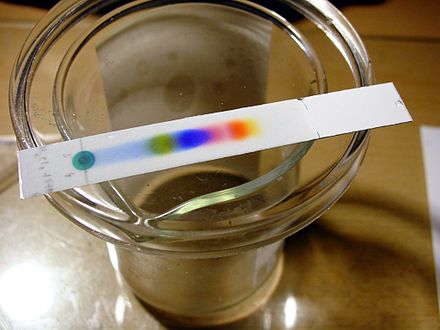
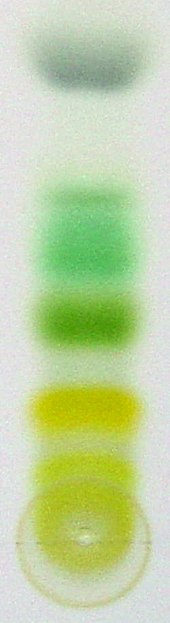
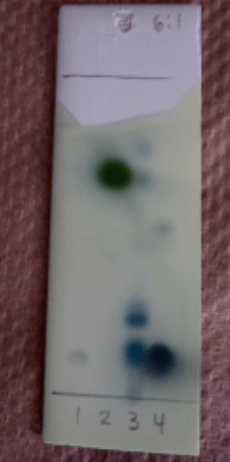
<p>Initial experiments on TLC allowed separating pigments of plant&#8217;s extracts. These pigments (such as chlorophyl) have different colors, and elute at different rates through the stationary phase, so they can be separated and easily visualized:</p>


<div class="wp-block-image"><figure class="aligncenter size-large is-resized"><img decoding="async" src="https://chemistryhall.com/wp-content/uploads/2019/11/tlcchlorophyl.jpg" alt="thin layer chromatography of a plant extract" class="wp-image-38673" width="82" height="302"/><figcaption>TLC of a plant extract</figcaption></figure></div>


<p>Chromatography can get very complex, with complicated and expensive instruments such as GC-MS or HPLC, but the most basic, most important and oldest technique is <strong>thin layer chromatography</strong>, or TLC. </p>


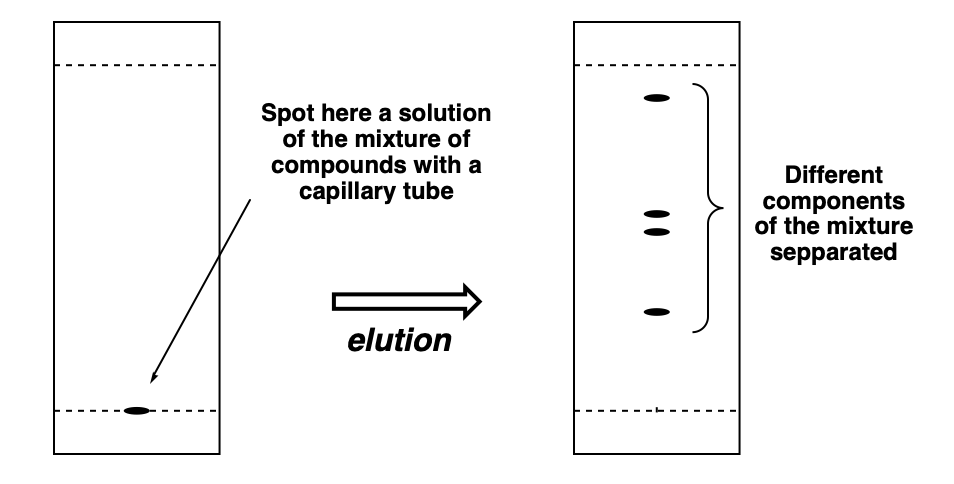
<p>In TLC, we use a stationary phase (most frequently silica gel) which is deposited over a glass or aluminum support. We then can spot mixtures of compounds over the same line. Then we elute the TLC with an organic solvent, and the different compounds will move upwards at different rates, allowing the separation of the different components.</p>


<h2 class="wp-block-heading">What Is Thin Layer Chromatography Used for?</h2>


<p>Thin Layer Chromatography is a cheap, quick and easy technique to separate components of a mixture. It is used by synthetic chemists to monitor chemical reactions and purifications.</p>


<h3 class="wp-block-heading">And How Does a TLC Work?</h3>


<p>Well, a TLC plate is an aluminum plate coated by a &#8220;thin layer&#8221; of a stationary phase, which is usually (&gt;95% of the time in organic synthesis) silica gel.</p>


<p>Around 1 cm above the bottom of the plate, you can spot a solution of a mixture of compounds of different polarity. </p>


<p>Then, you &#8220;elute&#8221; the plate. you basically put it vertically inside a closed chamber which contains an amount of an appropriate solvent mixture. The solvent flows slowly up the plate through <a rel="noreferrer noopener" aria-label="capillary action (opens in a new tab)" href="https://en.wikipedia.org/wiki/Capillary_action" target="_blank">capillary action</a>.</p>


<p>The stationary phase, silica gel contains Si–O–H bonds that bind to the different compounds of the mixtures in a variable manner depending on the polarity of the compounds. Also, depending on the nature of the solvent used (more polar or less polar), it will pull upwards some compounds faster than others.</p>


<p>In general, more polar compounds will &#8220;climb&#8221; slower up through the TLC plate, and less polar ones will fly upwards.</p>


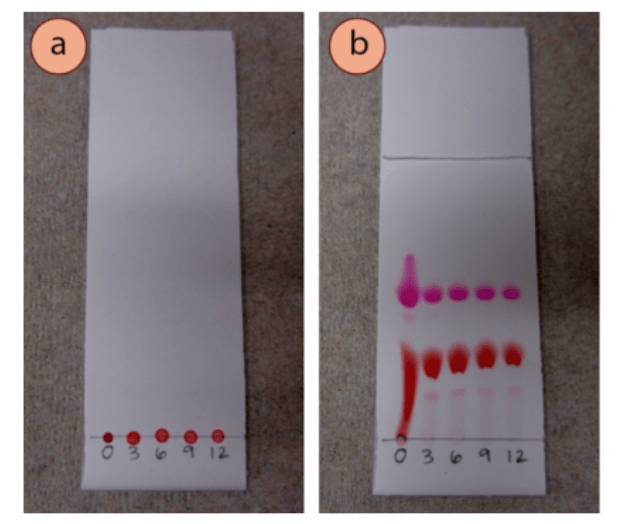
<p>Then you just need to check how many and where in the TLC plate each spot is. Each spot corresponds to a different chemical compound on the mixture. </p>


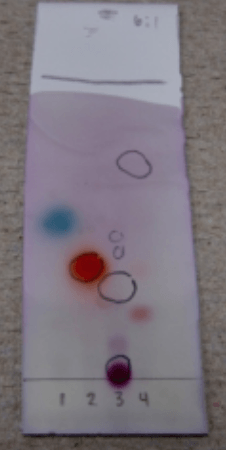
<div class="wp-block-image"><figure class="aligncenter size-large is-resized"><img decoding="async" src="https://chemistryhall.com/wp-content/uploads/2019/11/image-2.png" alt="TLC of a mixture of colored compounds" class="wp-image-38680" width="380" height="321" srcset="https://chemistryhall.com/wp-content/uploads/2019/11/image-2.png 618w, https://chemistryhall.com/wp-content/uploads/2019/11/image-2-300x254.png 300w" sizes="(max-width: 380px) 100vw, 380px" /><figcaption>Separation of two main components of a mixture (pink spot and red spot). Credit to Lisa Nichols via <a rel="noreferrer noopener nofollow" aria-label="LibreTexts (opens in a new tab)" href="https://chem.libretexts.org/Bookshelves/Organic_Chemistry/Book%3A_Organic_Chemistry_Lab_Techniques_(Nichols)/2%3A_Chromatography/2.2%3A_Thin_Layer_Chromatography_(TLC)/2.2E%3A_Step-by-Step_Procedures_for_Thin_Layer_Chromatography" target="_blank">LibreTexts</a></figcaption></figure></div>


<p>Usually you will need a UV (Ultraviolet) lamp to visualize the different spots, but if the compounds are strongly colored, as in the picture above, you can easily see the different components of the mixture.</p>


<h2 class="wp-block-heading">How Do You Run a TLC? Step by Step Guide</h2>


<h4 class="wp-block-heading">1. Cut Your Plate</h4>


<p>First you need to cut a piece of TLC plate of the appropriate size. What is the appropriate size? It depends on the purpose of the TLC, and how many spots you need to separate. If you just want to take a look on how many compounds you have in a mixture, one spot is enough.</p>


<p>TLC plates are generally made of aluminum coated by the stationary phase, and can be cut with scissors. Sometimes, the supporting material is glass and you will need a glass cutter to do the job.</p>


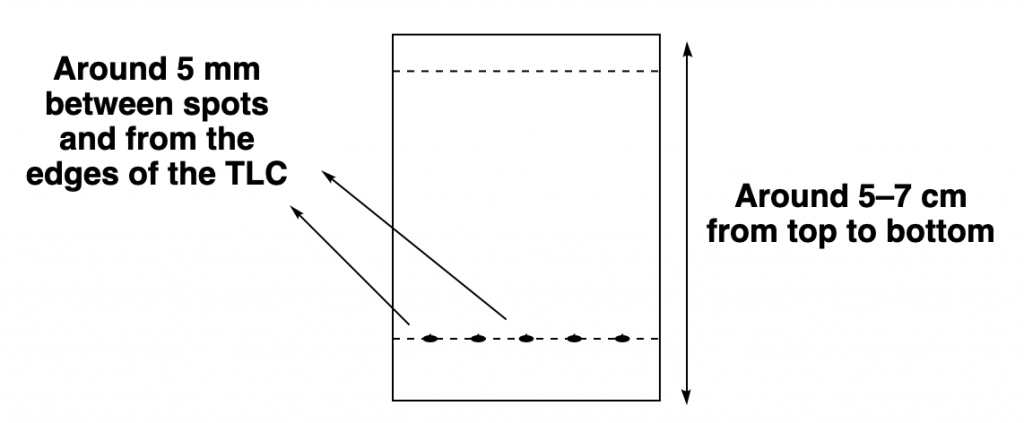
<p>Usually, a thin layer chromatography plate is around 5–7 cm high, and a line is drawn around 0.5–1.0 cm from the bottom. That is the line in which you will spot your mixtures to separate. It is important that you spot the mixtures <strong>above</strong> the solvent level on your elution chamber!</p>


<p>Also, remember to leave some separation between each spot at the bottom spotting line (so they don&#8217;t mix to each other!) and also leave a similar separation (of around half a centimeter) from each edge of the TLC plate.</p>


<div class="wp-block-image"><figure class="aligncenter size-large is-resized"><img decoding="async" src="https://chemistryhall.com/wp-content/uploads/2019/11/image-3-1024x423.png" alt="thin layer chromatography size plate" class="wp-image-38681" width="408" height="168" srcset="https://chemistryhall.com/wp-content/uploads/2019/11/image-3-1024x423.png 1024w, https://chemistryhall.com/wp-content/uploads/2019/11/image-3-300x124.png 300w, https://chemistryhall.com/wp-content/uploads/2019/11/image-3-768x317.png 768w, https://chemistryhall.com/wp-content/uploads/2019/11/image-3.png 1142w" sizes="(max-width: 408px) 100vw, 408px" /><figcaption>Typical TLC size and arrangement.</figcaption></figure></div>


<h4 class="wp-block-heading">2. Spot Your TLC</h4>


<p>Then is time to prepare the samples of the mixtures to separate, and spot them on the TLC plate. </p>


<p>For simplicity, let&#8217;s start off with just a single spot, in which we will put a solution of a mixture of several compounds. </p>


<p>First we need to prepare a solution of our mixture. The usual average concentration of these solutions is a few miligrams of mixture/compound in around 0.5–1 mL of solvent. Those few miligrams are totally approximate. Just add a spatula or Pasteur pipette tip and dissolve it in a bit of solvent!</p>


<p>Once you got the solutions prepared (in this case, just the one!), it&#8217;s time to spot it on the bottom line of the TLC. You need to use a capillary tube (see the corresponding section for details). Take up some mixture solution with the capillary tube and press it lightly into the corresponding marked spot (use ALWAYS a pencil to mark in a TLC! <strong>Pen ink will elute with organic solvents, pencil graphite will not!</strong>) at the line around 0.5–1 cm above the bottom of the TLC.</p>


<div class="wp-block-image"><figure class="aligncenter size-large is-resized"><img decoding="async" src="https://chemistryhall.com/wp-content/uploads/2019/11/image.png" alt="TLC elution" class="wp-image-38678" width="446" height="226" srcset="https://chemistryhall.com/wp-content/uploads/2019/11/image.png 954w, https://chemistryhall.com/wp-content/uploads/2019/11/image-300x152.png 300w, https://chemistryhall.com/wp-content/uploads/2019/11/image-768x390.png 768w" sizes="(max-width: 446px) 100vw, 446px" /><figcaption>Spot the TLC mixtures at the corresponding mark in the line above the bottom of the plate. Then elute the plate and see how many compounds there is in your mixture, and how polar are they, just by checking out the different spots.</figcaption></figure></div>


<p>Try to spot your mixtures as tightly as possible. Make very small spots of sample. Very wide spots will make the different compounds overlap leading to a not so nice separations. Maybe even some compounds will be hidden since those will be basically co-eluting with other massive spots. Generally speaking, more diluted and smaller spots are they way to go.</p>


<h4 class="wp-block-heading">3. Elute the TLC Plate</h4>


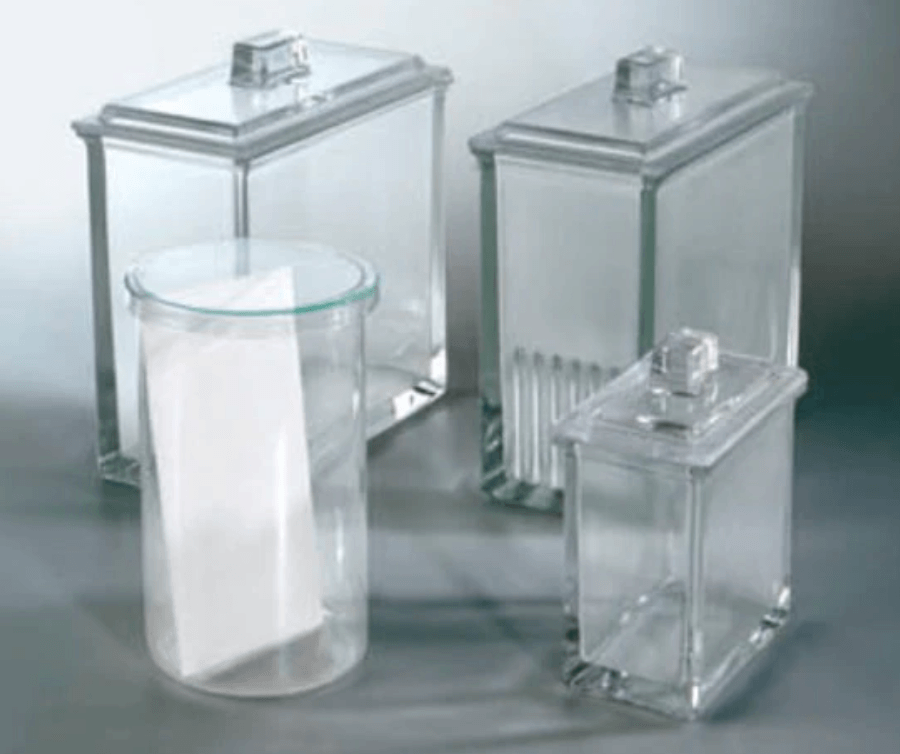
<p>Then is time to elute the plate. For this you need an elution chamber. There are commercial options, as the one in the picture below, specific for that purpose.</p>


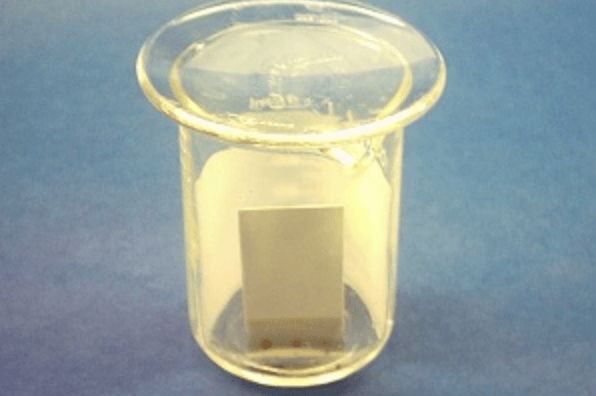
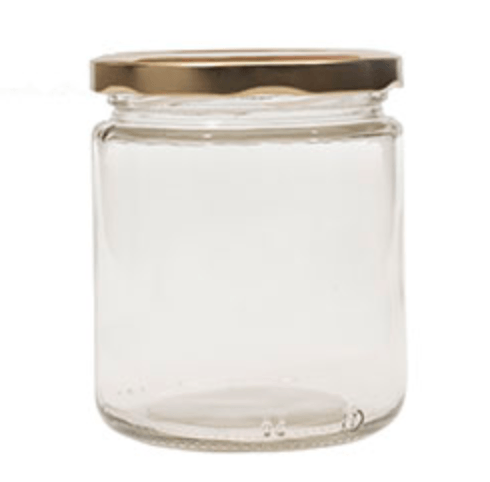
<p>But you can use any glass container that you can cap, actually. A beaker works. A a clean jam jar will also do the job!</p>


<p>Then you need to fill it with about 0.5 cm height of the desired <strong>solvent system</strong>.</p>


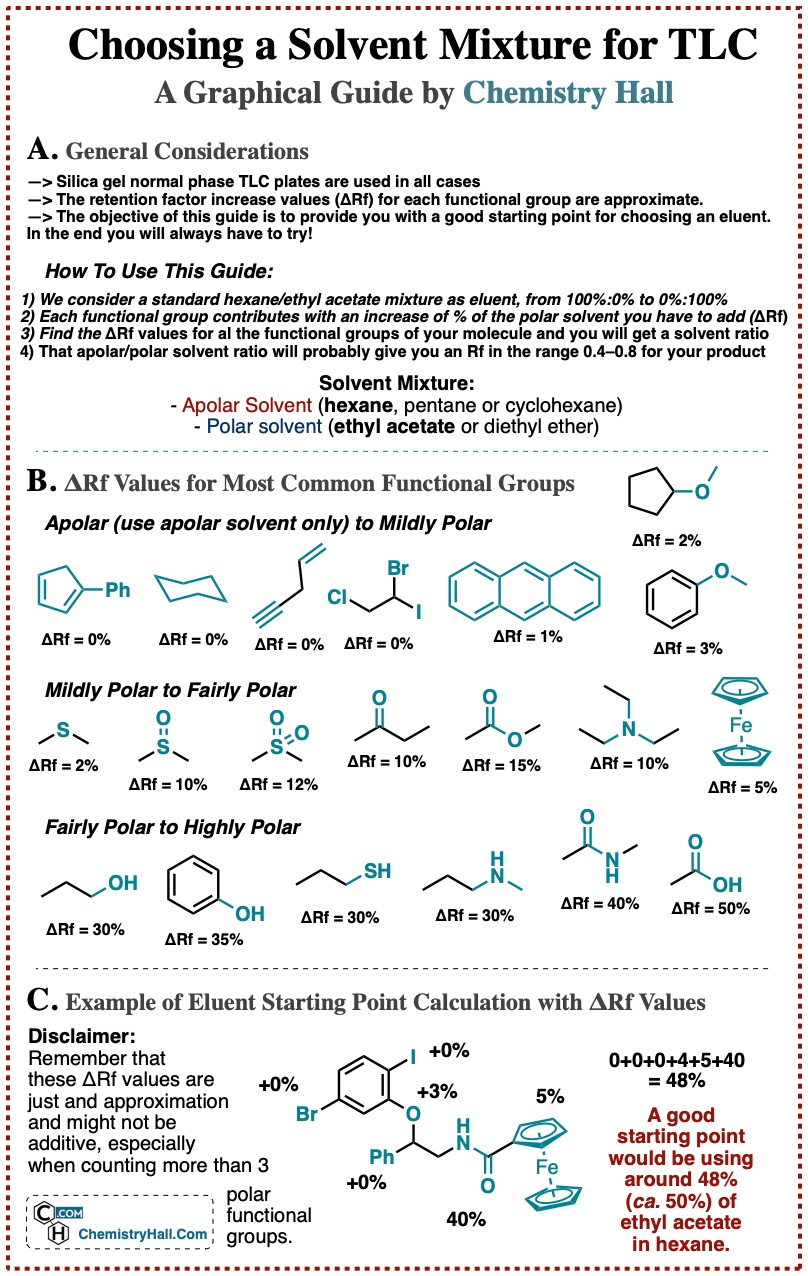
<p>There is no absolute best starting point for selecting a solvent system. However, a extremely quick summary would be:</p>


<ul><li>If you are working with absolutely apolar organic molecules (no polar functional groups, only C and H), such as naphthalene, start with pure pentane or hexane.</li><li>If you want to separate a compound with one or two mildly polar functional groups (ether, ketone, ester&#8230;), go for a 4:1 hexane/EtOAc mixture.</li><li>If your molecule has one or two very polar groups (alcohol, amine, etc), go for 1:1 hexane/EtOAc.</li><li>If your molecule is much more polar than that (e.g. a sugar, an amino acid&#8230;), swap hexane for DCM, and keep EtOAc as polar component. Use a 1:1 ratio for starters. </li><li>If your compounds are so polar that do not move at all from the baseline with DCM/EtOAc, go for 9:1 DCM/MeOH or even 9:1 EtOAc/MeOH.</li><li>If none of this works, you are looking at a extremely polar compound and you might want to consider using <strong>reverse phase</strong> (an apolar stationary phase, instead of silica gel)</li></ul>


<p>If you want more details about choosing a solvent system, check the corresponding section below!</p>


<p>This being said, it is important that the solvent level is below the initial point where you spot your samples! Otherwise, they will get diluted and you will not get a clean separation.</p>


<p>Once the chamber is ready, just put in the TLC inside, vertically, and wait for the solvent to go up by <strong>capillary action</strong>. Take out the TLC plate when the solvent level is around 90% form the top (<strong>don&#8217;t let it drown!</strong>)</p>


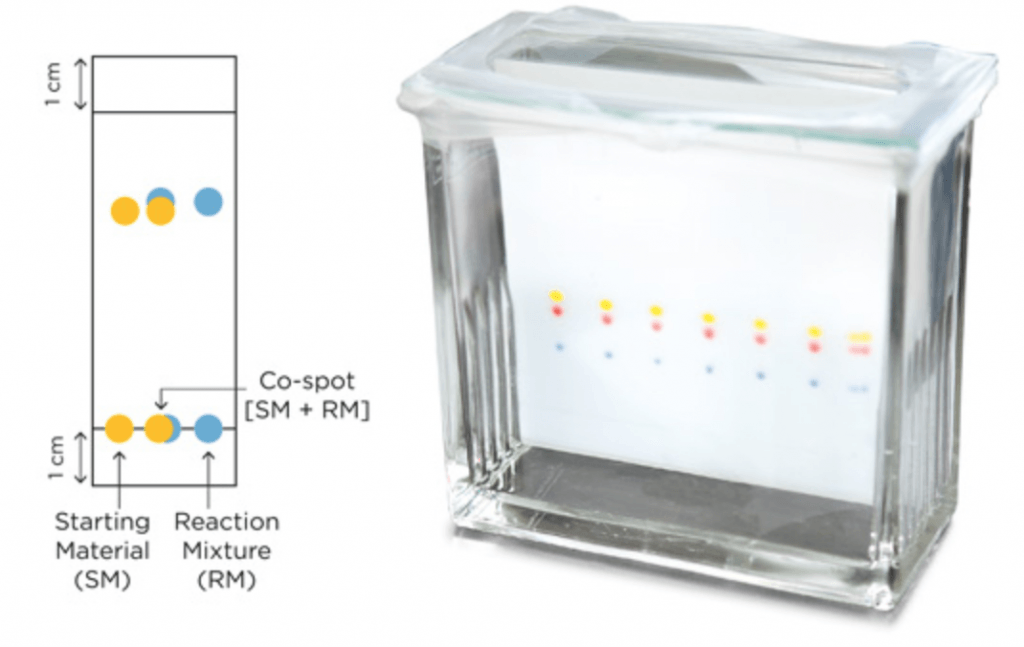
<div class="wp-block-image"><figure class="aligncenter size-large is-resized"><img decoding="async" src="https://chemistryhall.com/wp-content/uploads/2019/11/image-1-1024x647.png" alt="thin layer chromatography elution" class="wp-image-38679" width="358" height="226" srcset="https://chemistryhall.com/wp-content/uploads/2019/11/image-1-1024x647.png 1024w, https://chemistryhall.com/wp-content/uploads/2019/11/image-1-300x190.png 300w, https://chemistryhall.com/wp-content/uploads/2019/11/image-1-768x485.png 768w, https://chemistryhall.com/wp-content/uploads/2019/11/image-1.png 1070w" sizes="(max-width: 358px) 100vw, 358px" /><figcaption><strong>Left</strong>. TLC spots (before, at the bottom, and after elution, at the top). <strong>Right</strong>. TLC eluting in the solvent chamber. Credit to <a rel="noreferrer noopener" aria-label="SiliCycle (opens in a new tab)" href="https://www.silicycle.com/products/thin-layer-chromatography-tlc-plates/siliaplate-tlc-practical-guide" target="_blank">SiliCycle</a>.</figcaption></figure></div>


<p>Before the plate dries, mark the <strong>eluent front</strong> (the line on the plate the solvent level has reached). You will need this to determine the <strong>retention factor</strong> (Rf) of each spot/compound.</p>


<p>Then, dry off the plate (with compressed air, blowing air, or just waiting&#8230;)</p>


<h4 class="wp-block-heading">4. Visualize the TLC: Check Out the Results!</h4>


<p>Finally, visualization. This is a matter of finding the right way to visualize the spots corresponding to each compound in the mixture you just separated. </p>


<p>If they are strongly colored (as in the picture above), you are good! You don&#8217;t need anything else, just look directly at the plate.</p>


<p>Most of the times, organic compounds will not be visible, but they will absorb UV radiation. So you just use a UV lamp. Finally, there are a lot of staining solutions that can be used to develop the plates and easily tell where each compound appears. Scroll down to the corresponding section to known more about visualization.</p>


<h4 class="wp-block-heading">5. Determine the Retention Factor of the Different Compounds</h4>


<h5 class="wp-block-heading">What is Retention Factor?</h5>


<p>In thin layer chromatography, retention factor (Rf) is the distance that a compound travels through the stationary phase (TLC plate) between the origin spot and the distance the solvent front moved above the origin.</p>


<p>To calculate the value of the Rf, you just have to apply this simple formula:</p>


<blockquote class="wp-block-quote is-layout-flow wp-block-quote-is-layout-flow"><p>Rf(spot) = (distance the spot has moved)/(distance solvent front moved)</p></blockquote>


<p>A visual example: </p>


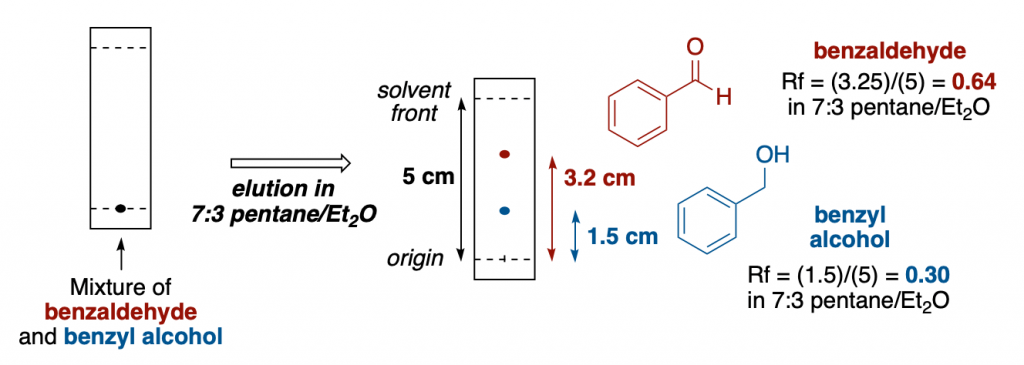
<div class="wp-block-image"><figure class="aligncenter size-large is-resized"><img decoding="async" src="https://chemistryhall.com/wp-content/uploads/2019/11/image-6-1024x365.png" alt="determining Rf retention factor in TLC" class="wp-image-38694" width="524" height="186" srcset="https://chemistryhall.com/wp-content/uploads/2019/11/image-6-1024x365.png 1024w, https://chemistryhall.com/wp-content/uploads/2019/11/image-6-300x107.png 300w, https://chemistryhall.com/wp-content/uploads/2019/11/image-6-768x274.png 768w, https://chemistryhall.com/wp-content/uploads/2019/11/image-6.png 1328w" sizes="(max-width: 524px) 100vw, 524px" /><figcaption>How to determine retention factor (Rf) in TLC</figcaption></figure></div>


<p>After eluting a mixture of benzaldehyde and benzyl alcohol in a TLC plate using 7:3 pentane/diethyl ether as a solvent, the two compounds travel a certain distance. </p>


<p>Benzaldehyde is less polar than the corresponding alcohol, so it is easily identifiable as the top spot. </p>


<p>After measuring the distance that both of the spots traveled, we can determine the retention factor for each compound in that solvent mixture. Simply divide the distance that one spot has traveled by the total distance the solvent has moved from the origin spot line.</p>


<p>For example, for benzaldehyde, it moved 3.2 cm from the origin. The solvent from has moved a total of 5 cm. So we can say and report the Rf of benzaldehyde in 7:3 pentane/diethyl ether to be 3.2/5 = 0.64.</p>


<p>Please, keep in mind that retention factors depend greatly on the solvent system used and on the stationary phase of the TLC. If you modify any of those, Rf will change. That&#8217;s why when reporting retention factor values, it is essential to specify those parameters for each compound.</p>


<h4 class="wp-block-heading">6. Re-run the TLC with a Better Solvent System if the First Attempt Was not Successful</h4>


<p>Finally, something that is very common while working with new compounds: Many times the first choice of solvent system will not be the appropriate, and maybe all the compounds of the mixture eluted together to the top of the TLC, or just didn&#8217;t move from the base spot, or maybe they are somewhere between, but still the separation is not perfect. </p>


<p>In any of these cases, you just have to keep tweaking the solvent system until you find the most suitable for your mixture! </p>


<p>It is not uncommon to run 3-4 TLC plates of a reaction crude (even for experienced chemists) before starting a <strong>flash column chromatography</strong> purification.</p>


<p>And that is pretty much what you really need to know to perform a TLC experiment. The only thing left is knowing which solvent system you need to separate your mixture appropriately, and to know what are the real-life applications of TLC.</p>


<p>Was anything not clear?</p>


<p>Don&#8217;t worry, a video is worth a thousand words! Check out this video guide for TLC:</p>


<center>
<figure class="wp-block-embed-youtube wp-block-embed is-type-video is-provider-youtube wp-embed-aspect-16-9 wp-has-aspect-ratio"><div class="wp-block-embed__wrapper">
<iframe loading="lazy" title="How to Spot and Run a TLC Plate" width="500" height="281" src="https://www.youtube.com/embed/SsOxBuIG_0A?feature=oembed" frameborder="0" allow="accelerometer; autoplay; clipboard-write; encrypted-media; gyroscope; picture-in-picture; web-share" referrerpolicy="strict-origin-when-cross-origin" allowfullscreen></iframe>
</div><figcaption>Video tutorial on how to run a TLC plate</figcaption></figure>
</center>


<h3 class="wp-block-heading">A Quick Infographic Guide for Thin Layer Chromatography</h3>


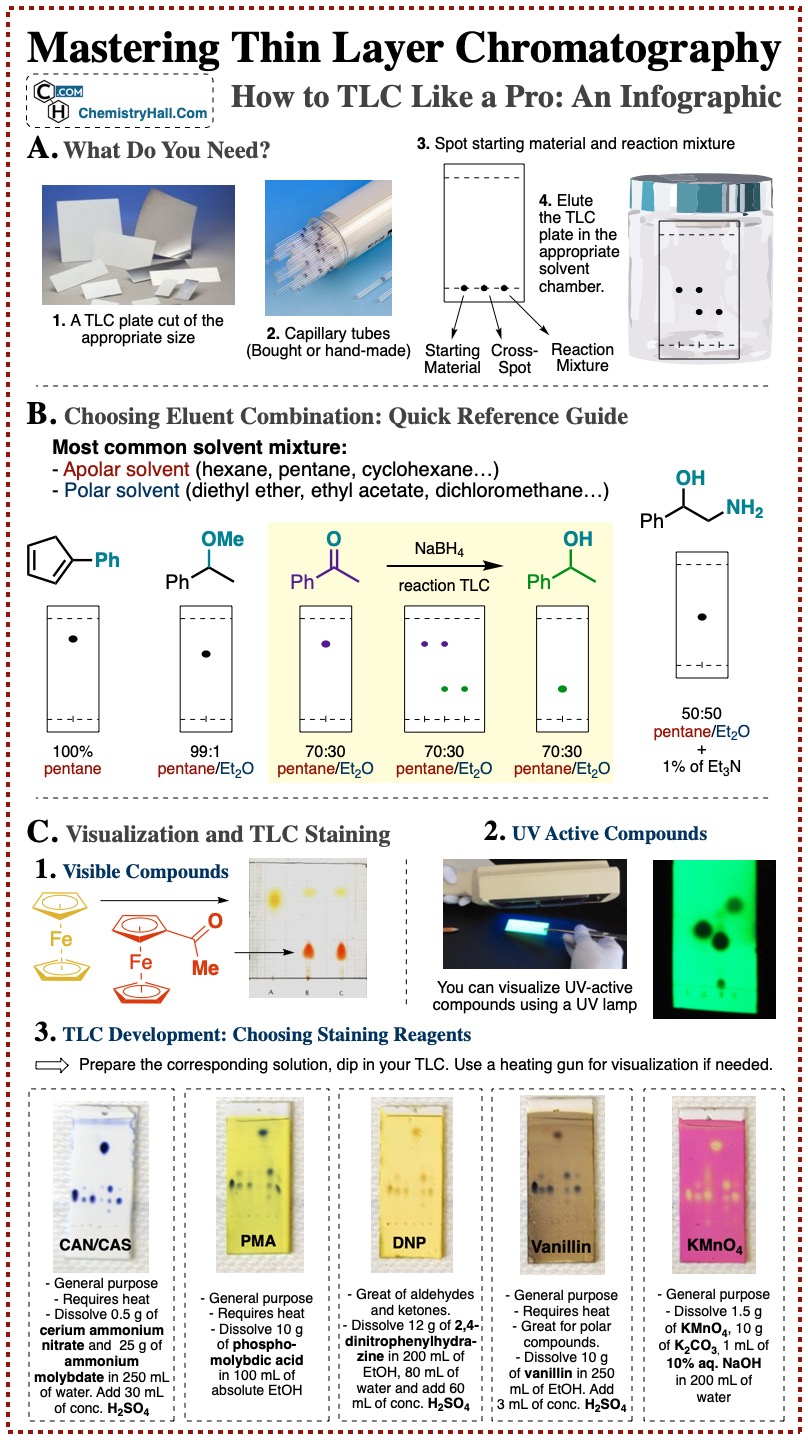
<p>After lining up the entire procedure for running a TLC, I want to cut to a quick reference graphical guide that we prepared.</p>


<p>It is the most visual way to sum up TLC technique that we could think of, and here it is for you:</p>


<div class="wp-block-image"><figure class="aligncenter size-large"><a href="https://chemistryhall.com/wp-content/uploads/2019/12/TLC-info.jpeg" target="_blank" rel="noreferrer noopener"><img decoding="async" width="575" height="1024" src="https://chemistryhall.com/wp-content/uploads/2019/12/TLC-info-575x1024.jpeg" alt="thin layer chromatography graphic guide" class="wp-image-38746" srcset="https://chemistryhall.com/wp-content/uploads/2019/12/TLC-info-575x1024.jpeg 575w, https://chemistryhall.com/wp-content/uploads/2019/12/TLC-info-168x300.jpeg 168w, https://chemistryhall.com/wp-content/uploads/2019/12/TLC-info-768x1369.jpeg 768w, https://chemistryhall.com/wp-content/uploads/2019/12/TLC-info.jpeg 808w" sizes="(max-width: 575px) 100vw, 575px" /></a><figcaption>Infographic guide on how to set up, run and analyze a TLC. Click on the image to expand.</figcaption></figure></div>


<p>Please, feel free to link, share and use this infographic as you please!</p>


<p>From this point, the introduction is finished.</p>


<p>We will get first into the main basic uses of TLC. Then we will move onto more details into each component of the technique. Then we will cover more advanced uses and techniques, such as prep TLC, 2D TLC, or flash chromatography.</p>


<p>And then we will finish with some mind-blowing tips and tricks and TLC troubleshooting.</p>


<p>Keep reading!</p>


<h3 class="wp-block-heading">Thin Layer Chromatography for Reaction Monitoring</h3>


<p>The main use of TLC is monitoring chemical reactions. </p>


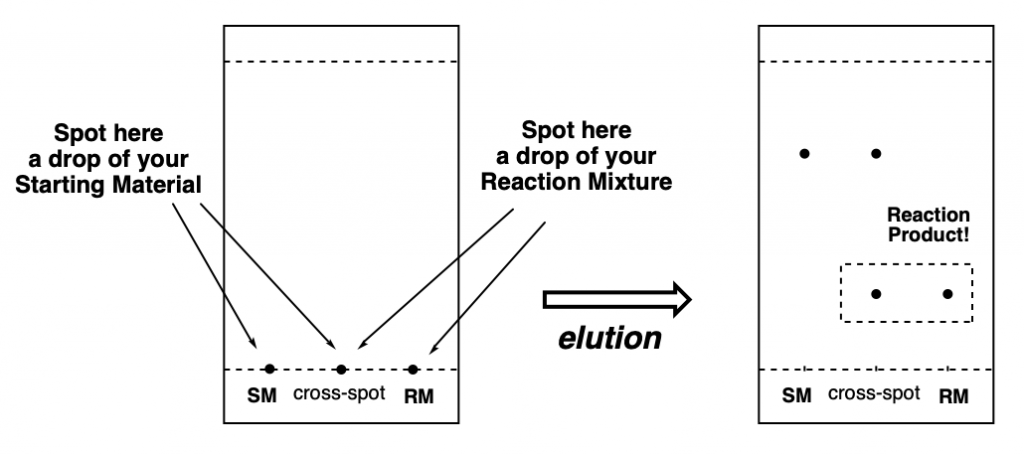
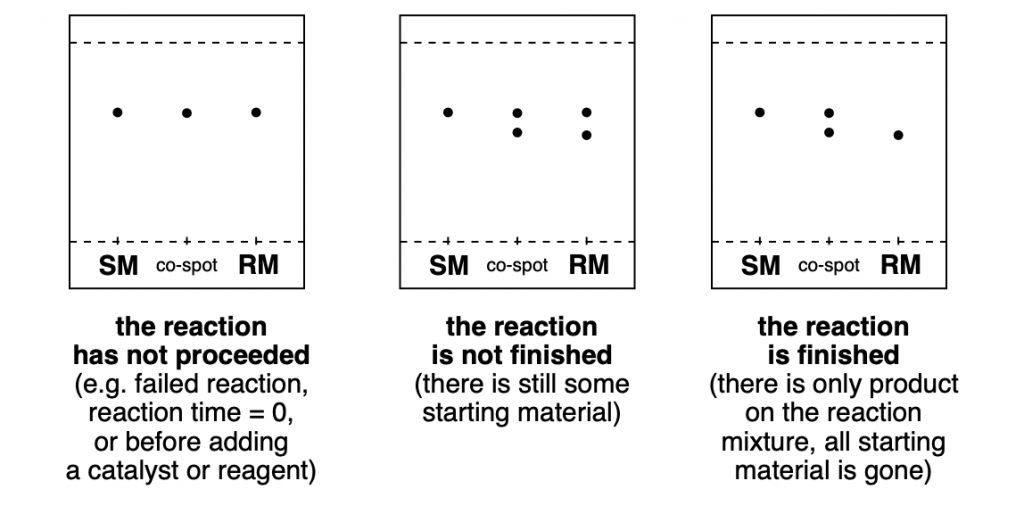
<p>In a chemical transformation, you usually have a <strong>starting material (SM)</strong> that will get consumed to give rise to a product. In most cases, this product will have a different polarity than the SM. This means that they will have different retention factor in TLC, and you will be able to separate them by TLC.</p>


<p>You generally want a solvent mixture that gives both compounds a retention factor between 0.2 and 0.8. But of course, the main idea is that you can see both spots resolved, not together, so you can see if you still have SM in your reaction mixture or if it is all consumed. This would mean that the reaction is finished in most of the cases.</p>


<p>The trick is to make three spots on the TLC, one with the SM, another one with the <strong>reaction mixture (RM)</strong>, and another one in the middle (co-spot or cross-spot) in which you put both a solution of the SM and the reaction mixture. This way you can clearly visualize, after elution, that your SM actually reacted to form a new product. This is particularly important if both SM and product have very similar Rf, and it is difficult to see if you actually have a new product or just SM in the reaction mixture.</p>


<div class="wp-block-image"><figure class="aligncenter size-large is-resized"><img decoding="async" src="https://chemistryhall.com/wp-content/uploads/2019/11/image-4-1024x455.png" alt="how to monitor reactions with TLC" class="wp-image-38683" width="495" height="219" srcset="https://chemistryhall.com/wp-content/uploads/2019/11/image-4-1024x455.png 1024w, https://chemistryhall.com/wp-content/uploads/2019/11/image-4-300x133.png 300w, https://chemistryhall.com/wp-content/uploads/2019/11/image-4-768x341.png 768w, https://chemistryhall.com/wp-content/uploads/2019/11/image-4.png 1030w" sizes="(max-width: 495px) 100vw, 495px" /><figcaption>Basic way of monitoring reaction progress by TLC. (SM = Starting Material, RM = Reaction Mixture)</figcaption></figure></div>


<p>As you can see in the diagrams below, it is very easy to see whether a reaction didn&#8217;t work at all (yet), if a product is being formed, but the reaction is not finished, or if all SM has been consumed and there are only products on the RM.</p>


<div class="wp-block-image"><figure class="aligncenter size-large is-resized"><img decoding="async" src="https://chemistryhall.com/wp-content/uploads/2019/12/image-1024x514.png" alt="determining conversion with thin layer chromatography" class="wp-image-38696" width="450" height="226" srcset="https://chemistryhall.com/wp-content/uploads/2019/12/image-1024x514.png 1024w, https://chemistryhall.com/wp-content/uploads/2019/12/image-300x151.png 300w, https://chemistryhall.com/wp-content/uploads/2019/12/image-768x385.png 768w, https://chemistryhall.com/wp-content/uploads/2019/12/image.png 1148w" sizes="(max-width: 450px) 100vw, 450px" /><figcaption>Typical scenarios encountered while monitoring reactions by TLC (SM = Starting Material, RM = Reaction Mixture)</figcaption></figure></div>


<p>Furthermore, if you happen to have a sample of the reaction product that you want to obtain (because maybe you had run the same reaction before, or because it is a commercially available product), you can add another spot for the product, and another for a co-spot of both product and reaction mixture. This way you can confirm that the desired product has been formed.</p>


<h3 class="wp-block-heading">TLC for Column Chromatography Purification</h3>


<p>The second most typical scenario in which you are gonna have to use thin layer chromatography is while working on a <a href="https://en.wikipedia.org/wiki/Column_chromatography" target="_blank" rel="noreferrer noopener" aria-label=" (opens in a new tab)">flash column chromatography purification</a>.</p>


<h5 class="wp-block-heading">What Is Column Chromatography?</h5>


<p>Column chromatography is a method for separating and isolating chemical compounds in the lab on a preparative scale, depending on its relative polarity. </p>


<p>The basis are exactly the same than for TLC. We have a glass column filled with a stationary phase (also usually silica gel). </p>


<p>On top of the stationary phase, we put the mixture of compounds that we want to separate. When we are trying to isolate one product from a reaction mixture, we call this mixture &#8220;crude product&#8221;.</p>


<p>Then, we pass solvent through the column, from the top to bottom, sometimes aided by applying pressure (this is what we call &#8220;flash column chromatography&#8221;). This makes the different compounds of the mixture elute through the stationary phase at different rates. </p>


<div class="wp-block-image"><figure class="aligncenter size-large is-resized"><img decoding="async" src="https://chemistryhall.com/wp-content/uploads/2019/12/image-1-1024x687.png" alt="flash column chromatography" class="wp-image-38698" width="488" height="327" srcset="https://chemistryhall.com/wp-content/uploads/2019/12/image-1-1024x687.png 1024w, https://chemistryhall.com/wp-content/uploads/2019/12/image-1-300x201.png 300w, https://chemistryhall.com/wp-content/uploads/2019/12/image-1-768x515.png 768w, https://chemistryhall.com/wp-content/uploads/2019/12/image-1-1536x1031.png 1536w, https://chemistryhall.com/wp-content/uploads/2019/12/image-1.png 1568w" sizes="(max-width: 488px) 100vw, 488px" /><figcaption>Flash column chromatography purification. Credit to <a rel="noreferrer noopener nofollow" aria-label="Dr. Jessica Torres (opens in a new tab)" href="https://bitesizebio.com/29947/basics-chromatography-column/" target="_blank">Dr. Jessica Torres</a></figcaption></figure></div>


<p>Then, the different fractions that come out of the bottom of the column are collected in different test tubes. If the separation was performed correctly, we will have each compound of the mixture in different test tubes. The we can just get rid of the solvent by evaporation and we will have our product pure.</p>


<p>The rate of elution for each compound depends on its retention factor (i.e. its polarity) in that particular solvent system. This means, they will come out of the column in the same relative rate rate as their spots eluted in a TLC.</p>


<h5 class="wp-block-heading">How Do We Use TLC for Column Chromatography?</h5>


<p>Well, first of all, before running a flash column chromatography, we need to select what is the appropriate solvent system for the purification. We do this by using TLC.</p>


<p>Ideally, the product(s) that we want to isolate, should have an Rf (retention factor) of around 0.4 in a given eluent (mixture of solvents) to allow for a smooth column purification.</p>


<p>The following image on the left illustrates how an ideal TLC for purification should look like. As you can see, two products are clearly visible and separated. So the solvent mixture that yields this result on TLC, will be a great choice for running the big scale column chromatography purification.</p>


<figure class="wp-block-image size-large"><img decoding="async" width="1024" height="287" src="https://chemistryhall.com/wp-content/uploads/2019/12/image-2-1024x287.png" alt="running flash column chromatography" class="wp-image-38699" srcset="https://chemistryhall.com/wp-content/uploads/2019/12/image-2-1024x287.png 1024w, https://chemistryhall.com/wp-content/uploads/2019/12/image-2-300x84.png 300w, https://chemistryhall.com/wp-content/uploads/2019/12/image-2-768x216.png 768w, https://chemistryhall.com/wp-content/uploads/2019/12/image-2-1536x431.png 1536w, https://chemistryhall.com/wp-content/uploads/2019/12/image-2-2048x575.png 2048w" sizes="(max-width: 1024px) 100vw, 1024px" /><figcaption>Ideal TLC for flash column chromatography purification. Credit to to Lisa Nichols via <a rel="noreferrer noopener" href="https://chem.libretexts.org/Bookshelves/Organic_Chemistry/Book%3A_Organic_Chemistry_Lab_Techniques_(Nichols)/2%3A_Chromatography/2.2%3A_Thin_Layer_Chromatography_(TLC)/2.2E%3A_Step-by-Step_Procedures_for_Thin_Layer_Chromatography" target="_blank">LibreTexts</a></figcaption></figure>


<p>The images on the right, illustrate how this separation does proceed using that same solvent system. As you can see on the far right, the first compound leaves the column completely separated from the other one. It can be collected, and concentrated in vacuum, getting your product completely pure and dry!</p>


<h4 class="wp-block-heading">TLCing the Fractions from Column Chromatography</h4>


<p>But after running the column chromatography, you usually end up with dozens of tubes filled with eluent with the different compounds dissolved. Now we have to use TLC again!</p>


<div class="wp-block-image"><figure class="aligncenter size-large is-resized"><img decoding="async" src="https://chemistryhall.com/wp-content/uploads/2019/12/image-3.png" alt="monitoring flash column fractions with TLC" class="wp-image-38700" width="242" height="237" srcset="https://chemistryhall.com/wp-content/uploads/2019/12/image-3.png 640w, https://chemistryhall.com/wp-content/uploads/2019/12/image-3-300x294.png 300w" sizes="(max-width: 242px) 100vw, 242px" /><figcaption>TLC of the different fractions/test tubes from column chromatography.</figcaption></figure></div>


<p>As you can see, we spotted all the fractions/test tubes on the TLC, and eluted in the same solvent system. As you can see, we have two different products (spots) that came out of the column pretty close. </p>


<p>From <strong>fraction 5 to 10</strong>, we only have compound one, pure. We can mix these fractions, concentrate them, and we will have pure compound 1.</p>


<p><strong>Fractions 11 and 12</strong>, have a mixture of the two compounds. Usually we throw away this kind of mixed fractions (unless we don&#8217;t actually care about the impurity, maybe it just doesn&#8217;t affect the next step of our synthesis!).</p>


<p><strong>Fractions 13 and 14</strong> have pure compound 2. If we also need this compound, we will just concentrate them together as well.</p>


<p>As you can see, <strong>TLC is extremely important for both reaction monitoring and product purification</strong>, the two cornerstones of any synthesis laboratory.</p>


<h4 class="wp-block-heading">Checking What&#8217;s on Each Fraction with Other Techinques</h4>


<p>Sometimes TLC is just not enough and you don&#8217;t know what compound/product is in each of the different fractions that came out of your flash column. Evaporating everything and taking an NMR is really time consuming, so you might want to go for an alternative technique if it&#8217;s available to you.</p>


<p>If you have access to a GC-MS (gas chromatography-mass spectrometer) or LC-MS (liquid chromatography-mass spectrometer), you can analyze quickly all the different fractions, and know the molecular mass of the compound(s) present on each of them.</p>


<p>Another cool instrument is the TLC-MS. This technique is usually much less available in chemistry labs than GC-MS or LC-MS, but if you can use it is great. Basically this machine automatically scraps off individual spots on an eluted TLC, and makes an MS analysis, so you can check the molecular masses present on of each spot of the TLC in usually less than a minute.</p>


<h4 class="wp-block-heading">A Comment on Retention Factors and Flash Column</h4>


<p>Using an eluent which gives an Rf of 0.4 for your compound is the usual rule of thumb, but it has of course many exceptions. If you have two compounds that are very close together in Rf, this might not be enough. Having two compounds show as two separate spots in TLC doesn&#8217;t mean that they will come out separately from flash column.</p>


<p>Column bands are like much much wider TLC spots, especially as we scale up the purification. Imagine that typical TLC that you overload with sample and you get two big unresolved overlapping spots. That is a closer picture to what is actually happening in your column chromatography.</p>


<p>For this reason, sometimes an Rf of 0.4 will not do the trick. If spots are separated by less than 0.15 Rf, you will usually need to be a bit more conservative and choose an eluent in which they have a retention factor of around 0.3, or even a bit less. Another cool trick to enhance this kind of purification is using thicker columns, this helps a lot with separation. Using longer columns doesn&#8217;t usually help, since you are just thickening the bands and making them overlap more!</p>


<p>On the flip side of the coin, sometimes your compound of interest just flies on TLC using certain solvent mixture, giving an Rf of 0.7-0.9. This might allow for extremely easy and fast separations in a couple of the first tubes/fractions.</p>


<h2 class="wp-block-heading">In Depth Guide: Materials for Thin Layer Chromatography </h2>


<h3 class="wp-block-heading">Making Capillary Tubes</h3>


<p>You will have to spot reaction mixtures, or reference samples in your TLC using <strong>capillary tubes</strong>. </p>


<p>You can either buy them, or make them yourself. This depends on your lab&#8217;s budget, but I don&#8217;t think there is much harm in buying some good capillary tubes. The commercial ones I use on a daily basis, usually last for months before breaking, if you are careful enough.</p>


<p>But you can make thin capillary tubes out of thicker glass tubes, you just need to heat them up and then pulling. For this, you can either use thicker capillary tubes or glass Pasteur pipettes. </p>


<p>Explaining the method for heating and pulling will sound more complicated than it actually is, just take a look at this short but on-point video:</p>


<center>
<figure class="wp-block-embed-youtube wp-block-embed is-type-video is-provider-youtube wp-embed-aspect-16-9 wp-has-aspect-ratio"><div class="wp-block-embed__wrapper">
<iframe loading="lazy" title="How to pull capillary tubes" width="500" height="281" src="https://www.youtube.com/embed/2yKHvKCatmM?feature=oembed" frameborder="0" allow="accelerometer; autoplay; clipboard-write; encrypted-media; gyroscope; picture-in-picture; web-share" referrerpolicy="strict-origin-when-cross-origin" allowfullscreen></iframe>
</div><figcaption>How to make your own capillary tubes for spotting TLC plates</figcaption></figure>
</center>


<p>As you can see is not terribly complicated, and it can even be a nice experiment for undergraduate labs. Just be careful with the flame (or other heating source that you use! Avoid using open flames in the lab if you have alternatives).</p>


<h3 class="wp-block-heading">Elution Chambers for TLC</h3>


<p>So, there are actual chambers designed for running TLC, and they are just great, such as these from Fischer:</p>


<div class="wp-block-image"><figure class="aligncenter size-large is-resized"><img decoding="async" src="https://chemistryhall.com/wp-content/uploads/2019/12/image-4.png" alt="actual TLC chambers " class="wp-image-38706" width="403" height="337" srcset="https://chemistryhall.com/wp-content/uploads/2019/12/image-4.png 900w, https://chemistryhall.com/wp-content/uploads/2019/12/image-4-300x251.png 300w, https://chemistryhall.com/wp-content/uploads/2019/12/image-4-768x643.png 768w" sizes="(max-width: 403px) 100vw, 403px" /><figcaption>TLC chambers designed for that purpose</figcaption></figure></div>


<p>But that doesn&#8217;t mean you need one of those fancy pieces of glasswares to run a TLC. The beauty and simplicity of this technique is that you can use it in basically any situation!</p>


<p>A typical temporary solution, if you are in a rush, is just using a beaker covered with something (like a watch glass, or even aluminum foil), so the solvent doesn&#8217;t evaporate and allows for a <strong>nice saturated atmosphere</strong> </p>


<p>It is worth mentioning here that this is another key for a good eluent chamber: You need the atmosphere as saturated as possible. This way, the solvent doesn&#8217;t evaporate on its way up through the plate, which would cause an uneven movement of the eluent front. This can be detrimental for the separation, so always ensure that your chamber is a reasonably closed system.</p>


<div class="wp-block-image"><figure class="aligncenter size-large is-resized"><img decoding="async" src="https://chemistryhall.com/wp-content/uploads/2019/12/image-5.png" alt="beaker TLC chamber" class="wp-image-38707" width="336" height="223" srcset="https://chemistryhall.com/wp-content/uploads/2019/12/image-5.png 596w, https://chemistryhall.com/wp-content/uploads/2019/12/image-5-300x199.png 300w" sizes="(max-width: 336px) 100vw, 336px" /><figcaption>TLC chamber made with a beaker, a watch glass and filter paper. Credit to <a href="https://www.orgchemboulder.com/Technique/Procedures/TLC/TLC.shtml" target="_blank" rel="noreferrer noopener" aria-label="CU Boulder (opens in a new tab)">CU Boulder</a></figcaption></figure></div>


<p>As you can see in the picture above, you can also put a piece of filter paper inside the chamber a while before eluting your TLC. </p>


<p>Why? The solvent will ascend through the filter paper as well (by the same principle than through the TLC), helping a lot in saturating the atmosphere inside the chamber with the eluent. This will make the eluent go up the TLC plate in a much more even manner.</p>


<p>Also, be patient, leave the eluent in the chamber with the filter paper for a while before eluting you plate!</p>


<p>Finally, the more practical low-cost alternative, in my opinion, is just using a  glass tar with a screw cap, like the ones you get you jam, or other edible stuff in!</p>


<div class="wp-block-image"><figure class="aligncenter size-large is-resized"><img decoding="async" src="https://chemistryhall.com/wp-content/uploads/2019/12/image-6.png" alt="glass jar for thin layer chromatography" class="wp-image-38708" width="234" height="230" srcset="https://chemistryhall.com/wp-content/uploads/2019/12/image-6.png 490w, https://chemistryhall.com/wp-content/uploads/2019/12/image-6-300x295.png 300w" sizes="(max-width: 234px) 100vw, 234px" /><figcaption>A glass tar with a cap makes up for a great TLC chamber</figcaption></figure></div>


<p>I survived through my undergrad labs and also through my first research experience only by using these &#8220;ghetto-chambers&#8221; on a daily basis!</p>


<h3 class="wp-block-heading">Alternative Stationary Phases</h3>


<p>As we were saying, more than 95% of the cases you will perform a TLC in plates coated by silica gel as stationary phase.</p>


<p>But there are very specific cases in which different stationary phase may be considered.</p>


<p>Silica gel (SiO2) is slightly acidic, so certain compounds are quite sensitive to these acidic conditions. In those cases, you can first try to <strong>neutralize the silica gel adding a basic solvent to your eluent</strong> (typical conditions are adding 2-5% of triethylamine to your solvent mixture). </p>


<p>Many times this does the trick, but in other cases is not enough. For those cases, there are alternative stationary phases such as neutral <strong>alumina</strong> (Al2O3). Maybe your target compound does survive in alumina and you can use it for both TLC and flash column chromatography purification.</p>


<p>Another alternative stationary phase is <strong>reverse phase</strong>. </p>


<p>Typical silica gel stationary phases are very polar, and you elute the plate with a solvent systems that is (much) less polar than SiO2. This works wonders form most typical organic compounds. </p>


<p>However, if you are working with extremely polar molecules, you will find that they get stuck into the SiO2 like crazy and no matter how polar you make your eluent, they simply won&#8217;t move.</p>


<p>For these cases, we can use <strong>reverse phase chromatography</strong>, in which  the stationary phase is apolar (it will retain polar compounds much less), and you will use polar solvents, such as MeOH, as eluent. Very polar compounds, such as <a href="https://en.wikipedia.org/wiki/Oligopeptide" target="_blank" rel="noreferrer noopener" aria-label="oligopeptides (opens in a new tab)">oligopeptides</a>, can literally fly on reverse phase.</p>


<p>But these alternative stationary phases have some drawbacks:</p>


<ul><li>They are not the standard method, and many times you won&#8217;t find TLC plates of alumina or reverse phase around in the lab.</li><li>Correlating with being less available: they are more expensive than silica gel.</li><li>In general, separation and resolution are worse. Also visualization can be more difficult in certain plates.</li></ul>


<p>But sometimes (although very few times, we have to say) they are the only way to go, so keep in mind that these alternatives exist!</p>


<p>Finally, I have to mention that simple <strong>filter paper</strong> can be used as stationary phase. Separations are going to be bad, and you will get poor visualization. But if you have colored compounds, you can still see some separation. As a matter of fact, my first TLC experiment was just spotting a solution of spinach extract on filtering paper, and eluting it with acetone. </p>


<h3 class="wp-block-heading">Visualizing Agents: Which One is Best?</h3>


<p>There is no use in running a TLC if you cannot see the spots of the different compounds on your mixture. That&#8217;s why having access to the appropriate visualization technique is a must.</p>


<h3 class="wp-block-heading">Visible or UV Light</h3>


<p>Sometimes your compounds absorb visible light very strongly, and you don&#8217;t need visualizing agent at all. You can see the spots right as they elute up the plate!</p>


<p>This is common with highly conjugated compounds (such as polyaromatics, or polyenes), and with organometallic compounds, such as ferrocene derivatives. These compounds are great because you can basically run TLCs and column chromatography purifications knowing at all times where your compounds are on the silica!</p>


<p>However, most organic compounds do not absorb visible light strongly enough. So you have to use a visualizing agent.</p>


<p>The most common one is just using an ultraviolet lamp. TLC stationary phases are prepared to make your compounds visible in certain UV wavelengths. Most organic compounds, which have a minimum of conjugation will be observable in this manner.</p>


<div class="wp-block-image"><figure class="aligncenter size-large is-resized"><img decoding="async" src="https://chemistryhall.com/wp-content/uploads/2019/12/image-7-1024x164.png" alt="uv tlc visualizing" class="wp-image-38714" width="555" height="88" srcset="https://chemistryhall.com/wp-content/uploads/2019/12/image-7-1024x164.png 1024w, https://chemistryhall.com/wp-content/uploads/2019/12/image-7-300x48.png 300w, https://chemistryhall.com/wp-content/uploads/2019/12/image-7-768x123.png 768w, https://chemistryhall.com/wp-content/uploads/2019/12/image-7.png 1174w" sizes="(max-width: 555px) 100vw, 555px" /><figcaption>Typical way of visualizing a TLC plate under UV light.</figcaption></figure></div>


<p>But there are some compounds which don&#8217;t even absorb light on the wavelengths typically used in TLC UV lamps. Those are generally highly aliphatic compounds with little functional groups.</p>


<p>For these cases, we use <strong>staining agents</strong>.</p>


<h3 class="wp-block-heading">Staining Solutions</h3>


<p>Staining agents for TLC are basically solutions of one or more compounds in which we can dip the plates after elution. They will react with your products and help visualizing easily all the different spots/compounds present.</p>


<p>It is worth keeping in mind that, even if your target compound(s) absorbs strongly UV (or even visible) light, it is recommended to stain the plate anyway, if you can. This is because there might be other components of the mixture present as impurities which you cannot observe correctly under typical UV-Vis conditions.</p>


<p>So remember, even if your compound is visible at first sight, check also under UV light. And even if you can see everything under UV light, developing the plate with a general-purpose staining agent will almost never be overkill.</p>


<p>Now follows a list of the most typical staining agents, and how to prepare them. There are many others, some incredibly specific for certain types of compounds. But for the reasons, above, I&#8217;d always go with a general-purpose stain. And one of these will work for &gt;95% of organic compounds, so pick your favorite, and go! </p>


<h4 class="wp-block-heading">Acidic Vanillin</h4>


<p>Many people use this vanillin solutions. It is really easy to prepare, and after heating, it is really sensitive to most functional groups.</p>


<p>The coolest thing is that many times, small changes in functionalities on organic compounds lead to a change in the color of the TLC plate after vanillin staining and heating. This is really great if your starting material and product have a very close Rf. You can still differentiate them by the color!</p>


<div class="wp-block-image"><figure class="aligncenter size-large is-resized"><img decoding="async" src="https://chemistryhall.com/wp-content/uploads/2019/12/image-13.png" alt="tlc vanillin stain" class="wp-image-38733" width="132" height="263" srcset="https://chemistryhall.com/wp-content/uploads/2019/12/image-13.png 226w, https://chemistryhall.com/wp-content/uploads/2019/12/image-13-151x300.png 151w" sizes="(max-width: 132px) 100vw, 132px" /><figcaption>TLC stained with acidic vanillin</figcaption></figure></div>


<p>Specifically, it shows brightly most compounds with polar functional groups. It might not be great for highly apolar compounds, such as simple alkenes or aromatics.</p>


<p>The recipe for this stain is really easy: Weigh 10-15 g of vanillin, dissolve it 250 mL of ethanol, and add 2.5 mL of concentrated sulfuric acid. Stir and you are good to go! To use it just dip your eluted TLC plate, and heat up with a heating gun.</p>


<h4 class="wp-block-heading">Phosphomolybdic Acid (PMA)</h4>


<p>This is another great general purpose stain. It is my personal favorite, and it does color almost anything you can find in an organic chemistry lab. From polyaromatics to alcohols, going through alkenes, or simpler aliphatic compounds.</p>


<p>It gives you different blue-green shades, so it might not be the best for identifying different compounds with similar Rf, but for first choice, it will do great.</p>


<div class="wp-block-image"><figure class="aligncenter size-large is-resized"><img decoding="async" src="https://chemistryhall.com/wp-content/uploads/2019/12/image-14.png" alt="TLC PMA stain" class="wp-image-38734" width="124" height="250" srcset="https://chemistryhall.com/wp-content/uploads/2019/12/image-14.png 230w, https://chemistryhall.com/wp-content/uploads/2019/12/image-14-149x300.png 149w" sizes="(max-width: 124px) 100vw, 124px" /><figcaption>TLC stained with PMA</figcaption></figure></div>


<p>This staining solution is also extremely easy to prepare. You just need to dissolve around 5 g of phosphomolybdic acid (buy the lesser quality one for this purpose!) for each 500 mL of ethanol, and it&#8217;s done!</p>


<h4 class="wp-block-heading">Potassium Permanganate (Basic KMnO4)</h4>


<p>This is the most classical one, probably the cheaper option, and it is also quite general. Basically it turns your TLC plate purple, and every compound that can potentially be oxidized will show up as a yellow spot. This guy makes no distinction, and TLCs don&#8217;t look very pretty, but sometimes it does the trick.</p>


<div class="wp-block-image"><figure class="aligncenter size-large is-resized"><img decoding="async" src="https://chemistryhall.com/wp-content/uploads/2019/12/image-15.png" alt="thin layer chromatography kmno4 stain" class="wp-image-38735" width="132" height="257" srcset="https://chemistryhall.com/wp-content/uploads/2019/12/image-15.png 228w, https://chemistryhall.com/wp-content/uploads/2019/12/image-15-154x300.png 154w" sizes="(max-width: 132px) 100vw, 132px" /><figcaption>TLC stained with basic KMnO4</figcaption></figure></div>


<p>The usual recipe is a bit more complex here, but nothing that you won&#8217;t find around in any lab. You basically need to dissolve 1.5 g of potassium permanganate and 10 g of potassium carbonate in 200 mL of water. To this mixture, add in 1 mL of 10% aqueous NaOH, and stir. Just be careful not to stain yourself with the mixture! You don&#8217;t want your skin to get oxidized (i.e. dark brown for a couple of days-weeks&#8230;)!</p>


<h4 class="wp-block-heading">Cerium Ammonium Molybdate/Sulfate/Nitrate (CAM/CAS/CAN&#8230;)</h4>


<p>This stain is also known as Hanessian&#8217;s Stain, or simply &#8220;blue stain&#8221; (for obvious reasons), and it is another multi-purpose beast. </p>


<p>It is a water based stain which makes your spots turn blue over a cool pale yellow background, after heating. If you heat too much, the background will also turn blue and the plate won&#8217;t look so nice, so be careful!</p>


<div class="wp-block-image"><figure class="aligncenter size-large is-resized"><img decoding="async" src="https://chemistryhall.com/wp-content/uploads/2019/12/image-16.png" alt="hanessian stain blue tlc" class="wp-image-38736" width="201" height="189" srcset="https://chemistryhall.com/wp-content/uploads/2019/12/image-16.png 464w, https://chemistryhall.com/wp-content/uploads/2019/12/image-16-300x282.png 300w" sizes="(max-width: 201px) 100vw, 201px" /><figcaption>TLC stained with CAM or Hanessian&#8217;s stain, after a bit of heating (left) and after overheating (right)</figcaption></figure></div>


<p>I have seen people use two different recipes. Both work more or less the same, it just depends in which cerium reagent you find around/is cheaper for you.</p>


<p>Dissolve 5 g of ammonium molybdate and 1 g of cerium sulfate (OR 2 g of cerium ammonium sulfate) into 100 mL of water. To this mixture, add 10 mL of concentrated sulfuric acid, and stir!</p>


<h4 class="wp-block-heading">Other Staining Agents</h4>


<p>There are many other staining agents, but they are usually more specific for certain types of compounds, and not the best ones to prepare or use routinely in the lab.</p>


<ul><li><strong>Iodine vapor chamber</strong>: Fill a more or less sealed jar with a small spoon of iodine crystals. Cover it with silica gel. Put the dry eluted TLC plate in this developing chamber, and wait for the brown spots to appear. This is not the most sensitive stain, but the good thing is that you can use the same plate and develop it right after with a different stain.</li><li><strong>Ninhydrin</strong>: A solution of 10 g of ninhydrin in 250 mL of EtOH. It is great for amines, especially primary ones. Those will show up as green spots even before heating.</li><li><strong>Dinitrophenylhydrazine (DNP)</strong>: Dissolve 1 g of DNP in 250 mL of aqueous HCl 2 M. This stain is extremely selective for aldehydes and ketones. Those spots will turn orange immediately at room temperature.</li><li><strong>Anisaldehyde</strong>: Dissolve 4 mL of anisaldehyde in  200 mL of EtOH. Then, add 3 mL of glacial acetic acid and finally 10 mL of concentrated sulfuric acid. The result is a stain very similar to vanillin. Maybe less selective and less easy to prepare, but sometimes, it makes for a wider variety of colors after development, allowing to distinguish very close spots on the plate.</li></ul>


<h2 class="wp-block-heading">Solvent Polarity: Reference Guide</h2>


<p>To anyone with a couple of years of experience in the lab, choosing the solvent combination for running a TLC or a column comes really easy. Or at least a good starting point.</p>


<p>But for beginners, it can be really overwhelming. After all, there are a lot of different functional groups, and A LOT of different combinations. Not to mention the endless solvent combinations that you could imagine.</p>


<p>That is the reason why it is extremely difficult to find a good guide out there to choosing the eluent for chromatography.</p>


<h4 class="wp-block-heading">A Solvent Polarity Guide for Thin Layer Chromatography</h4>


<p>We wanted to get as close as possible to the best guide. And we came up with the following infographic for choosing solvents for TLC.</p>


<p>Keep in mind that of course this is an orientation and approximation, and there will always be compounds that behave weirdly. But we think that it will do the trick to for most situations, at least as a first shoot for a new reaction that you are running.</p>


<div class="wp-block-image"><figure class="aligncenter size-large"><a href="https://chemistryhall.com/wp-content/uploads/2019/12/TLC-eluent-guide.jpeg" target="_blank" rel="noreferrer noopener"><img decoding="async" width="648" height="1024" src="https://chemistryhall.com/wp-content/uploads/2019/12/TLC-eluent-guide-648x1024.jpeg" alt="guide to choose solvent for thin layer chromatography " class="wp-image-38749" srcset="https://chemistryhall.com/wp-content/uploads/2019/12/TLC-eluent-guide-648x1024.jpeg 648w, https://chemistryhall.com/wp-content/uploads/2019/12/TLC-eluent-guide-190x300.jpeg 190w, https://chemistryhall.com/wp-content/uploads/2019/12/TLC-eluent-guide-768x1213.jpeg 768w, https://chemistryhall.com/wp-content/uploads/2019/12/TLC-eluent-guide.jpeg 808w" sizes="(max-width: 648px) 100vw, 648px" /></a><figcaption>Graphic guide to choose a eluent starting point for TLC</figcaption></figure></div>


<p>As you can see, we have broken down organic compounds depending on their functional groups, and added a value in the form of a % of polar solvent that you would need to your eluent mixture in order to get the compound with that group to go up the plate significantly. </p>


<p>We have limited it to classical mixtures of apolar solvent (hexane, pentane or cyclohexane) and polar solvent (ethyl acetate or diethyl ether), as a combination of these solvents will be usually enough to deal with most organic compounds.</p>


<p>Again, this is an approximation, and the values are not always additive. For example, an alcohol elutes with a 7:3 hexane/EtOAc. But if you have 3 alcohols, it is not certain that 1:9 will work. Maybe 1:1 is enough. Or maybe not even 1:9, maybe you even need to add methanol. There is no universal rule, that&#8217;s why guides such as this one are not very abundant.</p>


<p>As you can imagine, the most polar group itself will often dictate the polarity of the entire molecule. </p>


<p>Relative polarities of &#8220;minor&#8221; groups are important. Take a molecule which has an amide (6:4 hexane/EtOAc), but also a methoxy group (2-3% extra polarity). Then you change that methoxy group for an alcohol. Alcohol adds an extra 30-35% of polar solvent, so your reaction product spot will appear below the one for your starting substrate!</p>


<h4 class="wp-block-heading">Which One of the Most Common Solvents is Better?</h4>


<p>For practical purposes, solvents such as pentane, hexane, heptane or cyclohexane are similar, polarity-wise.</p>


<p>However, there are several considerations that might make you go for one or another.</p>


<p>Hexane/EtOAc is usually the standard mixture for organic separations. However, <a href="https://en.wikipedia.org/wiki/Hexane" target="_blank" rel="noreferrer noopener" aria-label="hexane (opens in a new tab)">hexane</a> is known to be a neurotoxic compound, that&#8217;s why many people swap from hexane to cyclohexane or heptane. </p>


<p>The only problem with those two solvents is that are less volatile, and more difficult to get rid of. If you need a more volatile alternative, use pentane. This should be used in cases where your target compound is relatively volatile and you cannot put it under high vacuum to remove the solvent completely.</p>


<p>In the polar component side, ethyl acetate and diethyl ether can be the main options. Diethyl ether is more volatile, so it should generally be avoided if possible, unless it gives you a much better separation or your target product is also volatile.</p>


<p>Also, when pairing solvent mixtures, try to go for solvents with similar volatility, so you don&#8217;t get faster evaporation of one of the components of the mixture than the other. This can potentially lead to reproducibility issues.</p>


<h4 class="wp-block-heading">&#8220;Sticky&#8221; Compounds with Acid or Basic Sites</h4>


<p>As an exception, you might want to consider as additives (up to 5-10%) of your mixtures other solvents such as MeOH (for extremely polar compounds), triethylamine (for compounds with basic sites) and acetic acid (for compounds with acid sites).</p>


<p>Compounds with basic or acidic sites, such as amines, amides (basic) or carboxylic acids (acid), can sometimes stick to the silica gel of the stationary phase a little bit too much. </p>


<p>This results on very wide spots on TLC, and as a consequence, very broad bands in your flash column chromatography purifications. Band/spot broadening often complicates purification, since your target compound might overlap with a byproduct or impurity that you want to get rid of.</p>


<p>Many times this has a simple solution: add to your solvent mixture 2-5% of triethylamine for basic compounds. This deactivates de acidic sites of the silica: Si–O–H bonds. These bonds, or extra protons, are responsible of basic compounds sticking to the silica gel, and making broader bands/spots. By adding Et3N to your eluent, you remove all of them and your compound will elute freely!</p>


<p>Similarly, acidic compounds such as carboxylic acids can react with Si–O bonds in silica gel to give Si–O–H, which really makes them stick to the stationary phase. You just need to add acetic acid as an additive, saturating Si–O sites into Si–O–H. This will make acidic compounds much more mobile through the TLC plate or column.</p>


<h2 class="wp-block-heading">Preparative TLC</h2>


<p>We have already covered flash column chromatography in a previous section. Running purifications is one of the main applications of thin layer chromatography.</p>


<p>But we can actually apply TLC to run preparative-scale purification. Not just to check how the different compounds/spots on a mixture separate, but to separate our reaction mixtures themselves, and isolate miligrams of pure products!</p>


<h4 class="wp-block-heading">How Does Prep TLC Work?</h4>


<p>Well, preparative TLC is just a regular thin layer chromatography separation, but with a bigger plate! </p>


<p>There are commercial TLC plates made specifically for prep TLC. They are usually made of glass coated with a thicker layer of silica gel. Then, instead of a single point spot, you apply the solution of your mixture (in roughly 0.5-1 mL of a volatile solvent such as DCM) along a line, parallel to the bottom (around 3-4 cm above the bottom). </p>


<p>For applying this solution, I usually use a 1 mL syringe with the thinest needle I can find. It has to be uniform and you need to be careful not to scrap the silica!</p>


<p>After drying it, you elute the plate in the appropriate solvent system (carefully chosen by classical TLC), and the different compounds will get separated. You obviously will need a bigger chamber. Typical prep TLC plates are around 30&#215;30 cm.</p>


<p>Afterwards, you just need to scrap off separately the bands that you are interested in. For this, visualize the plate under UV light, and mark with a pencil the bands you are interested in.</p>


<p>Then, scrap off the band, and just pass a polar solvent such as DCM through the silica gel with your product, so it gets dissolved. Filter it off to get rid of the SiO2.</p>


<p>Then, just remove the solvent and there you go, pure product!</p>


<div class="wp-block-image"><figure class="aligncenter size-large is-resized"><img decoding="async" src="https://chemistryhall.com/wp-content/uploads/2019/12/image-8.png" alt="preparative TLC" class="wp-image-38719" width="363" height="380"/><figcaption>Different compounds after a prep TLC separation. Then you just need to scrap the band of the compound that you want, and elute the compound from the silica, filtrate and concentrate.</figcaption></figure></div>


<h4 class="wp-block-heading">Preparative Thin Layer Chromatography: When Should I Use It?</h4>


<p>So what are the advantages of preparative TLC?</p>


<ul><li>Allows you to separate compounds that are extremely similar in polarity. Often times, you can separate a little bit two compounds by TLC but they wont come separately after column chromatography. This is the perfect scenario to run prep TLC!</li><li>You elute the plate several times with lower polarity solvent. If you need to perform a very careful separation, just use an eluent in which your compounds have a retention factor of around 0.10. Then, dry the plate, and elute it again. Repeat this process until your bands are well resolved.</li><li>It&#8217;s handier than column chromatography. You just spot your compound, put the plate in the elution chamber and wait until the solvent goes up. Then dry and repeat until the level of separation pleases you. In the meantime, you can do anything else!</li><li>It&#8217;s great to separate compound when you have only a few miligrams. Doing flash column of 10 mg of target product can be painful. This is not a problem with prep TLC.</li><li>Sometimes you can use the same 30&#215;30 to elute several mixtures. You can cut the glass plate on half to use different eluents, or just mark it in half with a pencil and deposit each solution in each of the halves, along the same parallel line.</li></ul>


<p>But of course, there are drawbacks:</p>


<ul><li>It is not really scalable. I have separated up to 100-150 mg of compound using 2000 microns silica gel prep plates. But you cannot really go further than that in a practical manner. Preparative TLC is great for purifying the products of a reaction scope, or for the final steps of your total synthesis, but you cannot get grams of pure material with it.</li><li>If your compound does not absorb UV or visible light, you will have a hard time knowing where it is on the plate. You can always &#8220;paint&#8221; a vertical line with a staining agent on one edge, and then heat. But I would only use this as a last resort measure. </li><li>It is more expensive than flash column chromatography. No more to add to this, regular silica gel will always be cheaper than a commercial prep TLC plate. And making them yourself is really time consuming.</li></ul>


<p>All this being said, I will leave you with a short time-lapse video of how does running preparative thin layer chromatography go:</p>


<center>
<figure class="wp-block-embed-youtube wp-block-embed is-type-video is-provider-youtube wp-embed-aspect-16-9 wp-has-aspect-ratio"><div class="wp-block-embed__wrapper">
<iframe loading="lazy" title="Time lapse - Preparative Thin Layer Chromatography (Prep TLC)" width="500" height="281" src="https://www.youtube.com/embed/dtthSx6czh0?feature=oembed" frameborder="0" allow="accelerometer; autoplay; clipboard-write; encrypted-media; gyroscope; picture-in-picture; web-share" referrerpolicy="strict-origin-when-cross-origin" allowfullscreen></iframe>
</div></figure>
</center>


<h2 class="wp-block-heading">Reporting Thin Layer Chromatography Data</h2>


<p>TLC is a simple yet widely used technique. So in most reports and journals, you should provide information about TLC data for experimental procedures.</p>


<p>The very minimum is stating in which solvent mixture you have run the purification of each compound.</p>


<p>The best way, is reporting <strong>retention factors </strong>(Rf) of your product in a certain solvent mixture. </p>


<p>For example, you report a procedure to make benzaldehyde. You should mention that the product was purified by X chromatographic technique, using pentane/diethyl ether 1:1 as eluent, in which the product has a Rf of 0.75.</p>


<h2 class="wp-block-heading">Tips and Tricks for Thin Layer Chromatography</h2>


<p>We will finish by gathering some tricks, tips and lab hacks for TLC. You will definitely find something useful here!</p>


<h3 class="wp-block-heading">2D TLC: Checking Compound Stability</h3>


<p>Two-dimensional thin layer chromatography or 2D TLC got me through my first year of grad school, when I had to work with a great deal of compounds that could potentially decompose during purification on silica gel.</p>


<h4 class="wp-block-heading">How to run a two-dimensional TLC</h4>


<ol><li><strong>Get a square TLC</strong>:<strong> </strong>Cut a TLC plate with the shape of a square, around 7&#215;7 cm is fine.</li><li><strong>Spot the sample in one corner</strong>: Spot the solution of your sample in one of the corners of the square, leaving around 0.5-1 cm from each of the two borders.</li><li><strong>Elute the plate in one direction</strong>: Use an eluent that gives roughly an Rf of 0.5 for your compound, and elute the plate as usual in one direction.</li><li><strong>Elute the plate in another direction</strong>: Dry your plate, and rotate it 90 degrees, so the lane of all the spots is at the bottom. Elute it again on this direction.</li><li><strong>Analyze the results</strong>: Any compound that is stable in silica gel, will appear somewhere in the diagonal of the square plate. Any compound that appears below the diagonal is decomposing.</li></ol>


<h3 class="wp-block-heading">Sand Bed for Your Elution Chamber</h3>


<p>We have covered this sand bed for TLC in our <a href="https://chemistryhall.com/lab-hacks-increase-productivity-lab/" target="_blank" rel="noreferrer noopener" aria-label="lab hacks (opens in a new tab)">lab hacks</a> post.</p>


<p>If you have trouble leaving your plates standing vertically on your elution chamber, of if you want to run many plates on the same eluent at the same time&#8230; Get a big enough chamber, and make a bed with sea sand at the bottom (about 2 cm is enough)</p>


<p>Then, put your eluent in the chamber covering just a bit above the sea sand, and stick all the TLCs you need on the sand! They will not fall, and you can elute many of them parallel to each other.</p>


<h2 class="wp-block-heading">Frequently Asked Questions (FAQ)</h2>


<div class="schema-faq wp-block-yoast-faq-block"><div class="schema-faq-section" id="faq-question-1576018233363"><strong class="schema-faq-question">Do you develop the TLC plate all the way to the top?</strong> <p class="schema-faq-answer">No. Letting your plate drawn will result in spot broadening and worse separations. Also, the most apolar components of the mixture might &#8220;disappear&#8221; if you elute them to the top.</p> </div> <div class="schema-faq-section" id="faq-question-1576018670158"><strong class="schema-faq-question">How do you fix big spots on TLC?</strong> <p class="schema-faq-answer">Huge spots appear when you overload your TLC plate. Dilute more your sample before spotting.</p> </div> <div class="schema-faq-section" id="faq-question-1576018773094"><strong class="schema-faq-question">How do you know if a compound is stable on silica gel?</strong> <p class="schema-faq-answer">Some compounds can decompose when passing through silica gel from TLC plates or columns. You can tell if a compound is stable by using 2D thin layer chromatography (see above).</p> </div> <div class="schema-faq-section" id="faq-question-1576018857361"><strong class="schema-faq-question">Should you spot TLC samples right at the bottom of the plate?</strong> <p class="schema-faq-answer">No, you should always spot the samples slightly above the level of eluent in your TLC chamber. Otherwise, you will dilute the spots and worsen your separation.</p> </div> <div class="schema-faq-section" id="faq-question-1576018955692"><strong class="schema-faq-question">How do you TLC extremely polar compounds?</strong> <p class="schema-faq-answer">If your compounds stay in the baseline while using typical solvent combinations, go for more polar ones such as DCM/MeOH, or use reverse phase TLC.</p> </div> <div class="schema-faq-section" id="faq-question-1576019038417"><strong class="schema-faq-question">How do you know if a reaction is finished by TLC?</strong> <p class="schema-faq-answer">Spot both the starting material and the reaction mixture in your TLC. Also, make an additional spot with both starting material and reaction (co-spot). If the reaction is finished, you will see two different spots (snowman shape) in the co-spot, even if the Rf of both compounds is the same.</p> </div> <div class="schema-faq-section" id="faq-question-1576019466516"><strong class="schema-faq-question">How do you report thin layer chromatography?</strong> <p class="schema-faq-answer">The most important thing is to report the retention factor (Rf) in a certain eluent combination, of all the compounds that you have used. Alternatively, you can draw the TLC in your lab report.</p> </div> <div class="schema-faq-section" id="faq-question-1576019774080"><strong class="schema-faq-question">How do you calculate retention factors on TLC?</strong> <p class="schema-faq-answer">The retention factor is the distance that a compound travels through the silica plate respect to the total distance the eluent front has moved. Rf = (distance compound moved from the baseline)/(distance of eluent front from the baseline).</p> </div> <div class="schema-faq-section" id="faq-question-1576197540564"><strong class="schema-faq-question">What solvents do you use in thin layer chromatography?</strong> <p class="schema-faq-answer">The typical eluent for TLC is a mixture of an apolar solvent (typically hexane or pentane) and a polar solvent (dichloromethane, diethyl ether or ethyl acetate).</p> </div> </div>


<h2 class="wp-block-heading">Closing Up and Conclusions</h2>


<p>We really hope this comprehensive guide can help you master this wonderful technique. </p>


<p>Also, thanks to Lisa Nichols for borrowing some of her images from: Organic Chemistry Laboratory Techniques, Nichols, 2017.</p>


<p>Top sum up, o matter if you are new to synthetic chemistry or an experienced researcher, we hope you have learnt something from it!</p>


<p>Also <strong>we would love to hear from you and read your feedback and questions</strong>! </p>


<p>So please, head right into the comment section, and ask whatever you want. Remember that there are no stupid questions.</p>


<p>Any criticism and suggestion to improve the guide further will be highly appreciated. If you think that something is missing, or not well explained, go for it.</p>


<p>Finally, if you found this guide useful, please, <strong>feel free to share this on your websites, with your students or colleagues, or anywhere you like</strong>.</p>
<p>The post <a href="https://chemistryhall.com/thin-layer-chromatography/">Thin Layer Chromatography: A Complete Guide to TLC</a> appeared first on <a href="https://chemistryhall.com">Chemistry Hall</a>.</p>
]]></content:encoded>
					
					<wfw:commentRss>https://chemistryhall.com/thin-layer-chromatography/feed/</wfw:commentRss>
			<slash:comments>31</slash:comments>
		
		
			</item>
		<item>
		<title>The Best Chemistry Set for Kids (and Adults!)</title>
		<link>https://chemistryhall.com/best-chemistry-set-for-kids-and-adults/</link>
					<comments>https://chemistryhall.com/best-chemistry-set-for-kids-and-adults/#comments</comments>
		
		<dc:creator><![CDATA[Emily McPeek]]></dc:creator>
		<pubDate>Wed, 01 Jan 2020 23:23:00 +0000</pubDate>
				<category><![CDATA[Education and Concepts]]></category>
		<category><![CDATA[Featured]]></category>
		<category><![CDATA[general chemistry]]></category>
		<guid isPermaLink="false">https://chemistryhall.com/?p=38475</guid>

					<description><![CDATA[<p>There’s no better way to learn about chemistry than with fun, hands-on experiments and science projects. Teachers and parents, read on to learn the best chemistry set for kids of practically any age. Adults are sure to have a blast, too! We have reviewed and updated this guide recently, so it is ready for 2020....&#160;<a href="https://chemistryhall.com/best-chemistry-set-for-kids-and-adults/">[Read&#160;More]</a></p>
<p>The post <a href="https://chemistryhall.com/best-chemistry-set-for-kids-and-adults/">The Best Chemistry Set for Kids (and Adults!)</a> appeared first on <a href="https://chemistryhall.com">Chemistry Hall</a>.</p>
]]></description>
										<content:encoded><![CDATA[
<p>There’s no better way to learn about chemistry than with fun, hands-on experiments and science projects. Teachers and parents, read on to learn <strong>the best chemistry set for kids of practically any age</strong>. Adults are sure to have a blast, too!</p>


<p>We have reviewed and updated this guide recently, so it is ready for 2020. You can check the best available options right now.</p>


<p><strong>Get ready to share a great adventure into chemistry together with your kids!</strong></p>


<h2 class="wp-block-heading"><strong>Why Do Chemistry Experiments at Home?</strong></h2>


<p>Kids are
naturally curious about the world around them. Satisfying and encouraging that
curiosity will help lay the foundation for a lifelong love of learning. </p>


<p>Chemistry is driving practically everything that happens in the universe, and the best way to learn it is to see it in action. Think back to your own schooldays. What parts of science class were the most memorable? <strong>The experiments and demonstrations!</strong></p>


<p>Chemistry is an empirical or experimental science, and it is extremely difficult to make it enjoyable for a kid using only theory, or textbook explanation. Many chemists even admit to not like chemistry very much when they were kids! This was because <strong>their learning experience lacked of experiments</strong>.</p>


<p>Basically, the reason to find the best chemistry set for kids with age-appropriate experiments is that they are <strong>educational and totally cool</strong>. Students of all levels can learn important science concepts and have tons of fun doing it.</p>


<p>We have previously covered <a rel="noreferrer noopener" aria-label="how to set up a home chemistry lab (opens in a new tab)" href="https://chemistryhall.com/chemistry-experiments-at-home-set-up-a-home-chemistry-lab/" target="_blank">how to set up a home chemistry lab</a>, but today we focus on another very important topic: <strong>learning together with our kids</strong>!</p>


<p>And this kind of sets go beyond <a href="https://chemistryhall.com/how-to-learn-chemistry/" target="_blank" rel="noreferrer noopener" aria-label="learning chemistry (opens in a new tab)">learning chemistry</a>. If you are interested in other fields of science, you should go and <a rel="noreferrer noopener" aria-label="get your hands into a science kit (opens in a new tab)" href="https://chemistryhall.com/science-kits-for-teens/" target="_blank">get your hands into a science kit</a>.</p>


<p>If you are looking for something to give as a gift to a chemist, check out <a href="https://chemistryhall.com/best-chemistry-gifts/" target="_blank" rel="noreferrer noopener" aria-label="this gift review (opens in a new tab)">this gift review</a>!</p>


<p>In this post, we’ve got our pick for the best chemistry set for kids, as well as detailed reviews for eight different chemistry kit products, all ideal for classroom or home use.</p>


<h2 class="wp-block-heading"><strong>Our Top Choice for Best Overall Chemistry Kit</strong></h2>


<p>As always, we start this review post with our number one pick. Today, that designation goes to the <strong><a href="https://www.amazon.com/Thames-Kosmos-CHEM-C2000-2-0/dp/B004UU3RCY/ref=as_li_ss_tl?ascsub&amp;cv_ct_id=amzn1.osp.3aaa153d-48eb-4b9f-bd56-216d79d39388&amp;cv_ct_pg=search&amp;cv_ct_wn=osp-search&amp;keywords=chemistry+kits&amp;pd_rd_i=B004UU3RCY&amp;pd_rd_r=eaf24a2b-bdf6-44b1-a85e-97e61d6a5c34&amp;pd_rd_w=AmFqo&amp;pd_rd_wg=5HgGb&amp;pf_rd_p=ecf33437-71b9-4523-8c89-d04c930d3865&amp;pf_rd_r=952VKRB0XNH21WSFRK73&amp;qid=1566946251&amp;s=gateway&amp;linkCode=ll1&amp;tag=chemhall09-20&amp;linkId=62eac656785a4cda875685ce0f93a7ed&amp;language=en_US" target="_blank" rel="noreferrer noopener" aria-label="Thames &amp; Kosmos Chem C2000 kit (opens in a new tab)">Thames &amp; Kosmos Chem C2000 kit</a></strong>. This would be considered the intermediate chemistry set, between the C1000 and the C3000 products.</p>


<center>
<div class="wp-block-image"><figure class="aligncenter is-resized"><a href="https://www.amazon.com/Thames-Kosmos-CHEM-C2000-2-0/dp/B004UU3RCY/ref=as_li_ss_tl?ascsub&amp;cv_ct_id=amzn1.osp.3aaa153d-48eb-4b9f-bd56-216d79d39388&amp;cv_ct_pg=search&amp;cv_ct_wn=osp-search&amp;keywords=chemistry+kits&amp;pd_rd_i=B004UU3RCY&amp;pd_rd_r=eaf24a2b-bdf6-44b1-a85e-97e61d6a5c34&amp;pd_rd_w=AmFqo&amp;pd_rd_wg=5HgGb&amp;pf_rd_p=ecf33437-71b9-4523-8c89-d04c930d3865&amp;pf_rd_r=952VKRB0XNH21WSFRK73&amp;qid=1566946251&amp;s=gateway&amp;linkCode=ll1&amp;tag=chemhall09-20&amp;linkId=62eac656785a4cda875685ce0f93a7ed&amp;language=en_US" target="_blank" rel="noopener noreferrer"><img decoding="async" src="https://chemistryhall.com/wp-content/uploads/2019/07/button_our-top-pick.gif" alt="checkprice" class="wp-image-36305" width="334" height="49"></a></figure></div>
</center>


<span id="more-38475"></span>


<center>
<a href="https://www.amazon.com/Thames-Kosmos-CHEM-C2000-2-0/dp/B004UU3RCY/ref=as_li_ss_il?ascsub&amp;cv_ct_id=amzn1.osp.3aaa153d-48eb-4b9f-bd56-216d79d39388&amp;cv_ct_pg=search&amp;cv_ct_wn=osp-search&amp;keywords=chemistry+kits&amp;pd_rd_i=B004UU3RCY&amp;pd_rd_r=eaf24a2b-bdf6-44b1-a85e-97e61d6a5c34&amp;pd_rd_w=AmFqo&amp;pd_rd_wg=5HgGb&amp;pf_rd_p=ecf33437-71b9-4523-8c89-d04c930d3865&amp;pf_rd_r=952VKRB0XNH21WSFRK73&amp;qid=1566946251&amp;s=gateway&amp;linkCode=li3&amp;tag=chemhall09-20&amp;linkId=743b701dc1aeb7c4fc5a997d8b77eeb5&amp;language=en_US" target="_blank" rel="noopener noreferrer"><img decoding="async" border="0" src="//ws-na.amazon-adsystem.com/widgets/q?_encoding=UTF8&amp;ASIN=B004UU3RCY&amp;Format=_SL250_&amp;ID=AsinImage&amp;MarketPlace=US&amp;ServiceVersion=20070822&amp;WS=1&amp;tag=chemhall09-20&amp;language=en_US"></a><img decoding="async" src="https://ir-na.amazon-adsystem.com/e/ir?t=chemhall09-20&amp;language=en_US&amp;l=li3&amp;o=1&amp;a=B004UU3RCY" width="1" height="1" border="0" alt="best chemistry set for kids" style="border:none !important; margin:0px !important;">

<p style="text-align:center"><strong>Thames &amp; Kosmos Chem C2000 (V 2.0)</strong></p>

<div class="wp-block-image"><figure class="aligncenter is-resized"><a href="https://www.amazon.com/Thames-Kosmos-CHEM-C2000-2-0/dp/B004UU3RCY/ref=as_li_ss_tl?ascsub&amp;cv_ct_id=amzn1.osp.3aaa153d-48eb-4b9f-bd56-216d79d39388&amp;cv_ct_pg=search&amp;cv_ct_wn=osp-search&amp;keywords=chemistry+kits&amp;pd_rd_i=B004UU3RCY&amp;pd_rd_r=eaf24a2b-bdf6-44b1-a85e-97e61d6a5c34&amp;pd_rd_w=AmFqo&amp;pd_rd_wg=5HgGb&amp;pf_rd_p=ecf33437-71b9-4523-8c89-d04c930d3865&amp;pf_rd_r=952VKRB0XNH21WSFRK73&amp;qid=1566946251&amp;s=gateway&amp;linkCode=ll1&amp;tag=chemhall09-20&amp;linkId=84ceb43e9b0a5a7af715206d44de3973&amp;language=en_US" target="_blank" rel="noopener noreferrer"><img decoding="async" src="https://chemistryhall.com/wp-content/uploads/2019/07/button_check-best-price-here.gif" alt="checkprice" class="wp-image-36305" width="393" height="69"></a></figure></div>

</center>


<p>We rate this best overall because of the amazing number of projects, quality materials and full-color experiment manual. It is on the higher end of the price range among the kits in this article, but with everything you get, it is a great value.</p>


<p>Chem C2000 was the best in 2019, and is still the best option out there in 2020.</p>


<p>The Chem C2000 chemistry set includes around <strong>250 experiments with professional quality equipment</strong>. As such, it is ideal for homeschooling and traditional classrooms alike. </p>


<p>Thames &amp; Kosmos recommend this kit for <strong>ages 11 and up</strong>; after all, there are some pretty serious chemicals in here, not to mention an alcohol burner for experiments that require heat.</p>


<h2 class="wp-block-heading"><strong>Quick Comparison Table</strong></h2>


<div id="footable_parent_38489"
         class=" footable_parent ninja_table_wrapper loading_ninja_table wp_table_data_press_parent semantic_ui ">
                <table data-ninja_table_instance="ninja_table_instance_0" data-footable_id="38489" data-filter-delay="1000"            id="footable_38489"
           data-unique_identifier="ninja_table_unique_id_380772727_38489"
           class=" foo-table ninja_footable foo_table_38489 ninja_table_unique_id_380772727_38489 ui table  nt_type_ajax_table selectable celled striped compact vertical_centered  footable-paging-right hide_stacked_th ninja_table_search_disabled">
                    <caption>Top 8 Chemistry Sets for Kids and Adults</caption>
                <colgroup>
                            <col class="ninja_column_0 ">
                            <col class="ninja_column_1 ">
                            <col class="ninja_column_2 ">
                            <col class="ninja_column_3 ">
                    </colgroup>
            </table>
                    <style type="text/css" id='ninja_table_custom_css_38489'>
                        #footable_38489  {
    font-family: ;
    font-size: px;
    }

    
    #footable_38489.ninja_stacked_table > tbody, #footable_38489.ninja_stacked_table {
    background: transparent !important;
    }
        
                        </style>


</div>


<p></p>


<h2 class="wp-block-heading"><strong>The Best Chemistry Sets for Kids</strong></h2>


<p>Now, starting with our top pick, we’ve got detailed reviews of eight products which provide fun chemistry experiments for kids of all ages.</p>


<h3 class="wp-block-heading">1. <strong>Thames &amp; Kosmos Chem C2000</strong> </h3>


<p>Thames &amp; Kosmos offer a range of Chem kids’ science kits, and the C2000 falls <strong>right in the middle in terms of extensiveness, level, and price</strong>. It comes with the equipment and supplies you need for some 250 experiments with a comprehensive lab manual to guide budding scientists through each activity. </p>


<center>
<a href="https://www.amazon.com/Thames-Kosmos-CHEM-C2000-2-0/dp/B004UU3RCY/ref=as_li_ss_il?ascsub&amp;cv_ct_id=amzn1.osp.3aaa153d-48eb-4b9f-bd56-216d79d39388&amp;cv_ct_pg=search&amp;cv_ct_wn=osp-search&amp;keywords=chemistry+kits&amp;pd_rd_i=B004UU3RCY&amp;pd_rd_r=eaf24a2b-bdf6-44b1-a85e-97e61d6a5c34&amp;pd_rd_w=AmFqo&amp;pd_rd_wg=5HgGb&amp;pf_rd_p=ecf33437-71b9-4523-8c89-d04c930d3865&amp;pf_rd_r=952VKRB0XNH21WSFRK73&amp;qid=1566946251&amp;s=gateway&amp;linkCode=li3&amp;tag=chemhall09-20&amp;linkId=c39d232d3a8e19ed5c7294a8aa376179&amp;language=en_US" target="_blank" rel="noopener noreferrer"><img decoding="async" border="0" src="//ws-na.amazon-adsystem.com/widgets/q?_encoding=UTF8&amp;ASIN=B004UU3RCY&amp;Format=_SL250_&amp;ID=AsinImage&amp;MarketPlace=US&amp;ServiceVersion=20070822&amp;WS=1&amp;tag=chemhall09-20&amp;language=en_US"></a><img decoding="async" src="https://ir-na.amazon-adsystem.com/e/ir?t=chemhall09-20&amp;language=en_US&amp;l=li3&amp;o=1&amp;a=B004UU3RCY" width="1" height="1" border="0" alt="c2000 chemistry kit" style="border:none !important; margin:0px !important;">

<p style="text-align:center"><strong>Thames &amp; Kosmos Chem C2000</strong></p>

<div class="wp-block-image"><figure class="aligncenter is-resized"><a href="https://www.amazon.com/Thames-Kosmos-CHEM-C2000-2-0/dp/B004UU3RCY/ref=as_li_ss_tl?ascsub&amp;cv_ct_id=amzn1.osp.3aaa153d-48eb-4b9f-bd56-216d79d39388&amp;cv_ct_pg=search&amp;cv_ct_wn=osp-search&amp;keywords=chemistry+kits&amp;pd_rd_i=B004UU3RCY&amp;pd_rd_r=eaf24a2b-bdf6-44b1-a85e-97e61d6a5c34&amp;pd_rd_w=AmFqo&amp;pd_rd_wg=5HgGb&amp;pf_rd_p=ecf33437-71b9-4523-8c89-d04c930d3865&amp;pf_rd_r=952VKRB0XNH21WSFRK73&amp;qid=1566946251&amp;s=gateway&amp;linkCode=ll1&amp;tag=chemhall09-20&amp;linkId=f98875181686e9cca79c8a2e4d77cd3f&amp;language=en_US" target="_blank" rel="noopener noreferrer"><img decoding="async" src="https://chemistryhall.com/wp-content/uploads/2019/07/button_check-best-price-here.gif" alt="checkprice" class="wp-image-36305" width="393" height="69"></a></figure></div>

</center>


<p>We would rate this as the <strong>ideal beginner chemistry set for older elementary school and up</strong>. Thames &amp; Kosmos are famous for their award-winning products, so it’s no wonder they rolled out the best science kit for kids. Both this and the more basic C1000 kit have won awards from the Parents’ Choice Foundation.</p>


<p>Although it does not have as many experiments as the C3000 kit, it is very <strong>complete and very professional</strong>. It is recommended for ages 11 and up, but honestly, adults are just as likely to find this chemistry kit enjoyable and educational as children are.</p>


<p>Of particular note in the
C2000 set is the alcohol burner, which greatly expands the number of possible
experiments by providing a heat source.</p>


<h3 class="wp-block-heading">2. Thames &amp; Kosmos Chem C3000 </h3>


<p>This product is, of course, the more <strong>advanced premium option from Thames &amp; Kosmos</strong>. Compared to the C2000 model, this chemistry kit has about 333 experiments, with extremely high quality equipment.</p>


<center>
<a href="https://www.amazon.com/gp/product/B004UU3REC/ref=as_li_ss_il?pf_rd_p=2d1ab404-3b11-4c97-b3db-48081e145e35&amp;pf_rd_r=M6JRW2VAQ78QRGQTA3TT&amp;linkCode=li3&amp;tag=chemhall09-20&amp;linkId=9068eed6dc17510c6eee26734fb9a593&amp;language=en_US" target="_blank" rel="noopener noreferrer"><img decoding="async" border="0" src="//ws-na.amazon-adsystem.com/widgets/q?_encoding=UTF8&amp;ASIN=B004UU3REC&amp;Format=_SL250_&amp;ID=AsinImage&amp;MarketPlace=US&amp;ServiceVersion=20070822&amp;WS=1&amp;tag=chemhall09-20&amp;language=en_US"></a><img decoding="async" src="https://ir-na.amazon-adsystem.com/e/ir?t=chemhall09-20&amp;language=en_US&amp;l=li3&amp;o=1&amp;a=B004UU3REC" width="1" height="1" border="0" alt="c3000 chemistry set" style="border:none !important; margin:0px !important;">

<p style="text-align:center"><strong>Thames &amp; Kosmos Chem C3000</strong></p>

<div class="wp-block-image"><figure class="aligncenter is-resized"><a href="https://www.amazon.com/gp/product/B004UU3REC/ref=as_li_ss_tl?pf_rd_p=2d1ab404-3b11-4c97-b3db-48081e145e35&amp;pf_rd_r=M6JRW2VAQ78QRGQTA3TT&amp;linkCode=ll1&amp;tag=chemhall09-20&amp;linkId=ee6e0ec4caade976c73e9a05014119b9&amp;language=en_US" target="_blank" rel="noopener noreferrer"><img decoding="async" src="https://chemistryhall.com/wp-content/uploads/2019/07/button_check-best-price-here.gif" alt="checkprice" class="wp-image-36305" width="393" height="69"></a></figure></div>

</center>


<p>If you don’t mind the higher price point, this would definitely be <strong>the best chemistry set for adults </strong>of all the products on this list. It is just about the closest thing you’ll find to a professional chemistry set out there.</p>


<p>The C3000 model is recommended for ages 12 and up, and its experiments cover some fairly advanced topics. It would make a <strong>great companion to high school science</strong>, and would be right at home in the classroom as well.</p>


<p>If you are looking for a more advanced chemistry set for teenagers, this is probably a very nice bet.</p>


<h3 class="wp-block-heading">3. Thames &amp; Kosmos Chem C1000</h3>


<p>Once again, another product from Thames &amp; Kosmos that ranks among the best science kits for kids. Unlike its higher-end counterparts, the <strong>C1000 has just 125 experiments</strong>. However, this is still a very complete set, recommended for ages 10 and up.</p>


<center>
<a href="https://www.amazon.com/Thames-Kosmos-Experiments-Laboratory-Instruments/dp/B004UU3RC4/ref=as_li_ss_il?SubscriptionId=AKIAINYWQL7SPW7D7JCA&amp;ascsub&amp;linkCode=li3&amp;tag=chemhall09-20&amp;linkId=9c0ae4a70a71f961c7f26d77665b3f2b&amp;language=en_US" target="_blank" rel="noopener noreferrer nofollow sponsored"><img decoding="async" border="0" src="//ws-na.amazon-adsystem.com/widgets/q?_encoding=UTF8&amp;ASIN=B004UU3RC4&amp;Format=_SL250_&amp;ID=AsinImage&amp;MarketPlace=US&amp;ServiceVersion=20070822&amp;WS=1&amp;tag=chemhall09-20&amp;language=en_US"></a><img decoding="async" src="https://ir-na.amazon-adsystem.com/e/ir?t=chemhall09-20&amp;language=en_US&amp;l=li3&amp;o=1&amp;a=B004UU3RC4" width="1" height="1" border="0" alt="c1000 chemistry kit" style="border:none !important; margin:0px !important;">

<p style="text-align:center"><strong>Thames &amp; Kosmos Chem C1000</strong></p>

<div class="wp-block-image"><figure class="aligncenter is-resized"><a href="https://www.amazon.com/Thames-Kosmos-Experiments-Laboratory-Instruments/dp/B004UU3RC4/ref=as_li_ss_tl?SubscriptionId=AKIAINYWQL7SPW7D7JCA&amp;ascsub&amp;linkCode=ll1&amp;tag=chemhall09-20&amp;linkId=6af6fd3cead236f873636740d88a0d4a&amp;language=en_US" target="_blank" rel="noopener noreferrer nofollow sponsored"><img decoding="async" src="https://chemistryhall.com/wp-content/uploads/2019/07/button_check-best-price-here.gif" alt="checkprice" class="wp-image-36305" width="393" height="69"></a></figure></div>

</center>


<p>Perhaps the most obvious benefit of the C1000 chemistry set compared to the other to is its <strong>more affordable price</strong>. Considering everything you get, we would still call the C2000 a better overall value, but this is another excellent choice.</p>


<p>Also, the <strong>Parents’ Choice Foundation has dubbed this one of the best chemistry sets for kids</strong>, too, by giving it their gold award.</p>


<h3 class="wp-block-heading">4. Ben Franklin Toys Chemistry Lab Pad Science Kit </h3>


<p>This product from Ben Franklin Toys is one of several options for chemistry kits for kids in preschool and early elementary school. Accordingly, it puts a focus on safety and exploration, and it is <strong>designed for children ages 5 and older</strong>.</p>


<center>
<a href="https://www.amazon.com/Ben-Franklin-Toys-Chemistry-Science/dp/B073X6KRYT/ref=as_li_ss_il?ascsub&amp;cv_ct_id=amzn1.osp.3aaa153d-48eb-4b9f-bd56-216d79d39388&amp;cv_ct_pg=search&amp;cv_ct_wn=osp-search&amp;keywords=chemistry+sets&amp;pd_rd_i=B073X6KRYT&amp;pd_rd_r=44aaa11b-a220-4202-99bf-2c8596f21929&amp;pd_rd_w=nPUxX&amp;pd_rd_wg=NTA4j&amp;pf_rd_p=ecf33437-71b9-4523-8c89-d04c930d3865&amp;pf_rd_r=93CP3JM2NS0XYNND7NKD&amp;qid=1566946210&amp;s=gateway&amp;linkCode=li3&amp;tag=chemhall09-20&amp;linkId=957c7d766b2dec0a4276ffbc1a7485d0&amp;language=en_US" target="_blank" rel="noopener noreferrer"><img decoding="async" border="0" src="//ws-na.amazon-adsystem.com/widgets/q?_encoding=UTF8&amp;ASIN=B073X6KRYT&amp;Format=_SL250_&amp;ID=AsinImage&amp;MarketPlace=US&amp;ServiceVersion=20070822&amp;WS=1&amp;tag=chemhall09-20&amp;language=en_US"></a><img decoding="async" src="https://ir-na.amazon-adsystem.com/e/ir?t=chemhall09-20&amp;language=en_US&amp;l=li3&amp;o=1&amp;a=B073X6KRYT" width="1" height="1" border="0" alt="ben franklin chemistry set" style="border:none !important; margin:0px !important;">

<p style="text-align:center"><strong>Ben Franklin Toys Chemistry Lab Pad Science Kit</strong></p>

<div class="wp-block-image"><figure class="aligncenter is-resized"><a href="https://www.amazon.com/Ben-Franklin-Toys-Chemistry-Science/dp/B073X6KRYT/ref=as_li_ss_tl?ascsub&amp;cv_ct_id=amzn1.osp.3aaa153d-48eb-4b9f-bd56-216d79d39388&amp;cv_ct_pg=search&amp;cv_ct_wn=osp-search&amp;keywords=chemistry+sets&amp;pd_rd_i=B073X6KRYT&amp;pd_rd_r=44aaa11b-a220-4202-99bf-2c8596f21929&amp;pd_rd_w=nPUxX&amp;pd_rd_wg=NTA4j&amp;pf_rd_p=ecf33437-71b9-4523-8c89-d04c930d3865&amp;pf_rd_r=93CP3JM2NS0XYNND7NKD&amp;qid=1566946210&amp;s=gateway&amp;linkCode=ll1&amp;tag=chemhall09-20&amp;linkId=7a6c303c8da994b5e6c4f1c18761d595&amp;language=en_US" target="_blank" rel="noopener noreferrer"><img decoding="async" src="https://chemistryhall.com/wp-content/uploads/2019/07/button_check-best-price-here.gif" alt="checkprice" class="wp-image-36305" width="393" height="69"></a></figure></div>

</center>


<p>The distinguishing feature of the Lab Pad Science Kit is, you guessed it, the lab pad. Parents and preschool teachers will appreciate the lab pad, because it serves as <strong>both a work surface for experiments and storage for all the included equipment</strong>. As a result, everything stays nice and organized in between science days.</p>


<p>However, the experiments in this product are very limited. In contrast to the other chemistry sets on this list—even the ones designed for younger kids—it <strong>only has around 12 activities to do</strong>.  The price for this product is in the middle of the range, but if you are looking for a great variety of experiments to do with your kids, then it might not be the best value. </p>


<h3 class="wp-block-heading">5. Learn &amp; Climb Kids Science Kit </h3>


<p>Another chemistry set for kids designed for the <strong>preschool and kindergarten age group</strong>, the Learn &amp; Climb Fun with Science kit is suitable for ages 5 and up. </p>


<center>
<a href="https://www.amazon.com/Learn-Climb-Kids-Science-Kit/dp/B077LV5ZP1/ref=as_li_ss_il?keywords=chemistry+kits&amp;pd_rd_i=B077LV5ZP1&amp;pd_rd_r=979ff7c5-b630-4d16-a9e4-8fcc889912ed&amp;pd_rd_w=fcw07&amp;pd_rd_wg=QOqJZ&amp;pf_rd_p=a6d018ad-f20b-46c9-8920-433972c7d9b7&amp;pf_rd_r=9EK0YYTWAAKW58NZ7Z61&amp;qid=1566946759&amp;rnid=2941120011&amp;s=toys-and-games&amp;linkCode=li3&amp;tag=chemhall09-20&amp;linkId=5099833f9cfb2c1117f78b130573e2a5&amp;language=en_US" target="_blank" rel="noopener noreferrer"><img decoding="async" border="0" src="//ws-na.amazon-adsystem.com/widgets/q?_encoding=UTF8&amp;ASIN=B077LV5ZP1&amp;Format=_SL250_&amp;ID=AsinImage&amp;MarketPlace=US&amp;ServiceVersion=20070822&amp;WS=1&amp;tag=chemhall09-20&amp;language=en_US"></a><img decoding="async" src="https://ir-na.amazon-adsystem.com/e/ir?t=chemhall09-20&amp;language=en_US&amp;l=li3&amp;o=1&amp;a=B077LV5ZP1" width="1" height="1" border="0" alt="best chemistry kit for kids" style="border:none !important; margin:0px !important;">

<p style="text-align:center"><strong>Learn &amp; Climb Kids Science Kit</strong></p>

<div class="wp-block-image"><figure class="aligncenter is-resized"><a href="https://www.amazon.com/Learn-Climb-Kids-Science-Kit/dp/B077LV5ZP1/ref=as_li_ss_tl?keywords=chemistry+kits&amp;pd_rd_i=B077LV5ZP1&amp;pd_rd_r=979ff7c5-b630-4d16-a9e4-8fcc889912ed&amp;pd_rd_w=fcw07&amp;pd_rd_wg=QOqJZ&amp;pf_rd_p=a6d018ad-f20b-46c9-8920-433972c7d9b7&amp;pf_rd_r=9EK0YYTWAAKW58NZ7Z61&amp;qid=1566946759&amp;rnid=2941120011&amp;s=toys-and-games&amp;linkCode=ll1&amp;tag=chemhall09-20&amp;linkId=5af77e9ccc2c48c209543b809ff9bcee&amp;language=en_US" target="_blank" rel="noopener noreferrer"><img decoding="async" src="https://chemistryhall.com/wp-content/uploads/2019/07/button_check-best-price-here.gif" alt="checkprice" class="wp-image-36305" width="393" height="69"></a></figure></div>

</center>


<p>Unlike the previous product, Learn &amp; Climb provides a much more complete kit. It <strong>contains over 60 experiments</strong>, compared to just 12 in the Ben Franklin Toys product, and it retails for a lower price.</p>


<p>In fact, we would rate this as the <strong>best chemistry set for kids between the ages of 5 and 10</strong>. The number and variety of activities is quite impressive, it is very affordable, and it is designed to help kids learn and explore independently. On this last point, the kit includes a kid-friendly experiment manual and <strong>an instructional DVD</strong> to guide young scientists through each project.</p>


<h3 class="wp-block-heading">6. Learning Resources Primary Science Deluxe Lab Set</h3>


<p>If the Learn &amp; Climb science kit is the best option for elementary school-aged children, then this lab set from Learning Resources is the best chemistry set for kids who are still in preschool. <strong>Designed for children as young as 3 years old</strong>, it is perfect for the youngest scientists.</p>


<center>
<a href="https://www.amazon.com/dp/B01N4IF1YU/ref=as_li_ss_il?psc=1&amp;pd_rd_i=B01N4IF1YU&amp;pd_rd_w=kmeVZ&amp;pf_rd_p=45a72588-80f7-4414-9851-786f6c16d42b&amp;pd_rd_wg=A2aBE&amp;pf_rd_r=BBHX26NK2T2BCKGQEMKK&amp;pd_rd_r=56ae1fa5-b9e2-408e-9aeb-a49739a378af&amp;spLa=ZW5jcnlwdGVkUXVhbGlmaWVyPUEyREI5NFNaRDk0SU9DJmVuY3J5cHRlZElkPUEwNTE2MDY5MUszVkpITzRLMUNTOSZlbmNyeXB0ZWRBZElkPUEwMDgzODg3SDQ5MUw2UzZVSjNFJndpZGdldE5hbWU9c3BfZGV0YWlsJmFjdGlvbj1jbGlja1JlZGlyZWN0JmRvTm90TG9nQ2xpY2s9dHJ1ZQ==&amp;linkCode=li3&amp;tag=chemhall09-20&amp;linkId=5d94ec91ba5a8578c808b6580656b178&amp;language=en_US" target="_blank" rel="noopener noreferrer"><img decoding="async" border="0" src="//ws-na.amazon-adsystem.com/widgets/q?_encoding=UTF8&amp;ASIN=B01N4IF1YU&amp;Format=_SL250_&amp;ID=AsinImage&amp;MarketPlace=US&amp;ServiceVersion=20070822&amp;WS=1&amp;tag=chemhall09-20&amp;language=en_US"></a><img decoding="async" src="https://ir-na.amazon-adsystem.com/e/ir?t=chemhall09-20&amp;language=en_US&amp;l=li3&amp;o=1&amp;a=B01N4IF1YU" width="1" height="1" border="0" alt="best chemistry kit for very young kids" style="border:none !important; margin:0px !important;">

<p style="text-align:center"><strong>Learning Resources Primary Science Deluxe Lab Set</strong></p>

<div class="wp-block-image"><figure class="aligncenter is-resized"><a href="https://www.amazon.com/dp/B01N4IF1YU/ref=as_li_ss_tl?psc=1&amp;pd_rd_i=B01N4IF1YU&amp;pd_rd_w=kmeVZ&amp;pf_rd_p=45a72588-80f7-4414-9851-786f6c16d42b&amp;pd_rd_wg=A2aBE&amp;pf_rd_r=BBHX26NK2T2BCKGQEMKK&amp;pd_rd_r=56ae1fa5-b9e2-408e-9aeb-a49739a378af&amp;spLa=ZW5jcnlwdGVkUXVhbGlmaWVyPUEyREI5NFNaRDk0SU9DJmVuY3J5cHRlZElkPUEwNTE2MDY5MUszVkpITzRLMUNTOSZlbmNyeXB0ZWRBZElkPUEwMDgzODg3SDQ5MUw2UzZVSjNFJndpZGdldE5hbWU9c3BfZGV0YWlsJmFjdGlvbj1jbGlja1JlZGlyZWN0JmRvTm90TG9nQ2xpY2s9dHJ1ZQ==&amp;linkCode=ll1&amp;tag=chemhall09-20&amp;linkId=cdb75b6c43d092fef74a08f8331cb0b3&amp;language=en_US" target="_blank" rel="noopener noreferrer"><img decoding="async" src="https://chemistryhall.com/wp-content/uploads/2019/07/button_check-best-price-here.gif" alt="checkprice" class="wp-image-36305" width="393" height="69"></a></figure></div>

</center>


<p>This kit comes with 20 double-sided activity cards that guide students through experiments with step by step instructions. Altogether, it’s a great kit for giving kids their <strong>first exposure to real scientific equipment</strong>, like test tubes, flasks, funnels, and even a “science view scope” that looks like a microscope.</p>


<p>So, if you want to encourage scientific exploration in your children or students between the ages of 3 and 5, then this would be our top recommendation.</p>


<h3 class="wp-block-heading">7. Dan &amp; Darci Light Up Crystal Growing Kit</h3>


<p>One of the most rewarding and visually impressive science experiments you can do with your kids is crystal growing. While natural crystals take thousands of years to form in the ground, crystal growing kits like this one from Dan &amp; Darci take just <strong>one week or less to form beautiful crystals</strong> that will fascinate children and adults alike.</p>


<center>
<a href="https://www.amazon.com/Mini-Explorer-Light-up-Crystal-Growing/dp/B07FB2VN8L/ref=as_li_ss_il?keywords=crystal+growing+kit&amp;qid=1566946597&amp;s=gateway&amp;sr=8-1-spons&amp;psc=1&amp;spLa=ZW5jcnlwdGVkUXVhbGlmaWVyPUFGUFU2RjhXQkZNSiZlbmNyeXB0ZWRJZD1BMDg2MDI5NzFLVUxVM041NlJQVkwmZW5jcnlwdGVkQWRJZD1BMDc2MDcyNjNUMlhXR1E3Mlk3SzImd2lkZ2V0TmFtZT1zcF9hdGYmYWN0aW9uPWNsaWNrUmVkaXJlY3QmZG9Ob3RMb2dDbGljaz10cnVl&amp;linkCode=li3&amp;tag=chemhall09-20&amp;linkId=2be9d618ea7383a515611d646a62495d&amp;language=en_US" target="_blank" rel="noopener noreferrer"><img decoding="async" border="0" src="//ws-na.amazon-adsystem.com/widgets/q?_encoding=UTF8&amp;ASIN=B07FB2VN8L&amp;Format=_SL250_&amp;ID=AsinImage&amp;MarketPlace=US&amp;ServiceVersion=20070822&amp;WS=1&amp;tag=chemhall09-20&amp;language=en_US"></a><img decoding="async" src="https://ir-na.amazon-adsystem.com/e/ir?t=chemhall09-20&amp;language=en_US&amp;l=li3&amp;o=1&amp;a=B07FB2VN8L" width="1" height="1" border="0" alt="crystal growing set" style="border:none !important; margin:0px !important;">

<p style="text-align:center"><strong>Light-up Crystal Growing Kit for Kids</strong></p>

<div class="wp-block-image"><figure class="aligncenter is-resized"><a href="https://www.amazon.com/Mini-Explorer-Light-up-Crystal-Growing/dp/B07FB2VN8L/ref=as_li_ss_tl?keywords=crystal+growing+kit&amp;qid=1566946597&amp;s=gateway&amp;sr=8-1-spons&amp;psc=1&amp;spLa=ZW5jcnlwdGVkUXVhbGlmaWVyPUFGUFU2RjhXQkZNSiZlbmNyeXB0ZWRJZD1BMDg2MDI5NzFLVUxVM041NlJQVkwmZW5jcnlwdGVkQWRJZD1BMDc2MDcyNjNUMlhXR1E3Mlk3SzImd2lkZ2V0TmFtZT1zcF9hdGYmYWN0aW9uPWNsaWNrUmVkaXJlY3QmZG9Ob3RMb2dDbGljaz10cnVl&amp;linkCode=ll1&amp;tag=chemhall09-20&amp;linkId=211a467911d4bc2d14e1044148295868&amp;language=en_US" target="_blank" rel="noopener noreferrer"><img decoding="async" src="https://chemistryhall.com/wp-content/uploads/2019/07/button_check-best-price-here.gif" alt="checkprice" class="wp-image-36305" width="393" height="69"></a></figure></div>

</center>


<p>Although the kit is not
recommended for use by kids under 8 years old, your younger kids can still get
excited checking the crystals each day to see how much they’ve grown.</p>


<p>The Dan &amp; Darci crystal growing kit is <strong>very reasonably priced </strong>for this type of product. It comes with materials to grow three crystals: one red, one blue, and one colorless. All you have to do is add boiling water and follow the instructions.</p>


<p>Arguably the most standout feature of this specific crystal growing kit is the <strong>LED light display.</strong> Once your crystals have finished growing, simply use the included USB charging cable to charge the LED display, and then set your crystals on top and enjoy the beautiful results.</p>


<h3 class="wp-block-heading">8. Happy Atoms Magnetic Molecular Modeling Complete Set </h3>


<p>When kids start learning about atoms and molecules in middle and high school, the new information can be very abstract and overwhelming. Don’t let this discourage them! Instead, help them feel curious and confident by <strong>putting those molecules right in their hands</strong>.</p>


<center>
<a href="https://www.amazon.com/Magnetic-Molecular-Molecules-Activities-Educational/dp/B01EIKR9CY/ref=as_li_ss_il?ascsub&amp;cv_ct_id=amzn1.osp.3aaa153d-48eb-4b9f-bd56-216d79d39388&amp;cv_ct_pg=search&amp;cv_ct_wn=osp-search&amp;keywords=chemistry+kits&amp;pd_rd_i=B01EIKR9CY&amp;pd_rd_r=eaf24a2b-bdf6-44b1-a85e-97e61d6a5c34&amp;pd_rd_w=AmFqo&amp;pd_rd_wg=5HgGb&amp;pf_rd_p=ecf33437-71b9-4523-8c89-d04c930d3865&amp;pf_rd_r=952VKRB0XNH21WSFRK73&amp;qid=1566946251&amp;s=gateway&amp;th=1&amp;linkCode=li3&amp;tag=chemhall09-20&amp;linkId=7324c51c9b210e07735f91c7259432ac&amp;language=en_US" target="_blank" rel="noopener noreferrer"><img decoding="async" border="0" src="//ws-na.amazon-adsystem.com/widgets/q?_encoding=UTF8&amp;ASIN=B01EIKR9CY&amp;Format=_SL250_&amp;ID=AsinImage&amp;MarketPlace=US&amp;ServiceVersion=20070822&amp;WS=1&amp;tag=chemhall09-20&amp;language=en_US"></a><img decoding="async" src="https://ir-na.amazon-adsystem.com/e/ir?t=chemhall09-20&amp;language=en_US&amp;l=li3&amp;o=1&amp;a=B01EIKR9CY" width="1" height="1" border="0" alt="molecular modeling chemistry set" style="border:none !important; margin:0px !important;">

<p style="text-align:center"><strong>Happy Atoms Magnetic Molecular Modeling Complete Set</strong></p>

<div class="wp-block-image"><figure class="aligncenter is-resized"><a href="https://www.amazon.com/Magnetic-Molecular-Molecules-Activities-Educational/dp/B01EIKR9CY/ref=as_li_ss_tl?ascsub&amp;cv_ct_id=amzn1.osp.3aaa153d-48eb-4b9f-bd56-216d79d39388&amp;cv_ct_pg=search&amp;cv_ct_wn=osp-search&amp;keywords=chemistry+kits&amp;pd_rd_i=B01EIKR9CY&amp;pd_rd_r=eaf24a2b-bdf6-44b1-a85e-97e61d6a5c34&amp;pd_rd_w=AmFqo&amp;pd_rd_wg=5HgGb&amp;pf_rd_p=ecf33437-71b9-4523-8c89-d04c930d3865&amp;pf_rd_r=952VKRB0XNH21WSFRK73&amp;qid=1566946251&amp;s=gateway&amp;th=1&amp;linkCode=ll1&amp;tag=chemhall09-20&amp;linkId=5b751ae3fdce7e66f4cadd3eb11a6afa&amp;language=en_US" target="_blank" rel="noopener noreferrer"><img decoding="async" src="https://chemistryhall.com/wp-content/uploads/2019/07/button_check-best-price-here.gif" alt="checkprice" class="wp-image-36305" width="393" height="69"></a></figure></div>

</center>


<p>This Happy Atoms kit might seem somewhat expensive for a molecular modeling kit; however, it has a very innovative special feature that accounts for the more premium price. In addition to the magnetic atoms and bonds, it comes with a scanning mat and a <strong>free app download that will scan and identify the molecules</strong> your child builds.</p>


<p>Because of this, it is a <strong>great tool for kids aged 10-17 </strong>as they go through their first dedicated chemistry classes. Also, it comes with 216 enrichment activities that are fun and sure to foster a love of science.</p>


<p>If you want more info on molecular modeling kits, make sure to check <a href="https://chemistryhall.com/best-organic-chemistry-model-kit/" target="_blank" rel="noreferrer noopener" aria-label="our previous review (opens in a new tab)">our previous review</a>.</p>


<h2 class="wp-block-heading">FAQ (Frequently Asked Questions)</h2>


<div class="schema-faq wp-block-yoast-faq-block"><div class="schema-faq-section"><strong class="schema-faq-question">How young can children start doing chemistry experiments?</strong> <p class="schema-faq-answer">In our opinion, from the very beginning when they start to learn some very basic scientific concepts (>3-5 years old), they can start doing some basic experiments. Of course, under the supervision of an adult! There are some kits specifically designed for very young kids&#8230;</p> </div> <div class="schema-faq-section"><strong class="schema-faq-question">Why are chemistry sets so important for kids&#8217; education?</strong> <p class="schema-faq-answer">Chemistry is an experimental science. It is all based on empirical evidence and therefore, the best way to learn it properly, is doing experiments. Chemistry sets are a great way to go on this road. Here we review the very best ones in the market&#8230;</p> </div> <div class="schema-faq-section"><strong class="schema-faq-question">Can adults use chemistry kits designed for kids?</strong> <p class="schema-faq-answer">Absolutely! Especially some of the high-end chemistry sets that we reviewed, are designed for teenagers, but can be used and enjoyed by an older audience. If you want something more sophisticated, maybe you want to check our guide on how to set up a home chemistry lab&#8230;</p> </div> </div>


<p>In all cases, any time you are performing chemistry experiments, always make sure that you wear <a href="https://chemistryhall.com/best-safety-glasses-chemistry-lab/" target="_blank" rel="noreferrer noopener" aria-label="lab safety glasses (opens in a new tab)">lab safety glasses</a>. Protect your eyes (and your kid&#8217;s) at all costs.</p>


<h2 class="wp-block-heading"><strong>Choosing the Best Chemistry Set for Kids</strong></h2>


<p>Luckily, this is a very easy choice for parents and teachers to make. After all, <strong>the main factor to consider is the age of the children </strong>who will be using the kit. </p>


<p>If your young scientist is <strong>at least 10 years old</strong>, then one of the Thames &amp; Kosmos chemistry sets will be most appropriate for general chemistry experiments, especially the <strong><a rel="noreferrer noopener" aria-label="Thames &amp; Kosmos Chem C2000 model (opens in a new tab)" href="https://www.amazon.com/Thames-Kosmos-CHEM-C2000-2-0/dp/B004UU3RCY/ref=as_li_ss_tl?ascsub&amp;cv_ct_id=amzn1.osp.3aaa153d-48eb-4b9f-bd56-216d79d39388&amp;cv_ct_pg=search&amp;cv_ct_wn=osp-search&amp;keywords=chemistry+kits&amp;pd_rd_i=B004UU3RCY&amp;pd_rd_r=eaf24a2b-bdf6-44b1-a85e-97e61d6a5c34&amp;pd_rd_w=AmFqo&amp;pd_rd_wg=5HgGb&amp;pf_rd_p=ecf33437-71b9-4523-8c89-d04c930d3865&amp;pf_rd_r=952VKRB0XNH21WSFRK73&amp;qid=1566946251&amp;s=gateway&amp;linkCode=ll1&amp;tag=chemhall09-20&amp;linkId=8eff0e54b4c4cc2d975e1a8012887074&amp;language=en_US" target="_blank">Thames &amp; Kosmos Chem C2000 model</a></strong>. This is a great option that even adults will enjoy. The chemistry kits from this series are a great complement for <a href="https://chemistryhall.com/best-high-school-chemistry-textbook/" target="_blank" rel="noreferrer noopener" aria-label="learning chemistry in high school too (opens in a new tab)">learning chemistry in high school too</a>.</p>


<p>If they are taking chemistry in high school, teenagers would also strongly benefit from the <a rel="noreferrer noopener" aria-label="Happy Atoms molecular modeling kit (opens in a new tab)" href="https://www.amazon.com/Magnetic-Molecular-Molecules-Activities-Educational/dp/B01EIKR9CY/ref=as_li_ss_tl?ascsub&amp;cv_ct_id=amzn1.osp.3aaa153d-48eb-4b9f-bd56-216d79d39388&amp;cv_ct_pg=search&amp;cv_ct_wn=osp-search&amp;keywords=chemistry+kits&amp;pd_rd_i=B01EIKR9CY&amp;pd_rd_r=eaf24a2b-bdf6-44b1-a85e-97e61d6a5c34&amp;pd_rd_w=AmFqo&amp;pd_rd_wg=5HgGb&amp;pf_rd_p=ecf33437-71b9-4523-8c89-d04c930d3865&amp;pf_rd_r=952VKRB0XNH21WSFRK73&amp;qid=1566946251&amp;s=gateway&amp;th=1&amp;linkCode=ll1&amp;tag=chemhall09-20&amp;linkId=c51387968e566d26108f82cee68b80bc&amp;language=en_US" target="_blank"><strong>Happy Atoms molecular modeling kit</strong></a> and its companion mobile app.</p>


<p>For elementary-aged kids, approximately <strong>ages 5-10</strong>, we would recommend the <strong><a href="https://www.amazon.com/Learn-Climb-Kids-Science-Kit/dp/B077LV5ZP1/ref=as_li_ss_tl?keywords=chemistry+kits&amp;pd_rd_i=B077LV5ZP1&amp;pd_rd_r=979ff7c5-b630-4d16-a9e4-8fcc889912ed&amp;pd_rd_w=fcw07&amp;pd_rd_wg=QOqJZ&amp;pf_rd_p=a6d018ad-f20b-46c9-8920-433972c7d9b7&amp;pf_rd_r=9EK0YYTWAAKW58NZ7Z61&amp;qid=1566946759&amp;rnid=2941120011&amp;s=toys-and-games&amp;linkCode=ll1&amp;tag=chemhall09-20&amp;linkId=38101f1c0faea28b7dd1b2fbd66c7748&amp;language=en_US" target="_blank" rel="noreferrer noopener" aria-label="Learn &amp; Climb Kids Science Kit (opens in a new tab)">Learn &amp; Climb Kids Science Kit</a></strong>. This is because of its excellent array of experiments compared to similar products, its great value, and its clear focus on kids.</p>


<p>Finally, the <strong><a rel="noreferrer noopener" aria-label="Learning Resources Primary Science Deluxe Lab Set (opens in a new tab)" href="https://www.amazon.com/dp/B01N4IF1YU/ref=as_li_ss_tl?psc=1&amp;pd_rd_i=B01N4IF1YU&amp;pd_rd_w=kmeVZ&amp;pf_rd_p=45a72588-80f7-4414-9851-786f6c16d42b&amp;pd_rd_wg=A2aBE&amp;pf_rd_r=BBHX26NK2T2BCKGQEMKK&amp;pd_rd_r=56ae1fa5-b9e2-408e-9aeb-a49739a378af&amp;spLa=ZW5jcnlwdGVkUXVhbGlmaWVyPUEyREI5NFNaRDk0SU9DJmVuY3J5cHRlZElkPUEwNTE2MDY5MUszVkpITzRLMUNTOSZlbmNyeXB0ZWRBZElkPUEwMDgzODg3SDQ5MUw2UzZVSjNFJndpZGdldE5hbWU9c3BfZGV0YWlsJmFjdGlvbj1jbGlja1JlZGlyZWN0JmRvTm90TG9nQ2xpY2s9dHJ1ZQ==&amp;linkCode=ll1&amp;tag=chemhall09-20&amp;linkId=70a3f8cdd3b9af22816e4032f26e0bb2&amp;language=en_US" target="_blank">Learning Resources Primary Science Deluxe Lab Set</a></strong> is certainly the best chemistry set for kids who are still in preschool and too young for the Learn &amp; Climb kit. With visual instructions, bright colors, and safe experiments, it’s <strong>ideal for ages 3+.</strong></p>


<p>If you want to check out some chemistry experiments that you can do at home without having to purchase any kit, make sure to check <a href="https://chemistryhall.com/chemistry-experiments-for-kids/">these examples</a>.</p>


<p>So you see, there are great options available to do fun chemistry at home no matter where you kids are on their learning journey. <strong>These experiments are so cool, they won’t even realize they’re educational!</strong></p>
<p>The post <a href="https://chemistryhall.com/best-chemistry-set-for-kids-and-adults/">The Best Chemistry Set for Kids (and Adults!)</a> appeared first on <a href="https://chemistryhall.com">Chemistry Hall</a>.</p>
]]></content:encoded>
					
					<wfw:commentRss>https://chemistryhall.com/best-chemistry-set-for-kids-and-adults/feed/</wfw:commentRss>
			<slash:comments>1</slash:comments>
		
		
			</item>
		<item>
		<title>The Best General Chemistry Textbook</title>
		<link>https://chemistryhall.com/best-chemistry-textbook/</link>
					<comments>https://chemistryhall.com/best-chemistry-textbook/#comments</comments>
		
		<dc:creator><![CDATA[C. Hall]]></dc:creator>
		<pubDate>Fri, 23 Aug 2019 07:05:21 +0000</pubDate>
				<category><![CDATA[Education and Concepts]]></category>
		<category><![CDATA[Featured]]></category>
		<category><![CDATA[general chemistry]]></category>
		<guid isPermaLink="false">https://chemistryhall.com/?p=38356</guid>

					<description><![CDATA[<p>The new academic year has already begun in many parts of the world, but it’s never too early to start planning for next year. Time to get your hands into the best general chemistry textbook for your situation! Whether you are a chemistry instructor at the university or high school level, or a student looking...&#160;<a href="https://chemistryhall.com/best-chemistry-textbook/">[Read&#160;More]</a></p>
<p>The post <a href="https://chemistryhall.com/best-chemistry-textbook/">The Best General Chemistry Textbook</a> appeared first on <a href="https://chemistryhall.com">Chemistry Hall</a>.</p>
]]></description>
										<content:encoded><![CDATA[
<p>The new academic year has already begun in many parts of the world, but it’s never too early to start planning for next year. Time to <strong>get your hands into the best general chemistry textbook for your situation</strong>!</p>


<p>Whether you are a chemistry instructor at the university or high school level, or a student looking for some guidance, we’re here to help! </p>


<p><strong>This guide for chemistry instructors and students will help you choose the best chemistry textbook for your particular course.</strong></p>


<h2 class="wp-block-heading">Choosing a Chemistry Textbook as an Instructor or Student</h2>


<p>In this guide, we’ve put together detailed reviews of some of the best general chemistry text books and related resources, along with handy quick comparison tables to help you make the best decision. But first, a few <strong>tips for both instructors and students on picking the right book</strong>.</p>


<p>We have previously covered reviews for the best textbooks for <a rel="noreferrer noopener" aria-label="organic chemistry (opens in a new tab)" href="https://chemistryhall.com/best-organic-chemistry-textbook/" target="_blank">organic chemistry</a> and <a rel="noreferrer noopener" aria-label="inorganic chemistry (opens in a new tab)" href="https://chemistryhall.com/best-inorganic-chemistry-textbook/" target="_blank">inorganic chemistry</a>. It was about time that we reviewed also the best books for general chemistry! On the other hand, if you are looking for help to learn chemistry in high school, <a href="https://chemistryhall.com/best-high-school-chemistry-textbook/" target="_blank" rel="noreferrer noopener" aria-label="check some of these other books (opens in a new tab)">check some of these other books</a>.</p>


<span id="more-38356"></span>


<p>In a perfect world, instructors would consider the quality and relevance of the content and the needs of their student population. </p>


<p>Unfortunately, textbooks are often assigned to classes by department heads and not by the professors who actually teach the class.</p>


<p>When teachers and professors are given the freedom to choose their text, the most diligent will ask questions such as those posed by <a href="https://www.the-scientist.com/profession/textbook-adoption-how-do-professors-select-the-right-one-60192" target="_blank" rel="noreferrer noopener" aria-label="Dr. Robert Sherman (opens in a new tab)">Dr. Robert Sherman</a> of Miami University: </p>


<blockquote class="wp-block-quote is-layout-flow wp-block-quote-is-layout-flow"><p>Does the book match our course content, and is the overall organization reasonable? Is the material at a level at which I plan to teach? Is the information accurate? Is it well-written, with good illustrations?</p></blockquote>


<p>A dilemma emerges
when it comes to the writing style of science textbooks. <strong>Students value
clarity above all else</strong>, and lots of technical jargon can be an obstacle for
them in understanding a text. However, instructors will sometimes view
terminology-dense writing as being indicative of the author’s expertise in the
field.</p>


<p>As for students, they will usually choose the chemistry textbook that appears on their professor’s syllabus, especially if it is listed as a required material for the class. However, they <strong>may want to choose another title if the instructor allows it</strong> or supplement the required textbook if it doesn’t adequately meet their needs. </p>


<p>Some books are written more clearly than others, and every student’s learning style is different; a visual learner may prefer a text with plenty of illustrations, while a hands-on learner might benefit from a book bundled with interactive content and practice problems. There&#8217;s a best tool to <a href="https://chemistryhall.com/how-to-learn-chemistry/" target="_blank" rel="noreferrer noopener" aria-label="learn chemistry (opens in a new tab)">learn chemistry</a> for everyone.</p>


<h2 class="wp-block-heading"><strong>The Best Chemistry Textbook: Our Top Choice</strong></h2>


<p>With that out of the way, we can get straight to business and talk about our top choice for what is, in our opinion, <strong>the best general chemistry textbook</strong> that will suit the needs of most college professors and students. It would also be appropriate for an AP chemistry course in high school taken for college credit.</p>


<div class="wp-block-image"><figure class="aligncenter"><img decoding="async" src="https://chemistryhall.com/wp-content/uploads/2019/07/button_our-top-pick.gif" alt="top pick"/></figure></div>


<div id="footable_parent_38382"
         class=" footable_parent ninja_table_wrapper loading_ninja_table wp_table_data_press_parent bootstrap3 ">
                <table data-ninja_table_instance="ninja_table_instance_1" data-footable_id="38382" data-filter-delay="1000" aria-label="General Chemistry Textbook: Our Top Picks"            id="footable_38382"
           data-unique_identifier="ninja_table_unique_id_213099024_38382"
           class=" foo-table ninja_footable foo_table_38382 ninja_table_unique_id_213099024_38382 table  nt_type_ajax_table hide_horizonal_borders table-condensed vertical_centered  footable-paging-right ninjatable_hide_header_row ninja_table_search_disabled">
                <colgroup>
                            <col class="ninja_column_0 ">
                            <col class="ninja_column_1 ">
                    </colgroup>
            </table>
                    <style type="text/css" id='ninja_table_custom_css_38489'>
                        #footable_38489  {
    font-family: ;
    font-size: px;
    }

    
    #footable_38489.ninja_stacked_table > tbody, #footable_38489.ninja_stacked_table {
    background: transparent !important;
    }
        
                        </style>
                                <style type="text/css" id='ninja_table_custom_css_38382'>
                        #footable_38382  {
    font-family: ;
    font-size: px;
    }

    
                </style>


</div>


<p>However, in this review guide, we actually have two top choices depending on the student’s budget. First, the more economical option, which is <strong>Brown et al.’s <em>Chemistry: The Central Science</em></strong>. This textbook is in its 14<sup>th</sup> edition, which speaks volumes for the quality of the material. Its biggest strengths are the student-friendly explanations of the most essential concepts for general chemistry 1 and 2 and, its helpful practice problems, and emphasis on practical applications.</p>


<p>The other candidate for best overall general chem book is <strong>Tro’s <em>Chemistry: A Molecular Approach</em></strong>.</p>


<p>Although this is a more expensive option. Of all the textbooks in this review guide, this seems to be the most universally student-friendly one. It is especially ideal for visual learners and students who like to work through practice problems to master the material. The sample exercises are much more helpful than in an average chemistry textbook because they run the gamut from basic conceptual questions to more complex problems so that you’re prepared for anything.</p>


<h2 class="wp-block-heading"><strong>Quick Comparison Chart of the Best Chemistry Textbooks</strong></h2>


<p>Before we get into the detailed reviews of each item on the list, here is a table with the most important information:</p>


<div id="footable_parent_38386"
         class=" footable_parent ninja_table_wrapper loading_ninja_table wp_table_data_press_parent semantic_ui ">
                <table data-ninja_table_instance="ninja_table_instance_2" data-footable_id="38386" data-filter-delay="1000"            id="footable_38386"
           data-unique_identifier="ninja_table_unique_id_1475957553_38386"
           class=" foo-table ninja_footable foo_table_38386 ninja_table_unique_id_1475957553_38386 ui table  nt_type_ajax_table selectable celled striped compact vertical_centered  footable-paging-right hide_stacked_th ninja_table_search_disabled">
                    <caption>Best General Chemistry Textbooks</caption>
                <colgroup>
                            <col class="ninja_column_0 ">
                            <col class="ninja_column_1 ">
                            <col class="ninja_column_2 ">
                            <col class="ninja_column_3 ">
                    </colgroup>
            </table>
                    <style type="text/css" id='ninja_table_custom_css_38489'>
                        #footable_38489  {
    font-family: ;
    font-size: px;
    }

    
    #footable_38489.ninja_stacked_table > tbody, #footable_38489.ninja_stacked_table {
    background: transparent !important;
    }
        
                        </style>
                                <style type="text/css" id='ninja_table_custom_css_38382'>
                        #footable_38382  {
    font-family: ;
    font-size: px;
    }

    
                </style>
                                <style type="text/css" id='ninja_table_custom_css_38386'>
                        #footable_38386  {
    font-family: ;
    font-size: px;
    }

    
    #footable_38386.ninja_stacked_table > tbody, #footable_38386.ninja_stacked_table {
    background: transparent !important;
    }
        
                        </style>


</div>


<h2 class="wp-block-heading"><strong>The Best General Chemistry Textbooks</strong></h2>


<p>Now for the meaty stuff: <strong>detailed chemistry textbook reviews</strong> to help you choose the
best book for your students, if you are an instructor, or for personal use as a
student. The first two items on the list are our top picks for economy and
premium textbooks, respectively.</p>


<h3 class="wp-block-heading"><strong>Chemistry: The Central Science</strong> </h3>


<p>Brown et al.’s <em>Chemistry: The Central Science</em> is our top economy pick and an overall great textbook. </p>


<center>
<a href="https://www.amazon.com/Chemistry-Central-Science-SI-Units-dp-1292221224/dp/1292221224/ref=as_li_ss_il?_encoding=UTF8&amp;me=&amp;qid=&amp;linkCode=li3&amp;tag=chemhall09-20&amp;linkId=de91024c7f0791ef84f3d1835daa2194&amp;language=en_US" target="_blank" rel="noopener noreferrer"><img decoding="async" border="0" src="//ws-na.amazon-adsystem.com/widgets/q?_encoding=UTF8&amp;ASIN=1292221224&amp;Format=_SL250_&amp;ID=AsinImage&amp;MarketPlace=US&amp;ServiceVersion=20070822&amp;WS=1&amp;tag=chemhall09-20&amp;language=en_US"></a><img decoding="async" src="https://ir-na.amazon-adsystem.com/e/ir?t=chemhall09-20&amp;language=en_US&amp;l=li3&amp;o=1&amp;a=1292221224" width="1" height="1" border="0" alt="best chemistry textbook brown" style="border:none !important; margin:0px !important;">

<p style="text-align:center"><strong>Chemistry: The Central Science </strong></p>

<div class="wp-block-image"><figure class="aligncenter is-resized"><a href="https://www.amazon.com/Chemistry-Central-Science-SI-Units-dp-1292221224/dp/1292221224/ref=as_li_ss_tl?_encoding=UTF8&amp;me=&amp;qid=&amp;linkCode=ll1&amp;tag=chemhall09-20&amp;linkId=a207fd0b53667eea7bb4376ee8ead49b&amp;language=en_US" target="_blank" rel="noopener noreferrer"><img decoding="async" src="https://chemistryhall.com/wp-content/uploads/2019/07/button_check-best-price-here.gif" alt="checkprice" class="wp-image-36305" width="354" height="62"></a></figure></div>

</center>


<p>We rate this the best general chemistry book for students on a budget, but even if you aren’t strapped for cash, it is an excellent option. It has made it through 14 editions so far, and they wouldn’t keep printing new editions if it wasn’t top quality. </p>


<p>The book’s main strengths are:</p>


<ul><li>Core concepts are explained very clearly</li><li>Shows practical applications for chemistry in
everyday life</li><li>Practice exercises help students understand
the material and improve problem-solving skills</li><li>One book will get you through both semesters
of college or university general chemistry</li></ul>


<p>The main drawback is that, while most chapters are engaging, easy to
understand and explained very well, some parts are a bit dry, which may make it
more difficult for students to grasp these specific concepts.</p>


<h3 class="wp-block-heading"><strong>Chemistry: A Molecular Approach</strong> </h3>


<p>We rate Chemistry: A Molecular Approach by Nivaldo J. Tro as the best chemistry textbook overall on our list and easily one of the best general chemistry books for undergraduates you can find. </p>


<center>
<a href="https://www.amazon.com/Chemistry-Molecular-Approach-Nivaldo-Tro/dp/0134874374/ref=as_li_ss_il?keywords=Chemistry:+A+Molecular+Approach+5th&amp;qid=1565751390&amp;s=books&amp;sr=1-1&amp;linkCode=li3&amp;tag=chemhall09-20&amp;linkId=7f321890e3ea1a2036b7c4107ffe3df6&amp;language=en_US" target="_blank" rel="noopener noreferrer"><img decoding="async" border="0" src="//ws-na.amazon-adsystem.com/widgets/q?_encoding=UTF8&amp;ASIN=0134874374&amp;Format=_SL250_&amp;ID=AsinImage&amp;MarketPlace=US&amp;ServiceVersion=20070822&amp;WS=1&amp;tag=chemhall09-20&amp;language=en_US"></a><img decoding="async" src="https://ir-na.amazon-adsystem.com/e/ir?t=chemhall09-20&amp;language=en_US&amp;l=li3&amp;o=1&amp;a=0134874374" width="1" height="1" border="0" alt="best general chemistry textbook" style="border:none !important; margin:0px !important;">

<p style="text-align:center"><strong>Chemistry: A Molecular Approach </strong></p>

<div class="wp-block-image"><figure class="aligncenter is-resized"><a href="https://www.amazon.com/Chemistry-Molecular-Approach-Nivaldo-Tro/dp/0134874374/ref=as_li_ss_tl?keywords=Chemistry:+A+Molecular+Approach+5th&amp;qid=1565751390&amp;s=books&amp;sr=1-1&amp;linkCode=ll1&amp;tag=chemhall09-20&amp;linkId=1ad99c8af13f6a0882d81b7de23d0ca9&amp;language=en_US" target="_blank" rel="noopener noreferrer"><img decoding="async" src="https://chemistryhall.com/wp-content/uploads/2019/07/button_check-best-price-here.gif" alt="checkprice" class="wp-image-36305" width="354" height="62"></a></figure></div>

</center>


<p>Just like the first title, this text contains all the relevant material with logical organization and clear explanations. </p>


<p>What makes <em>Chemistry: A Molecular Approach</em> stand out, though, is how obvious it is that everything was written and put together with students in mind. The many visual aids provided alongside the text excel at helping students understand tough concepts. </p>


<p>Another point in its favor are the high-quality practice exercises with scaling levels of difficulty to deepen students’ understanding of each concept and give them opportunities to apply that knowledge.</p>


<p>The main advantages of this book are:</p>


<ul><li>Written with students in mind</li><li>Excellent visual aids</li><li>Lots of sample problems with difficulty
ranging from basic to cumulative</li><li>Contains all the material you need for general
chemistry 1 and 2</li></ul>


<p>Apart from the more premium price point, the only negative thing we
can say about this chemistry textbook is that the various topics are not always
given equal weight or consideration. In some chapters, students may feel they
are inundated with information, while other chapters may not provide a suitably
in-depth explanation.</p>


<h3 class="wp-block-heading"><strong>General Chemistry: Principles and Modern Applications</strong> </h3>


<p>General Chemistry by Ralph H. Petrucci is a perfectly acceptable general chemistry textbook, and a little cheaper than the top two books in its hardcover edition. It is well written and logically organized, and it has everything you will need for gen chem 1 and 2. </p>


<center>
<a href="https://www.amazon.com/General-Chemistry-Principles-Modern-Applications/dp/0132931281/ref=as_li_ss_il?ie=UTF8&amp;linkCode=li3&amp;tag=chemhall09-20&amp;linkId=21722078cbe3dc827b93b86303e28952&amp;language=en_US" target="_blank" rel="noopener noreferrer"><img decoding="async" border="0" src="//ws-na.amazon-adsystem.com/widgets/q?_encoding=UTF8&amp;ASIN=0132931281&amp;Format=_SL250_&amp;ID=AsinImage&amp;MarketPlace=US&amp;ServiceVersion=20070822&amp;WS=1&amp;tag=chemhall09-20&amp;language=en_US"></a><img decoding="async" src="https://ir-na.amazon-adsystem.com/e/ir?t=chemhall09-20&amp;language=en_US&amp;l=li3&amp;o=1&amp;a=0132931281" width="1" height="1" border="0" alt="petrucci general chemistry" style="border:none !important; margin:0px !important;">

<p style="text-align:center"><strong>General Chemistry: Principles and Modern Applications</strong></p>

<div class="wp-block-image"><figure class="aligncenter is-resized"><a href="https://www.amazon.com/General-Chemistry-Principles-Modern-Applications/dp/0132931281/ref=as_li_ss_tl?ie=UTF8&amp;linkCode=ll1&amp;tag=chemhall09-20&amp;linkId=7a016123400952f1d0e6744525ed8ee8&amp;language=en_US" target="_blank" rel="noopener noreferrer"><img decoding="async" src="https://chemistryhall.com/wp-content/uploads/2019/07/button_check-best-price-here.gif" alt="checkprice" class="wp-image-36305" width="354" height="62"></a></figure></div>

</center>


<p>There’s just one issue that has disappointed several customers on Amazon, and that is that the digital edition of the textbook for Kindle and e-reader has major formatting issues. The text itself is readable, but mathematical equations and formulae are sometimes nearly indecipherable. </p>


<p>Despite the very low price of the digital edition, we recommend you choose the print version instead to avoid frustrating formatting errors.</p>


<h3 class="wp-block-heading"><strong>General Chemistry: The Essential Concepts</strong></h3>


<p>For anyone who just has a casual interest in the subject, Chang&#8217;s condensed book of essential concepts in chemistry might be the best chemistry textbook for self-study. </p>


<center>
<a href="https://www.amazon.com/General-Chemistry-The-Essential-Concepts-dp-1259073769/dp/1259073769/ref=as_li_ss_il?_encoding=UTF8&amp;me=&amp;qid=&amp;linkCode=li3&amp;tag=chemhall09-20&amp;linkId=7b5b2c7db3988e53fa2d1ddc73432eb5&amp;language=en_US" target="_blank" rel="noopener noreferrer"><img decoding="async" border="0" src="//ws-na.amazon-adsystem.com/widgets/q?_encoding=UTF8&amp;ASIN=1259073769&amp;Format=_SL250_&amp;ID=AsinImage&amp;MarketPlace=US&amp;ServiceVersion=20070822&amp;WS=1&amp;tag=chemhall09-20&amp;language=en_US"></a><img decoding="async" src="https://ir-na.amazon-adsystem.com/e/ir?t=chemhall09-20&amp;language=en_US&amp;l=li3&amp;o=1&amp;a=1259073769" width="1" height="1" border="0" alt="chang general chemistry" style="border:none !important; margin:0px !important;">

<p style="text-align:center"><strong>General Chemistry: The Essential Concepts</strong></p>

<div class="wp-block-image"><figure class="aligncenter is-resized"><a href="https://www.amazon.com/General-Chemistry-The-Essential-Concepts-dp-1259073769/dp/1259073769/ref=as_li_ss_tl?_encoding=UTF8&amp;me=&amp;qid=&amp;linkCode=ll1&amp;tag=chemhall09-20&amp;linkId=9cb55ea907cf84b0ff048d9c65978186&amp;language=en_US" target="_blank" rel="noopener noreferrer"><img decoding="async" src="https://chemistryhall.com/wp-content/uploads/2019/07/button_check-best-price-here.gif" alt="checkprice" class="wp-image-36305" width="354" height="62"></a></figure></div>

</center>


<p>It is also a fine choice for students in a formal class, because it is designed to cover all the material taught in two semesters of general chemistry as concisely as possible, without weighing you down with topics your professors will never lecture on. </p>


<p>According to the editors, these qualities make the book 200 to 300 pages shorter than an average chemistry textbook, which, naturally, makes it a more affordable option as well.</p>


<h3 class="wp-block-heading"><strong>Chemistry: An Introduction to General, Organic, and Biological Chemistry</strong> </h3>


<p>This book by Karen C. Timberlake offers an introduction to three of the major fields of chemistry. Therefore, this book could be described as the only introductory chemistry text you’ll ever need. </p>


<center>
<a href="https://www.amazon.com/Chemistry-Introduction-General-Organic-Biological-dp-1292228865/dp/1292228865/ref=as_li_ss_il?_encoding=UTF8&amp;me=&amp;qid=&amp;linkCode=li3&amp;tag=chemhall09-20&amp;linkId=7ab10499f7cf0d223e3cac5e748f8424&amp;language=en_US" target="_blank" rel="noopener noreferrer"><img decoding="async" border="0" src="//ws-na.amazon-adsystem.com/widgets/q?_encoding=UTF8&amp;ASIN=1292228865&amp;Format=_SL250_&amp;ID=AsinImage&amp;MarketPlace=US&amp;ServiceVersion=20070822&amp;WS=1&amp;tag=chemhall09-20&amp;language=en_US"></a><img decoding="async" src="https://ir-na.amazon-adsystem.com/e/ir?t=chemhall09-20&amp;language=en_US&amp;l=li3&amp;o=1&amp;a=1292228865" width="1" height="1" border="0" alt="timberlake general chemistry" style="border:none !important; margin:0px !important;">

<p style="text-align:center"><strong>Chemistry: An Introduction to General, Organic, and Biological Chemistry</strong></p>

<div class="wp-block-image"><figure class="aligncenter is-resized"><a href="https://www.amazon.com/Chemistry-Introduction-General-Organic-Biological-dp-1292228865/dp/1292228865/ref=as_li_ss_tl?_encoding=UTF8&amp;me=&amp;qid=&amp;linkCode=ll1&amp;tag=chemhall09-20&amp;linkId=7e7cc738c69f1f187b1db0b16f909a20&amp;language=en_US" target="_blank" rel="noopener noreferrer"><img decoding="async" src="https://chemistryhall.com/wp-content/uploads/2019/07/button_check-best-price-here.gif" alt="checkprice" class="wp-image-36305" width="354" height="62"></a></figure></div>

</center>


<p>Designed with allied health students in mind, it is the best chemistry textbook for college students who plan to take one-semester courses in these different chemistry disciplines. </p>


<p>It provides plenty of examples of real-life applications of chemistry, with a focus on health care and environmental science.</p>


<h3 class="wp-block-heading"><strong>Introductory Chemistry Essentials</strong> </h3>


<p>This introductory chemistry book is written by the same author as our top pick (Nivaldo J. Tro), which gives you a clue as to its level of quality. </p>


<center>
<a href="https://www.amazon.com/Introductory-Chemistry-Essentials-6th-Nivaldo/dp/0134291808/ref=as_li_ss_il?ie=UTF8&amp;linkCode=li3&amp;tag=chemhall09-20&amp;linkId=abb18635ba9fda45a063df5846f9e252&amp;language=en_US" target="_blank" rel="noopener noreferrer"><img decoding="async" border="0" src="//ws-na.amazon-adsystem.com/widgets/q?_encoding=UTF8&amp;ASIN=0134291808&amp;Format=_SL250_&amp;ID=AsinImage&amp;MarketPlace=US&amp;ServiceVersion=20070822&amp;WS=1&amp;tag=chemhall09-20&amp;language=en_US"></a><img decoding="async" src="https://ir-na.amazon-adsystem.com/e/ir?t=chemhall09-20&amp;language=en_US&amp;l=li3&amp;o=1&amp;a=0134291808" width="1" height="1" border="0" alt="chemistry essentials textbook" style="border:none !important; margin:0px !important;">

<p style="text-align:center"><strong>Introductory Chemistry Essentials </strong></p>

<div class="wp-block-image"><figure class="aligncenter is-resized"><a href="https://www.amazon.com/Introductory-Chemistry-Essentials-6th-Nivaldo/dp/0134291808/ref=as_li_ss_tl?ie=UTF8&amp;linkCode=ll1&amp;tag=chemhall09-20&amp;linkId=150fbc46feb53948be83cbfbe610004f&amp;language=en_US" target="_blank" rel="noopener noreferrer"><img decoding="async" src="https://chemistryhall.com/wp-content/uploads/2019/07/button_check-best-price-here.gif" alt="checkprice" class="wp-image-36305" width="354" height="62"></a></figure></div>

</center>


<p>It is truly an excellent textbook for preparatory or introductory chemistry courses, but not in-depth enough for two semesters of gen chem. </p>


<p>With its clear explanations that make tough concepts easy for students to understand, we would rate this as the best chemistry textbook for high school of all the titles included in this guide. It may also be appropriate for remedial or introductory chemistry courses at the college level. </p>


<p>All in all, a high-quality text that is easy to use and ideal for students who are new to chemistry.</p>


<h3 class="wp-block-heading"><strong>Chemistry for Dummies</strong> </h3>


<p>As you can guess from the name, <strong>this is not a textbook</strong>, but it can be an extremely helpful supplemental resource for a better understanding of core concepts. </p>


<center>
<a href="https://www.amazon.com/Chemistry-Dummies-Math-Science/dp/1119293464/ref=as_li_ss_il?keywords=general+chemistry+textbook&amp;qid=1565750580&amp;rnid=1000&amp;s=books&amp;sr=1-16&amp;linkCode=li3&amp;tag=chemhall09-20&amp;linkId=002536934a0c57e10dc5cc0e6ed0bb6c&amp;language=en_US" target="_blank" rel="noopener noreferrer"><img decoding="async" border="0" src="//ws-na.amazon-adsystem.com/widgets/q?_encoding=UTF8&amp;ASIN=1119293464&amp;Format=_SL250_&amp;ID=AsinImage&amp;MarketPlace=US&amp;ServiceVersion=20070822&amp;WS=1&amp;tag=chemhall09-20&amp;language=en_US"></a><img decoding="async" src="https://ir-na.amazon-adsystem.com/e/ir?t=chemhall09-20&amp;language=en_US&amp;l=li3&amp;o=1&amp;a=1119293464" width="1" height="1" border="0" alt="chemistry for dummies" style="border:none !important; margin:0px !important;">

<p style="text-align:center"><strong>Chemistry for Dummies</strong></p>

<div class="wp-block-image"><figure class="aligncenter is-resized"><a href="https://www.amazon.com/Chemistry-Dummies-Math-Science/dp/1119293464/ref=as_li_ss_tl?keywords=general+chemistry+textbook&amp;qid=1565750580&amp;rnid=1000&amp;s=books&amp;sr=1-16&amp;linkCode=ll1&amp;tag=chemhall09-20&amp;linkId=ca9e3a923e8ebe29d4d35bec0d09901a&amp;language=en_US" target="_blank" rel="noopener noreferrer"><img decoding="async" src="https://chemistryhall.com/wp-content/uploads/2019/07/button_check-best-price-here.gif" alt="checkprice" class="wp-image-36305" width="354" height="62"></a></figure></div>

</center>


<p>It can be used at practically every level of basic chemistry, from undergraduate general chemistry to high school chemistry and even middle school science. <em>Chemistry for Dummies</em> covers all the essential concepts and skills you need to succeed in chemistry, but in language that is simpler and more straightforward than most textbooks. </p>


<p>Chapter topics include: chemical calculations
and units, matter and energy, atomic structure, the periodic table, gases,
chemical reactions, the mole, solutions, thermochemistry, acids and bases, quantum
theory, ionic bonding, covalent bonding, molecular geometry, periodic trends,
intermolecular forces, environmental and nuclear chemistry, and other fun
sections such as “Ten (Or So) Great Chemistry Nerds” and “Ten Terrific Tips for
Passing Chem I”.</p>


<h2 class="wp-block-heading"><strong>Summary of Our Best Chemistry Textbook Guide</strong></h2>


<p>So, there you have
it! Our roundup of the best chemistry books includes several general chemistry
texts, a more expansive allied health text, and a great study aid, all of which
cater to just about every level. </p>


<p>The first two spots on this list correspond to our top two picks. If you have the option to choose your own textbook or want a supplemental resource because you don’t like the one your professor assigned, either of these would be perfect. <strong>Our choice for best overall, Tro’s <em><a href="https://www.amazon.com/Chemistry-Molecular-Approach-Nivaldo-Tro/dp/0134874374/ref=as_li_ss_tl?keywords=Chemistry:+A+Molecular+Approach+5th&amp;qid=1565751390&amp;s=books&amp;sr=1-1&amp;linkCode=ll1&amp;tag=chemhall09-20&amp;linkId=68554e5d1d9111b1836faa2480d3f8a4&amp;language=en_US" target="_blank" rel="noreferrer noopener" aria-label="Chemistry: A Molecular Approach (opens in a new tab)">Chemistry: A Molecular Approach</a></em>, falls at the higher end of the price range</strong>—it’s what you would expect to pay for a new, hardcover college textbook these days. </p>


<div id="footable_parent_38382"
         class=" footable_parent ninja_table_wrapper loading_ninja_table wp_table_data_press_parent bootstrap3 ">
                <table data-ninja_table_instance="ninja_table_instance_3" data-footable_id="38382" data-filter-delay="1000" aria-label="General Chemistry Textbook: Our Top Picks"            id="footable_38382"
           data-unique_identifier="ninja_table_unique_id_833504666_38382"
           class=" foo-table ninja_footable foo_table_38382 ninja_table_unique_id_833504666_38382 table  nt_type_ajax_table hide_horizonal_borders table-condensed vertical_centered  footable-paging-right ninjatable_hide_header_row ninja_table_search_disabled">
                <colgroup>
                            <col class="ninja_column_0 ">
                            <col class="ninja_column_1 ">
                    </colgroup>
            </table>
                    <style type="text/css" id='ninja_table_custom_css_38489'>
                        #footable_38489  {
    font-family: ;
    font-size: px;
    }

    
    #footable_38489.ninja_stacked_table > tbody, #footable_38489.ninja_stacked_table {
    background: transparent !important;
    }
        
                        </style>
                                <style type="text/css" id='ninja_table_custom_css_38382'>
                        #footable_38382  {
    font-family: ;
    font-size: px;
    }

    
                </style>
                                <style type="text/css" id='ninja_table_custom_css_38386'>
                        #footable_38386  {
    font-family: ;
    font-size: px;
    }

    
    #footable_38386.ninja_stacked_table > tbody, #footable_38386.ninja_stacked_table {
    background: transparent !important;
    }
        
                        </style>
                                <style type="text/css" id='ninja_table_custom_css_38382'>
                        #footable_38382  {
    font-family: ;
    font-size: px;
    }

    
                </style>


</div>


<p>A more budget friendly option is Brown’s <em><a href="https://www.amazon.com/Chemistry-Central-Science-SI-Units-dp-1292221224/dp/1292221224/ref=as_li_ss_tl?_encoding=UTF8&amp;me=&amp;qid=&amp;linkCode=ll1&amp;tag=chemhall09-20&amp;linkId=542c7ab8ed595c2f6ba22b11d138e742&amp;language=en_US" target="_blank" rel="noreferrer noopener" aria-label="Chemistry: The Central Science (opens in a new tab)">Chemistry: The Central Science</a></em>. This is another excellent textbook, but a quick note on editions: the “Global Edition” is priced significantly below the standard “A La Carte Edition”. Most American colleges and universities recommending this textbook will be referring to the a la carte edition, and this may be what your professor is expecting if they consider the book a required material. </p>


<p>However, students who have used the global edition in their classes say that the chapters themselves are essentially the same as in the a la carte edition, but the end of chapter questions are different. So, <strong>you can save money by choosing the global edition</strong>, just keep in mind that if your teacher asks for those questions to be worked out as part of an assignment, you might not have direct access to them.</p>


<h3 class="wp-block-heading">Further Options for the Best Chemistry Textbook</h3>


<p>With those two clear winners, assigning third place is a bit more complicated because of the different focus each of the remaining books has. For a traditional general chemistry book, that spot would go to #3 on the list, <strong>Petrucci’s <em><a href="https://www.amazon.com/General-Chemistry-Principles-Modern-Applications/dp/0132931281/ref=as_li_ss_il?ie=UTF8&amp;linkCode=li3&amp;tag=chemhall09-20&amp;linkId=21722078cbe3dc827b93b86303e28952&amp;language=en_US" target="_blank" rel="noreferrer noopener" aria-label="General Chemistry: Principles and Modern Applications (opens in a new tab)">General Chemistry: Principles and Modern Applications</a></em></strong> because it is most likely to meet the needs of most gen chem students as a main course textbook.</p>


<p>However, if you already have your professor’s required textbook but aren’t happy with it, and you don’t have a ton of cash to spend on an additional book this semester, <strong>Chang &amp; Goldsby’s <em><a href="https://www.amazon.com/General-Chemistry-The-Essential-Concepts-dp-1259073769/dp/1259073769/ref=as_li_ss_il?_encoding=UTF8&amp;me=&amp;qid=&amp;linkCode=li3&amp;tag=chemhall09-20&amp;linkId=7b5b2c7db3988e53fa2d1ddc73432eb5&amp;language=en_US" target="_blank" rel="noreferrer noopener" aria-label="General Chemistry: The Essential Concepts (opens in a new tab)">General Chemistry: The Essential Concepts</a></em> would be a perfect supplement</strong> without weighing you down with drawn-out explanations or extraneous information.</p>


<p>Every chemistry professor has different expectations and teaching style, just like every student has a different learning style. </p>


<p><strong>Use the reviews in this guide to help find the chemistry textbook that fits your needs best.</strong> </p>


<p>And remember to <a href="https://chemistryhall.com/best-chemistry-gifts/" target="_blank" rel="noreferrer noopener" aria-label="get a cool chemistry gift to your teacher (opens in a new tab)">get a cool chemistry gift to your teacher</a>!</p>


<p>Whichever you choose, you’ll be one step closer to understanding how chemistry affects every aspect of our lives!</p>
<p>The post <a href="https://chemistryhall.com/best-chemistry-textbook/">The Best General Chemistry Textbook</a> appeared first on <a href="https://chemistryhall.com">Chemistry Hall</a>.</p>
]]></content:encoded>
					
					<wfw:commentRss>https://chemistryhall.com/best-chemistry-textbook/feed/</wfw:commentRss>
			<slash:comments>1</slash:comments>
		
		
			</item>
		<item>
		<title>The Best Inorganic Chemistry Textbooks</title>
		<link>https://chemistryhall.com/best-inorganic-chemistry-textbook/</link>
					<comments>https://chemistryhall.com/best-inorganic-chemistry-textbook/#comments</comments>
		
		<dc:creator><![CDATA[C. Hall]]></dc:creator>
		<pubDate>Mon, 05 Aug 2019 19:57:10 +0000</pubDate>
				<category><![CDATA[Education and Concepts]]></category>
		<category><![CDATA[Featured]]></category>
		<category><![CDATA[inorganic chemistry]]></category>
		<guid isPermaLink="false">https://chemistryhall.com/?p=36915</guid>

					<description><![CDATA[<p>Inorganic chemistry is one of the cornerstones of the central science. For many is the most fun, but it covers an extremely wide range of topics. For this reason, you need to make sure to find the best inorganic chemistry textbook for learning efficiently! We have recently reviewed a selection of the best organic chemistry...&#160;<a href="https://chemistryhall.com/best-inorganic-chemistry-textbook/">[Read&#160;More]</a></p>
<p>The post <a href="https://chemistryhall.com/best-inorganic-chemistry-textbook/">The Best Inorganic Chemistry Textbooks</a> appeared first on <a href="https://chemistryhall.com">Chemistry Hall</a>.</p>
]]></description>
										<content:encoded><![CDATA[
<p>Inorganic chemistry is one of the cornerstones of the central science. For many is the most fun, but it covers an extremely wide range of topics. For this reason, you need to make sure to <strong>find the best inorganic chemistry textbook for learning efficiently</strong>!</p>


<p>We have recently reviewed a selection of <a aria-label="the best organic chemistry textbooks (opens in a new tab)" rel="noreferrer noopener" href="https://chemistryhall.com/best-organic-chemistry-textbook/" target="_blank">the best organic chemistry textbooks</a>. Shortly after, we started to receive emails asking for similar recommendations, but directed towards <strong><a aria-label="inorganic chemistry (opens in a new tab)" rel="noreferrer noopener" href="https://en.wikipedia.org/wiki/Inorganic_chemistry" target="_blank">inorganic chemistry</a></strong>. There&#8217;s a <a aria-label="slight big difference between inorganic and inorganic chemistry (opens in a new tab)" href="https://chemistryhall.com/difference-organic-inorganic-compounds/" target="_blank" rel="noreferrer noopener">slight big difference between organic and inorganic chemistry</a>, so different approaches are often employed to teach learn each one of the two.</p>


<p>So we decided to go back to the library a check the best texts for this fascinating and diverse subject. This resulted on a nice and concise review guide of 6 books which we believe are the best for learning inorganic chem.</p>


<p>This reference guide is aimed at <strong>education professionals</strong> that are looking for a textbook to base their inorganic chemistry syllabus on. But also to all <strong>inorganic chem students</strong> that do not have a defined textbook on their courses, or want a better one to fully understand the topics on their class.</p>


<p>As always, we start off by cutting right to the chase and present what we believe is the best inorganic chemistry textbook, overall.</p>


<h2 class="wp-block-heading">What Is the Best Inorganic Chemistry Textbook?</h2>


<p>From our point of view, <strong><a href="https://www.amazon.com/Inorganic-Chemistry-5th-Catherine-Housecroft/dp/1292134143/ref=as_li_ss_tl?crid=2W69N19A00ITG&amp;keywords=housecroft+inorganic+chemistry&amp;qid=1564863927&amp;s=gateway&amp;sprefix=housecroft,aps,216&amp;sr=8-1&amp;linkCode=ll1&amp;tag=chemhall09-20&amp;linkId=017c9be7b6d52ab5791cc158ff39287e&amp;language=en_US" target="_blank" rel="noreferrer noopener" aria-label="Inorganic Chemistry by C. Housecroft and A. Sharpe (opens in a new tab)">Inorganic Chemistry</a></strong><a href="https://www.amazon.com/Inorganic-Chemistry-5th-Catherine-Housecroft/dp/1292134143/ref=as_li_ss_tl?crid=2W69N19A00ITG&amp;keywords=housecroft+inorganic+chemistry&amp;qid=1564863927&amp;s=gateway&amp;sprefix=housecroft,aps,216&amp;sr=8-1&amp;linkCode=ll1&amp;tag=chemhall09-20&amp;linkId=017c9be7b6d52ab5791cc158ff39287e&amp;language=en_US" target="_blank" rel="noreferrer noopener" aria-label="Inorganic Chemistry by C. Housecroft and A. Sharpe (opens in a new tab)"> by C. Housecroft and A. Sharpe</a> is the most recommended textbook for inorganic chemistry. It approaches <strong>many areas of this wide subject</strong> in a very <strong>methodical and logical </strong>fashion.</p>


<center>
<div class="wp-block-image"><figure class="aligncenter is-resized"><a href="https://www.amazon.com/Inorganic-Chemistry-5th-Catherine-Housecroft/dp/1292134143/ref=as_li_ss_tl?crid=2W69N19A00ITG&amp;keywords=housecroft+inorganic+chemistry&amp;qid=1564863927&amp;s=gateway&amp;sprefix=housecroft,aps,216&amp;sr=8-1&amp;linkCode=ll1&amp;tag=chemhall09-20&amp;linkId=017c9be7b6d52ab5791cc158ff39287e&amp;language=en_US" target="_blank" rel="noopener noreferrer"><img decoding="async" src="https://chemistryhall.com/wp-content/uploads/2019/07/button_our-top-pick.gif" alt="checkprice" class="wp-image-36305" width="334" height="49"></a></figure></div>
</center>


<span id="more-36915"></span>


<center>
<a href="https://www.amazon.com/Inorganic-Chemistry-5th-Catherine-Housecroft/dp/1292134143/ref=as_li_ss_il?crid=2W69N19A00ITG&amp;keywords=housecroft+inorganic+chemistry&amp;qid=1564863927&amp;s=gateway&amp;sprefix=housecroft,aps,216&amp;sr=8-1&amp;linkCode=li3&amp;tag=chemhall09-20&amp;linkId=035730ad8d7ab0d0ce2e8c77d4dfc5d9&amp;language=en_US" target="_blank" rel="noopener noreferrer"><img decoding="async" border="0" src="//ws-na.amazon-adsystem.com/widgets/q?_encoding=UTF8&amp;ASIN=1292134143&amp;Format=_SL250_&amp;ID=AsinImage&amp;MarketPlace=US&amp;ServiceVersion=20070822&amp;WS=1&amp;tag=chemhall09-20&amp;language=en_US"></a><img decoding="async" src="https://ir-na.amazon-adsystem.com/e/ir?t=chemhall09-20&amp;language=en_US&amp;l=li3&amp;o=1&amp;a=1292134143" width="1" height="1" border="0" alt="the best inorganic chemistry textbook housecroft" style="border:none !important; margin:0px !important;">

<p style="text-align:center"><strong>Housecroft Inorganic Chemistry</strong></p>

<div class="wp-block-image"><figure class="aligncenter is-resized"><a href="https://www.amazon.com/Inorganic-Chemistry-5th-Catherine-Housecroft/dp/1292134143/ref=as_li_ss_tl?crid=2W69N19A00ITG&amp;keywords=housecroft+inorganic+chemistry&amp;qid=1564863927&amp;s=gateway&amp;sprefix=housecroft,aps,216&amp;sr=8-1&amp;linkCode=ll1&amp;tag=chemhall09-20&amp;linkId=017c9be7b6d52ab5791cc158ff39287e&amp;language=en_US" target="_blank" rel="noopener noreferrer"><img decoding="async" src="https://chemistryhall.com/wp-content/uploads/2019/07/button_check-best-price-here.gif" alt="checkprice" class="wp-image-36305" width="393" height="69"></a></figure></div>

</center>


<p>It is the best book we have put our hands into so far.</p>


<p>This text is very detailed, even in the more specialized chapters. If you buy it, <strong>it will probably be the only introductory textbook</strong> that you will ever need for any inorganic chemistry university course.</p>


<h2 class="wp-block-heading">Quick Summary Table of the Best Inorganic Chemistry Textbooks</h2>


<p>Here we have condensed the six reviews included on this guide in a reference table. You can take a quick glance at the best features of each option, or continue reading for the complete reviews!</p>


<div id="footable_parent_37026"
         class=" footable_parent ninja_table_wrapper loading_ninja_table wp_table_data_press_parent semantic_ui ">
                <table data-ninja_table_instance="ninja_table_instance_4" data-footable_id="37026" data-filter-delay="1000"            id="footable_37026"
           data-unique_identifier="ninja_table_unique_id_139914214_37026"
           class=" foo-table ninja_footable foo_table_37026 ninja_table_unique_id_139914214_37026 ui table  nt_type_ajax_table selectable celled striped compact vertical_centered  footable-paging-right hide_stacked_th ninja_table_search_disabled">
                    <caption>Best Inorganic Chemistry Textbooks</caption>
                <colgroup>
                            <col class="ninja_column_0 ">
                            <col class="ninja_column_1 ">
                            <col class="ninja_column_2 ">
                            <col class="ninja_column_3 ">
                    </colgroup>
            </table>
                    <style type="text/css" id='ninja_table_custom_css_38489'>
                        #footable_38489  {
    font-family: ;
    font-size: px;
    }

    
    #footable_38489.ninja_stacked_table > tbody, #footable_38489.ninja_stacked_table {
    background: transparent !important;
    }
        
                        </style>
                                <style type="text/css" id='ninja_table_custom_css_38382'>
                        #footable_38382  {
    font-family: ;
    font-size: px;
    }

    
                </style>
                                <style type="text/css" id='ninja_table_custom_css_38386'>
                        #footable_38386  {
    font-family: ;
    font-size: px;
    }

    
    #footable_38386.ninja_stacked_table > tbody, #footable_38386.ninja_stacked_table {
    background: transparent !important;
    }
        
                        </style>
                                <style type="text/css" id='ninja_table_custom_css_38382'>
                        #footable_38382  {
    font-family: ;
    font-size: px;
    }

    
                </style>
                                <style type="text/css" id='ninja_table_custom_css_37026'>
                        #footable_37026  {
    font-family: ;
    font-size: px;
    }

    
    #footable_37026.ninja_stacked_table > tbody, #footable_37026.ninja_stacked_table {
    background: transparent !important;
    }
        
                        </style>


</div>


<p></p>


<h3 class="wp-block-heading">1. Housecroft Inorganic Chemistry</h3>


<p>Our number one choice is<strong> <a href="https://www.amazon.com/Inorganic-Chemistry-5th-Catherine-Housecroft/dp/1292134143/ref=as_li_ss_tl?crid=2W69N19A00ITG&amp;keywords=housecroft+inorganic+chemistry&amp;qid=1564863927&amp;s=gateway&amp;sprefix=housecroft,aps,216&amp;sr=8-1&amp;linkCode=ll1&amp;tag=chemhall09-20&amp;linkId=017c9be7b6d52ab5791cc158ff39287e&amp;language=en_US" target="_blank" rel="noreferrer noopener" aria-label="Inorganic Chemistry (opens in a new tab)">Inorganic Chemistry</a> by Catherine Housecroft and Alan G. Sharpe</strong>. It is the text I used though my undergraduate courses years ago. And it is the first choice for many educators I know.</p>


<center>
<a href="https://www.amazon.com/Inorganic-Chemistry-5th-Catherine-Housecroft/dp/1292134143/ref=as_li_ss_il?crid=2W69N19A00ITG&amp;keywords=housecroft+inorganic+chemistry&amp;qid=1564863927&amp;s=gateway&amp;sprefix=housecroft,aps,216&amp;sr=8-1&amp;linkCode=li3&amp;tag=chemhall09-20&amp;linkId=5acad38dbd8d6440e89a14f67721bec7&amp;language=en_US" target="_blank" rel="noopener noreferrer"><img decoding="async" border="0" src="//ws-na.amazon-adsystem.com/widgets/q?_encoding=UTF8&amp;ASIN=1292134143&amp;Format=_SL250_&amp;ID=AsinImage&amp;MarketPlace=US&amp;ServiceVersion=20070822&amp;WS=1&amp;tag=chemhall09-20&amp;language=en_US"></a><img decoding="async" src="https://ir-na.amazon-adsystem.com/e/ir?t=chemhall09-20&amp;language=en_US&amp;l=li3&amp;o=1&amp;a=1292134143" width="1" height="1" border="0" alt="housecroft best inorganic chemistry textbook" style="border:none !important; margin:0px !important;">

<p style="text-align:center"><strong>Housecroft Inorganic Chemistry</strong></p>

<div class="wp-block-image"><figure class="aligncenter is-resized"><a href="https://www.amazon.com/Inorganic-Chemistry-5th-Catherine-Housecroft/dp/1292134143/ref=as_li_ss_tl?crid=2W69N19A00ITG&amp;keywords=housecroft+inorganic+chemistry&amp;qid=1564863927&amp;s=gateway&amp;sprefix=housecroft,aps,216&amp;sr=8-1&amp;linkCode=ll1&amp;tag=chemhall09-20&amp;linkId=017c9be7b6d52ab5791cc158ff39287e&amp;language=en_US" target="_blank" rel="noopener noreferrer"><img decoding="async" src="https://chemistryhall.com/wp-content/uploads/2019/07/button_check-best-price-here.gif" alt="checkprice" class="wp-image-36305" width="393" height="69"></a></figure></div>

</center>


<p>Housecroft is <strong>greatly organized, and the explanations are easy to understand</strong>. But this does not sacrifice level of detail. Most topics are explored deeply.</p>


<p>Many questions and problems are provided in order to help you grasp all the concepts on each chapter. The book has review sections which work greatly for this purpose.</p>


<p>This best inorganic chemistry textbook is filled with beautiful and attractive schemes, pictures and images. Most inorganic chemistry textbooks don&#8217;t really have illustrations as powerful and instructive as Housecroft&#8217;s.</p>


<p>This textbook is right now on its 5th edition, released in 2018, so its 1300 pages are full of updated content. </p>


<p>It is also worth highlighting how real-life or interdisciplinary applications of pure and basic inorganic chemistry concepts are described throughout the book.</p>


<p>Overall, in our opinion, Housecroft&#8217;s is the most complete inorganic chemistry textbook. It is wide, but also deep enough so <strong>you will be able to push through any introductory inorganic chemistry course with it</strong>.</p>


<h3 class="wp-block-heading">2. Miessler Inorganic Chemistry</h3>


<p>Inorganic chemistry by Miessler and Tarr is another pretty standard option. The last edition brings colored images and diagrams which make the textbook much easier to follow.</p>


<center>
<a href="https://www.amazon.com/Inorganic-Chemistry-5th-Gary-Miessler/dp/0321811054/ref=as_li_ss_il?keywords=inorganic+chemistry+textbook&amp;qid=1564863553&amp;s=books&amp;sr=1-1&amp;linkCode=li3&amp;tag=chemhall09-20&amp;linkId=075a68ba2ddd7b0835e7d39b5b3e33f0&amp;language=en_US" target="_blank" rel="noopener noreferrer"><img decoding="async" border="0" src="//ws-na.amazon-adsystem.com/widgets/q?_encoding=UTF8&amp;ASIN=0321811054&amp;Format=_SL250_&amp;ID=AsinImage&amp;MarketPlace=US&amp;ServiceVersion=20070822&amp;WS=1&amp;tag=chemhall09-20&amp;language=en_US"></a><img decoding="async" src="https://ir-na.amazon-adsystem.com/e/ir?t=chemhall09-20&amp;language=en_US&amp;l=li3&amp;o=1&amp;a=0321811054" width="1" height="1" border="0" alt="miessler inorganic chemistry" style="border:none !important; margin:0px !important;">

<p style="text-align:center"><strong>Miessler Inorganic Chemistry</strong></p>

<div class="wp-block-image"><figure class="aligncenter is-resized"><a href="https://www.amazon.com/Inorganic-Chemistry-5th-Gary-Miessler/dp/0321811054/ref=as_li_ss_tl?keywords=inorganic+chemistry+textbook&amp;qid=1564863553&amp;s=books&amp;sr=1-1&amp;linkCode=ll1&amp;tag=chemhall09-20&amp;linkId=a42dbb01015c09d2ab3f72bf8bf2960a&amp;language=en_US" target="_blank" rel="noopener noreferrer"><img decoding="async" src="https://chemistryhall.com/wp-content/uploads/2019/07/button_check-best-price-here.gif" alt="checkprice" class="wp-image-36305" width="393" height="69"></a></figure></div>

</center>


<p>This book is very accesible, and <strong>describes concepts very visually</strong>. It even goes into some <strong>computational chemistry</strong>. This is generally an advantage, but there is people that, for this reason, find some of the concepts difficult to grasp without a solid basic knowledge on physical chemistry. </p>


<p>For both professors and students, Miessler&#8217;s is one of the best options if you want teach or take medium to advanced inorganic chemistry courses. It finds interesctions between physical and organic chemistry, which is good. </p>


<p>As a drawback, it lacks a bit on the problems and exercises department. You will need the corresponding solutions manual, which fortunately is not that expensive. <a rel="noreferrer noopener" aria-label="You can find it here. (opens in a new tab)" href="https://www.amazon.com/Solution-Manual-Inorganic-Chemistry-Miessler/dp/013612867X/ref=as_li_ss_tl?keywords=inorganic+chemistry+miessler+solutions&amp;qid=1564961468&amp;s=books&amp;sr=1-1&amp;linkCode=ll1&amp;tag=chemhall09-20&amp;linkId=516d42eebfb5dc25c77806530850dbab&amp;language=en_US" target="_blank">You can find it here.</a></p>


<h3 class="wp-block-heading">3. Cotton-Wilkinson Advanced Inorganic Chemistry</h3>


<p>Advanced Inorganic Chemistry is probably the best and most complete reference inorganic chem textbook out there.</p>


<p>We wouldn&#8217;t choose it as the best option for basing an introductory inorganic chemistry course on, but it is difficult to beat for anything above that. It is a classic masterpiece, written by F. Albert Cotton and the Nobel laureate Sir <a rel="noreferrer noopener" aria-label="Geoffrey Wilkinson (opens in a new tab)" href="https://en.wikipedia.org/wiki/Geoffrey_Wilkinson" target="_blank">Geoffrey Wilkinson</a>.</p>


<center>
<a href="https://www.amazon.com/Advanced-Inorganic-Chemistry-Albert-Cotton/dp/0471199575/ref=as_li_ss_il?keywords=Advanced+Inorganic+Chemistry+cotton+wilkinson&amp;qid=1564863644&amp;s=books&amp;sr=1-1&amp;linkCode=li3&amp;tag=chemhall09-20&amp;linkId=fc6d2e6fef9c2be7d10f8ae0a753369c&amp;language=en_US" target="_blank" rel="noopener noreferrer"><img decoding="async" border="0" src="//ws-na.amazon-adsystem.com/widgets/q?_encoding=UTF8&amp;ASIN=0471199575&amp;Format=_SL250_&amp;ID=AsinImage&amp;MarketPlace=US&amp;ServiceVersion=20070822&amp;WS=1&amp;tag=chemhall09-20&amp;language=en_US"></a><img decoding="async" src="https://ir-na.amazon-adsystem.com/e/ir?t=chemhall09-20&amp;language=en_US&amp;l=li3&amp;o=1&amp;a=0471199575" width="1" height="1" border="0" alt="cotton advanced inorganic chemistry" style="border:none !important; margin:0px !important;">

<p style="text-align:center"><strong>Cotton-Wilkinson Advanced Inorganic Chemistry</strong></p>

<div class="wp-block-image"><figure class="aligncenter is-resized"><a href="https://www.amazon.com/Advanced-Inorganic-Chemistry-Albert-Cotton/dp/0471199575/ref=as_li_ss_tl?keywords=Advanced+Inorganic+Chemistry+cotton+wilkinson&amp;qid=1564863644&amp;s=books&amp;sr=1-1&amp;linkCode=ll1&amp;tag=chemhall09-20&amp;linkId=dc141ff40729be034f5049ae9ee83ace&amp;language=en_US" target="_blank" rel="noopener noreferrer"><img decoding="async" src="https://chemistryhall.com/wp-content/uploads/2019/07/button_check-best-price-here.gif" alt="checkprice" class="wp-image-36305" width="393" height="69"></a></figure></div>

</center>


<p>If you are either a professional or somebody looking forward to develop a career on inorganic or organometallic chemistry, this textbook should be in your shelf. On the other hand, if you are a student which enjoys inorganic chemistry a lot, and you already have covered the basics of chemistry in class, this book might be your perfect choice. If you want something for self-study or reference, or as a suplement, Advanced Inorganic Chemistry by Cotton and Wilkinson will do the job.</p>


<p>I&#8217;m actually an organic chemist and this reference book has been right next to me on my room for a lot of years. It is a great text for both inorganic and organometallic chemistry students (or professionals) alike.</p>


<p>In contrast with other typical textbooks, <strong>Cotton-Wilkinson&#8217;s Advanced Inorganic Chemistry is organized by elements</strong>, describing all the typical compounds for each element, going through bonding and reactivity. This  arrangement makes it the absolute best book for just picking it up and starting to get into the inorganic chemistry of one element you are particularly interested in. It has <strong>plenty of relevant references</strong> to go through and expand your knowledge.</p>


<p>Some describe this book as more like a dictionary or reference guide than a textbook, that&#8217;s why using it for introductory courses might not be the best choice. But <strong>for reference and self-study, it is the best inorganic chemistry book </strong>out there.</p>


<h3 class="wp-block-heading">4. Weller Inorganic Chemistry (Former Atkins)</h3>


<p>Over the years, one of the golden reference textbooks was <strong>Inorganic Chemistry by Shriver, Atkins</strong> and co-workers. Atkins is no longer updating his book, but his co-workers, Mark Weller, Tina Overton and Jonathan Rourke, took over with this Inorganic Chemistry textbook.</p>


<p>This is <strong>the last edition of one of the best inorganic chemistry texbooks</strong> out there. Together with Housecroft&#8217;s, make up probably the top 2 best textbooks for introductory inorganic chemistry courses. </p>


<center>
<a href="https://www.amazon.com/INORGANIC-CHEMISTRY-7E-Mark-Weller/dp/0198768125/ref=as_li_ss_il?ie=UTF8&amp;linkCode=li3&amp;tag=chemhall09-20&amp;linkId=1f129bca6f54b1235342412cdac2c471&amp;language=en_US" target="_blank" rel="noopener noreferrer"><img decoding="async" border="0" src="//ws-na.amazon-adsystem.com/widgets/q?_encoding=UTF8&amp;ASIN=0198768125&amp;Format=_SL250_&amp;ID=AsinImage&amp;MarketPlace=US&amp;ServiceVersion=20070822&amp;WS=1&amp;tag=chemhall09-20&amp;language=en_US"></a><img decoding="async" src="https://ir-na.amazon-adsystem.com/e/ir?t=chemhall09-20&amp;language=en_US&amp;l=li3&amp;o=1&amp;a=0198768125" width="1" height="1" border="0" alt="weller atkins inorganic chemistry" style="border:none !important; margin:0px !important;">

<p style="text-align:center"><strong>Weller Inorganic Chemistry</strong></p>

<div class="wp-block-image"><figure class="aligncenter is-resized"><a href="https://www.amazon.com/INORGANIC-CHEMISTRY-7E-Mark-Weller/dp/0198768125/ref=as_li_ss_tl?ie=UTF8&amp;linkCode=ll1&amp;tag=chemhall09-20&amp;linkId=788cc6e70e30f7a8c8bda935c27ad355&amp;language=en_US" target="_blank" rel="noopener noreferrer"><img decoding="async" src="https://chemistryhall.com/wp-content/uploads/2019/07/button_check-best-price-here.gif" alt="checkprice" class="wp-image-36305" width="393" height="69"></a></figure></div>

</center>


<p>This inorganic chemistry textbook goes generally into more detail than Housecroft&#8217;s, but it is generally not as easy to read, especially if you are just getting started.</p>


<p>For chapters such as the ones for the crystal/ligand field theory (the base for coordination chemistry), it is great and very detailed. If you are approaching organometallic chemistry, this text may be the way to go. Another advantage is that it seems to be cheaper than the original Atkins used to be. Also, it was updated in 2018.</p>


<p>Overall, if you want something that goes into a bit more of detail than Housecroft (although covering a less broad amount of material, and with less examples), or if for some reason you don&#8217;t like that text, Weller&#8217;s Inorganic Chemistry is probably your best bet.</p>


<h3 class="wp-block-heading">5. Lee Concise Inorganic Chemistry</h3>


<p>As you can probably tell from its name, Lee&#8217;s Concise Inorganic Chemistry is a textbook that goes right to the point. It does not contain things that the author may consider to be not relevant. This can be good, but it also means that you might find that it lacks examples in some cases.</p>


<center>
<a href="https://www.amazon.com/Concise-Inorganic-Chemistry-J-Lee/dp/0632052937/ref=as_li_ss_il?keywords=Concise+Inorganic+Chemistry&amp;qid=1564864299&amp;s=gateway&amp;sr=8-1&amp;linkCode=li3&amp;tag=chemhall09-20&amp;linkId=63f6e4c62fb4bbc05211c85b6932ccbe&amp;language=en_US" target="_blank" rel="noopener noreferrer"><img decoding="async" border="0" src="//ws-na.amazon-adsystem.com/widgets/q?_encoding=UTF8&amp;ASIN=0632052937&amp;Format=_SL250_&amp;ID=AsinImage&amp;MarketPlace=US&amp;ServiceVersion=20070822&amp;WS=1&amp;tag=chemhall09-20&amp;language=en_US"></a><img decoding="async" src="https://ir-na.amazon-adsystem.com/e/ir?t=chemhall09-20&amp;language=en_US&amp;l=li3&amp;o=1&amp;a=0632052937" width="1" height="1" border="0" alt="lee concise inorganic chemistry" style="border:none !important; margin:0px !important;">

<p style="text-align:center"><strong>Lee Concise Inorganic Chemistry</strong></p>

<div class="wp-block-image"><figure class="aligncenter is-resized"><a href="https://www.amazon.com/Concise-Inorganic-Chemistry-J-Lee/dp/0632052937/ref=as_li_ss_tl?keywords=Concise+Inorganic+Chemistry&amp;qid=1564864299&amp;s=gateway&amp;sr=8-1&amp;linkCode=ll1&amp;tag=chemhall09-20&amp;linkId=399f616ef730e32c1a4ec369af82aa41&amp;language=en_US" target="_blank" rel="noopener noreferrer"><img decoding="async" src="https://chemistryhall.com/wp-content/uploads/2019/07/button_check-best-price-here.gif" alt="checkprice" class="wp-image-36305" width="393" height="69"></a></figure></div>

</center>


<p>It may be a &#8220;concise&#8221; textbook, but by no means it is short in content. Throughout its 1000 pages, Concise Inorganic Chemistry is one of the best introductions to the subject there is. I&#8217;ve known people that have used it from <a rel="noreferrer noopener" aria-label="preparing AP chemistry exams (opens in a new tab)" href="https://chemistryhall.com/best-ap-chemistry-review-book/" target="_blank">preparing AP chemistry exams</a>, or <a href="https://chemistryhall.com/best-chemistry-sat-subject-test-book/" target="_blank" rel="noreferrer noopener" aria-label="SAT chemistry subject tests (opens in a new tab)">SAT chemistry subject tests</a>, to getting through university courses.</p>


<p>As most inorganic chemistry texts, it starts describing the different bonds and trends on the elements of the preiodic table. Then it quickly jumps into describing groups of elements. You won&#8217;t find many discussions such as &#8220;why is this element important&#8221; or &#8220;what are the every day uses of this kind of compounds&#8221;, instead, Lee focuses on properties, structure and bonding.</p>


<p>However, don&#8217;t think that this book would be too boring because of this. It is actually one of the most enjoyable inorganic chemistry textbooks to read. There is a great balance between theory and applications. And it is definitely one of the best choices if you just want to prepare for an inorganic chemistry course.</p>


<h3 class="wp-block-heading">6. Chemistry: A Molecular Approach</h3>


<p>First of all, <strong>Chemistry: A Molecular Approach is a general chemistry textbook</strong>, not an inorganic chemistry one.</p>


<p>So what&#8217;s it doing on this review?</p>


<p>Well, in contrast to the other areas of chemistry (which usually need a more specialized text, even at introductory levels), the content of introductory inorganic chemistry courses usually overlaps with what you can find in most general chemistry textbooks.</p>


<p>This is because most introductions to inorganic chemistry are strongly based and centered around the different concepts of chemical bonding. And this is amazingly well explained in general chemistry textbooks. Specifically, <strong>Chemistry: A Molecular Approach by Nivaldo J. Tro does an excellent job</strong> on this sense.</p>


<center>
<a href="https://www.amazon.com/Chemistry-Molecular-Approach-Loose-Leaf-5th/dp/0134989694/ref=as_li_ss_il?ie=UTF8&amp;linkCode=li3&amp;tag=chemhall09-20&amp;linkId=b3a9f87e1b4a043924953bf1c8ddee77&amp;language=en_US" target="_blank" rel="noopener noreferrer"><img decoding="async" border="0" src="//ws-na.amazon-adsystem.com/widgets/q?_encoding=UTF8&amp;ASIN=0134989694&amp;Format=_SL250_&amp;ID=AsinImage&amp;MarketPlace=US&amp;ServiceVersion=20070822&amp;WS=1&amp;tag=chemhall09-20&amp;language=en_US"></a><img decoding="async" src="https://ir-na.amazon-adsystem.com/e/ir?t=chemhall09-20&amp;language=en_US&amp;l=li3&amp;o=1&amp;a=0134989694" width="1" height="1" border="0" alt="chemistry a molecular approach" style="border:none !important; margin:0px !important;">

<p style="text-align:center"><strong>Chemistry: A Molecular Approach</strong></p>

<div class="wp-block-image"><figure class="aligncenter is-resized"><a href="https://www.amazon.com/Chemistry-Molecular-Approach-Loose-Leaf-5th/dp/0134989694/ref=as_li_ss_tl?ie=UTF8&amp;linkCode=ll1&amp;tag=chemhall09-20&amp;linkId=fd898c3af911b9cde9d61f564b1c2f3d&amp;language=en_US" target="_blank" rel="noopener noreferrer"><img decoding="async" src="https://chemistryhall.com/wp-content/uploads/2019/07/button_check-best-price-here.gif" alt="checkprice" class="wp-image-36305" width="393" height="69"></a></figure></div>

</center>


<p>If you are just getting into inorganic chemistry, you can perfectly stick to this textbook.</p>


<p>It covers, from the very beginning, all basic concepts of chemical bonding. From the Lewis model to a latter chapter on transition metals and coordination compounds.</p>


<p>However, it is a general chemistry text, after all. If you move deeper into any field within inorganic chemistry, you will probably run out of content pretty soon.</p>


<p>If you want more information about <strong>general chemistry textbooks</strong>, check out <a rel="noreferrer noopener" aria-label="our review post (opens in a new tab)" href="https://chemistryhall.com/best-chemistry-textbook/" target="_blank">our review post</a> to look for the best one for you!</p>


<p>Overall, this a perfect choice if you are just getting started with inorganic chemistry, and you want a book that can be versatile: you will be able to use it in many other introductory chemistry courses! You need a base to study any field of chemistry. Chemistry: A Molecular Approach does a great job on providing this base, particularly for inorganic chemistry.</p>


<h2 class="wp-block-heading">Final Thoughts and Summary</h2>


<p>To sum up, if you are in doubt, go for <strong><a href="https://www.amazon.com/Inorganic-Chemistry-5th-Catherine-Housecroft/dp/1292134143/ref=as_li_ss_tl?crid=2W69N19A00ITG&amp;keywords=housecroft+inorganic+chemistry&amp;qid=1564863927&amp;s=gateway&amp;sprefix=housecroft,aps,216&amp;sr=8-1&amp;linkCode=ll1&amp;tag=chemhall09-20&amp;linkId=017c9be7b6d52ab5791cc158ff39287e&amp;language=en_US" target="_blank" rel="noreferrer noopener" aria-label="Housecroft Inorganic Chemistry (opens in a new tab)">Housecroft Inorganic Chemistry</a></strong>. Overall, it is the best option. It will fit any inorganic chemistry course that you want to teach or take.</p>


<p>If you are going to take or teach an advanced inorganic chemistry course, or you want a book that can serve as reference for future courses, or in your chemistry career, go for <strong><a href="https://www.amazon.com/Advanced-Inorganic-Chemistry-Albert-Cotton/dp/0471199575/ref=as_li_ss_tl?keywords=Advanced+Inorganic+Chemistry+cotton+wilkinson&amp;qid=1564863644&amp;s=books&amp;sr=1-1&amp;linkCode=ll1&amp;tag=chemhall09-20&amp;linkId=dc141ff40729be034f5049ae9ee83ace&amp;language=en_US" target="_blank" rel="noreferrer noopener" aria-label="Advanced Organic Chemistry (opens in a new tab)">Advanced Organic Chemistry</a> by Cotton and Wilkinson</strong>.</p>


<p>Finally, if you are just taking basic inorganic chemistry courses, and you are just getting started in chemistry, a general chemistry text will be the best fit. It will also be useful for introductory courses on other branches of chemistry. Our best recommendation for this case is <strong><a href="https://www.amazon.com/Chemistry-Molecular-Approach-Loose-Leaf-5th/dp/0134989694/ref=as_li_ss_tl?ie=UTF8&amp;linkCode=ll1&amp;tag=chemhall09-20&amp;linkId=fd898c3af911b9cde9d61f564b1c2f3d&amp;language=en_US" target="_blank" rel="noreferrer noopener" aria-label="Chemistry: A Molecular Approach (opens in a new tab)">Chemistry: A Molecular Approach</a></strong>.</p>


<p>You can take a quick glance or purchase the best option for your needs through the following table:</p>


<div id="footable_parent_37028"
         class=" footable_parent ninja_table_wrapper loading_ninja_table wp_table_data_press_parent semantic_ui ">
                <table data-ninja_table_instance="ninja_table_instance_5" data-footable_id="37028" data-filter-delay="1000"            id="footable_37028"
           data-unique_identifier="ninja_table_unique_id_879018466_37028"
           class=" foo-table ninja_footable foo_table_37028 ninja_table_unique_id_879018466_37028 ui table  nt_type_ajax_table selectable celled striped compact vertical_centered  footable-paging-right hide_stacked_th ninja_table_search_disabled">
                    <caption>Top 3 Best Inorganic Chemistry Textbooks</caption>
                <colgroup>
                            <col class="ninja_column_0 ">
                            <col class="ninja_column_1 ">
                            <col class="ninja_column_2 ">
                            <col class="ninja_column_3 ">
                    </colgroup>
            </table>
                    <style type="text/css" id='ninja_table_custom_css_38489'>
                        #footable_38489  {
    font-family: ;
    font-size: px;
    }

    
    #footable_38489.ninja_stacked_table > tbody, #footable_38489.ninja_stacked_table {
    background: transparent !important;
    }
        
                        </style>
                                <style type="text/css" id='ninja_table_custom_css_38382'>
                        #footable_38382  {
    font-family: ;
    font-size: px;
    }

    
                </style>
                                <style type="text/css" id='ninja_table_custom_css_38386'>
                        #footable_38386  {
    font-family: ;
    font-size: px;
    }

    
    #footable_38386.ninja_stacked_table > tbody, #footable_38386.ninja_stacked_table {
    background: transparent !important;
    }
        
                        </style>
                                <style type="text/css" id='ninja_table_custom_css_38382'>
                        #footable_38382  {
    font-family: ;
    font-size: px;
    }

    
                </style>
                                <style type="text/css" id='ninja_table_custom_css_37026'>
                        #footable_37026  {
    font-family: ;
    font-size: px;
    }

    
    #footable_37026.ninja_stacked_table > tbody, #footable_37026.ninja_stacked_table {
    background: transparent !important;
    }
        
                        </style>
                                <style type="text/css" id='ninja_table_custom_css_37028'>
                        #footable_37028  {
    font-family: ;
    font-size: px;
    }

    
    #footable_37028.ninja_stacked_table > tbody, #footable_37028.ninja_stacked_table {
    background: transparent !important;
    }
        
                        </style>


</div>


<p></p>


<p>If you want further information or educational resources, make sure to check <a href="https://chemistryhall.com/how-to-learn-chemistry/" target="_blank" rel="noreferrer noopener" aria-label="our guide to learn chemistry (opens in a new tab)">our guide to learn chemistry</a>.</p>


<p>Enjoy learning inorganic chemistry! </p>
<p>The post <a href="https://chemistryhall.com/best-inorganic-chemistry-textbook/">The Best Inorganic Chemistry Textbooks</a> appeared first on <a href="https://chemistryhall.com">Chemistry Hall</a>.</p>
]]></content:encoded>
					
					<wfw:commentRss>https://chemistryhall.com/best-inorganic-chemistry-textbook/feed/</wfw:commentRss>
			<slash:comments>14</slash:comments>
		
		
			</item>
		<item>
		<title>100 Fun Chemistry Facts (With Awesome Explanations!)</title>
		<link>https://chemistryhall.com/fun-chemistry-facts/</link>
					<comments>https://chemistryhall.com/fun-chemistry-facts/#comments</comments>
		
		<dc:creator><![CDATA[C. Hall]]></dc:creator>
		<pubDate>Thu, 18 Jul 2019 18:59:29 +0000</pubDate>
				<category><![CDATA[Education and Concepts]]></category>
		<category><![CDATA[Featured]]></category>
		<category><![CDATA[general chemistry]]></category>
		<guid isPermaLink="false">https://chemistryhall.com/?p=15114</guid>

					<description><![CDATA[<p>You probably agree with me on the first fact: chemistry is fascinating. There are plenty of unanswered mysteries within this science, but there are also many interesting and fun chemistry facts which have been explained. The so called central science offers us so many awesome things to think about. From chemistry facts in daily life...&#160;<a href="https://chemistryhall.com/fun-chemistry-facts/">[Read&#160;More]</a></p>
<p>The post <a href="https://chemistryhall.com/fun-chemistry-facts/">100 Fun Chemistry Facts (With Awesome Explanations!)</a> appeared first on <a href="https://chemistryhall.com">Chemistry Hall</a>.</p>
]]></description>
										<content:encoded><![CDATA[
<p>You probably agree with me on the first fact: <strong>chemistry is fascinating</strong>. There are plenty of unanswered mysteries within this science, but there are also many <strong>interesting and fun chemistry facts </strong>which have been explained.</p>


<p>The so
called central science offers us so many awesome things to think about. From
chemistry facts in daily life to recent scientific discoveries. Therefore, it
is not an easy task to put together an objective list of the most interesting
questions and facts that you can find out there. </p>


<p>But we did a great deal of research to finally come up with a <strong>massive list of facts about chemistry and explanations</strong>. It has been cooking slowly for weeks, but it is finally here!</p>


<p>We did our
best to collect no less than <strong>100 of the
most popular fun chemistry facts</strong>!</p>


<div class="wp-block-image"><figure class="aligncenter is-resized"><img decoding="async" src="https://chemistryhall.com/wp-content/uploads/2019/07/1.png" alt="top 100 fun chemistry facts" class="wp-image-20220" width="312" height="244" srcset="https://chemistryhall.com/wp-content/uploads/2019/07/1.png 358w, https://chemistryhall.com/wp-content/uploads/2019/07/1-300x235.png 300w" sizes="(max-width: 312px) 100vw, 312px" /><figcaption>Top 100 Fun Chemistry Facts</figcaption></figure></div>


<p>We consulted chemistry forums, and typical questions that people ask on search engines. Of course, we also used our own personal experience on what kind of chemistry questions we keep getting asked as chemists.</p>


<p>This is a long list of chemistry facts, so feel free to use the table of contents to navigate through it. Start reading about whatever catches you attention, and come back later to the list! </p>


<p>If something strikes you as an interesting fact about chemistry, we have succeeded in our mission!</p>


<p class="has-text-align-center"><strong>We like a lot the result, and we want this to serve as a scientific outreach resource, so if you like it too, make sure to link or share this website among your students, friends, colleagues or any potential chemistry enthusiast!</strong></p>


<span id="more-15114"></span>


<p>By the wat, if you are interested in learning more fun chemistry with your kids, get your hands into <a rel="noreferrer noopener" aria-label="one chemistry set (opens in a new tab)" href="https://chemistryhall.com/best-chemistry-set-for-kids-and-adults/" target="_blank">one chemistry set</a> now, and start enjoying the best part of chemistry: <strong>experiments</strong>!</p>


<p><font size="+2><strong"><strong>Table of Contents</strong></font></p>


<p>You can use the next <strong>table of contents</strong> to navigate directly to the question you are interested on the most:</p>


<h3 class="wp-block-heading"><strong>What Kind of Chemistry Facts Are We Going to Learn About in This Article?</strong></h3>


<p>This research resulted on a selection of <strong>one hundred interesting and fun chemistry facts</strong> that can be explained and enjoyed by most audiences (don’t worry, you don’t need a PhD in chemistry to understand the explanations!). </p>


<p>We present
them in the form of questions and also try to explain them in the more concise,
and clear way as possible, for a broad audience, but without compromising
scientific rigor. </p>


<p>We also cite reliable sources so you can expand further in all the covered topics. This list is obviously not meant to offer deep or exhaustive explanations, just the tip of the iceberg. Enough to light up you attention towards any interesting chemistry fact or story.</p>


<p>You will find also many facts that can be even interesting for young students or kids. If you are taking care of those, maybe you want to add some more fun to their scientific education and <a href="https://chemistryhall.com/best-chemistry-set-for-kids-and-adults/" target="_blank" rel="noreferrer noopener" aria-label="play with a chemistry set  (opens in a new tab)">play with a chemistry set </a>with them!</p>


<p>We have previously looked into <a href="https://chemistryhall.com/basic-chemistry-concepts/">some essential basic chemistry concepts</a>, we suggest you to take a look at them if you are not very familiar with chemistry. Furthermore, if you are an early chemistry student, maybe you want some help to prepare for <a rel="noreferrer noopener" aria-label="your ap chem exam (opens in a new tab)" href="https://chemistryhall.com/best-ap-chemistry-review-book/" target="_blank">your ap chem exam</a>. But for now let’s just get into some really interesting and fun chemistry facts.</p>


<p>Without further ado, let’s dive into answering the <strong>best chemistry questions that we could come up with!</strong></p>


<p>We hope you enjoy the chemistry and we guarantee that you will learn something cool out of it!</p>


<h2 class="wp-block-heading">1. How Do Glow Sticks Glow?</h2>


<p>A <strong>glow stick</strong> is a self-contained light source. It is basically a plastic tube, in which different substances are contained: mainly a basic catalyst and a dye. Inside the plastic tube, there is a glass vial is filled with the other required component: hydrogen peroxide (H<sub>2</sub>O<sub>2</sub>).</p>


<p>When the
glass vial within the plastic stick tube is broken by the user, all the components
are mixed together. Then, a series of chemical reactions take place. This
results in the excitation of the “dye” molecule, which upon relaxation releases
light through a process known as <a href="https://en.wikipedia.org/wiki/Chemiluminescence">chemiluminescence</a>.</p>


<div class="wp-block-image"><figure class="aligncenter is-resized"><img decoding="async" src="https://chemistryhall.com/wp-content/uploads/2019/07/001.png" alt="glow stick fun chemistry facts" class="wp-image-20454" width="530" height="310" srcset="https://chemistryhall.com/wp-content/uploads/2019/07/001.png 808w, https://chemistryhall.com/wp-content/uploads/2019/07/001-300x176.png 300w, https://chemistryhall.com/wp-content/uploads/2019/07/001-768x450.png 768w" sizes="(max-width: 530px) 100vw, 530px" /><figcaption>Chemical and photochemical processes happening inside a glow stick.</figcaption></figure></div>


<p>Hydrogen peroxide reacts with diphenyl oxalate giving
peroxyacid ester. This molecule decomposes spontaneously, giving CO<sub>2</sub>
and releasing energy that can excite the dye molecules. The excited dye
molecules can relax back, releasing photons of light of different colors.
Depending on the nature of the dye, the color (wavelength) of the emitted light
will be different.</p>


<div class="wp-block-image"><figure class="aligncenter is-resized"><img decoding="async" src="https://chemistryhall.com/wp-content/uploads/2019/07/0002.png" alt="glow sticks green color" class="wp-image-20455" width="527" height="128" srcset="https://chemistryhall.com/wp-content/uploads/2019/07/0002.png 819w, https://chemistryhall.com/wp-content/uploads/2019/07/0002-300x73.png 300w, https://chemistryhall.com/wp-content/uploads/2019/07/0002-768x188.png 768w" sizes="(max-width: 527px) 100vw, 527px" /><figcaption>Structure of the dye responsible of the green color on glow sticks</figcaption></figure></div>


<p>For example, typical green glow sticks use 9,10-bis(2-phenylethynyl)anthracene as dye.</p>


<h2 class="wp-block-heading">2. How Do You Make Fireworks of Different Colors?</h2>


<p>Two
thousand years ago, a cook mixed three ingredients very common in any kitchen:
potassium nitrate (food preservative), sulphur and charcoal. Mixed and and
heated, they go off exploding on a huge bang. This is basically gunpowder.</p>


<p>If this mixture is put on a cane, pressure builds up giving rise to a bigger explosion. Originally, potassium nitrate was used. Potassium cations are responsible of a white color. If different salts are used instead, with different metals as cations, you get the different colors. For example, strontium salts give red colors. Iron compounds give gold-colored fireworks. Also, sodium gives yellow, barium gives green and copper gives blue. There is a <a href="https://www.compoundchem.com/wp-content/uploads/2013/12/Firework-Colours-2015.png" target="_blank" rel="noreferrer noopener" aria-label=" (opens in a new tab)">great infograhic by Compound Interest</a> about this.</p>


<div class="wp-block-image"><figure class="aligncenter is-resized"><img decoding="async" src="https://chemistryhall.com/wp-content/uploads/2019/07/2.png" alt="interesting chemistry of fireworks" class="wp-image-20221" width="299" height="299" srcset="https://chemistryhall.com/wp-content/uploads/2019/07/2.png 472w, https://chemistryhall.com/wp-content/uploads/2019/07/2-150x150.png 150w, https://chemistryhall.com/wp-content/uploads/2019/07/2-300x300.png 300w" sizes="(max-width: 299px) 100vw, 299px" /><figcaption>Firework colors. Credit to Deanna Conners <em>via</em> Human World</figcaption></figure></div>


<h2 class="wp-block-heading">3. How Does Ozone Destroy Elastomers?</h2>


<p>Ozone (O<sub>3</sub>) is a strongly oxidizing agent, and it is reactive towards double bonds in a chemical process known as <a href="https://en.wikipedia.org/wiki/Ozonolysis" target="_blank" rel="noreferrer noopener" aria-label=" (opens in a new tab)">ozonolyisis</a>. </p>


<div class="wp-block-image"><figure class="aligncenter is-resized"><img decoding="async" src="https://chemistryhall.com/wp-content/uploads/2019/07/b1.png" alt="ozonolysis of alkenes" class="wp-image-20256" width="342" height="95" srcset="https://chemistryhall.com/wp-content/uploads/2019/07/b1.png 394w, https://chemistryhall.com/wp-content/uploads/2019/07/b1-300x83.png 300w" sizes="(max-width: 342px) 100vw, 342px" /><figcaption>Ozonolysis of alkenes</figcaption></figure></div>


<p>This
oxidative reaction which splits double bonds into two carbonyls, is the process
that disrupts the rubber polymer in elastomers, such as wheel tires and rubber
tubing. But you don’t need huge amounts of ozone to get the cracking initiated,
only a very small amount of O<sub>3</sub> gets the process going.</p>


<div class="wp-block-image"><figure class="aligncenter is-resized"><img decoding="async" src="https://chemistryhall.com/wp-content/uploads/2019/07/b2.png" alt="cracked rubber by ozone" class="wp-image-20257" width="361" height="183" srcset="https://chemistryhall.com/wp-content/uploads/2019/07/b2.png 432w, https://chemistryhall.com/wp-content/uploads/2019/07/b2-300x152.png 300w" sizes="(max-width: 361px) 100vw, 361px" /><figcaption>Cracked rubber by the action of ozone.</figcaption></figure></div>


<h2 class="wp-block-heading">4. Why Do We Add Fluorinated Groups to Many Drugs?</h2>


<p>This goes beyond basic knowledge, but sometimes you see that medicinal chemists decide to &#8220;randomly&#8221; put a F atom in a molecule. This is a common pattern in drug design, which is weird because fluorine appears very rarely in naturally occurring molecules. </p>


<div class="wp-block-image"><figure class="aligncenter"><img decoding="async" width="1024" height="233" src="https://chemistryhall.com/wp-content/uploads/2019/07/image-1024x233.png" alt="fluorine in drug molecules" class="wp-image-20288" srcset="https://chemistryhall.com/wp-content/uploads/2019/07/image-1024x233.png 1024w, https://chemistryhall.com/wp-content/uploads/2019/07/image-300x68.png 300w, https://chemistryhall.com/wp-content/uploads/2019/07/image-768x175.png 768w, https://chemistryhall.com/wp-content/uploads/2019/07/image.png 1574w" sizes="(max-width: 1024px) 100vw, 1024px" /><figcaption>Fluorine in Pharmaceuticals. Credit to F. Diederich and coworkers, <em>via</em> <a href="https://science.sciencemag.org/content/317/5846/1881" target="_blank" rel="noreferrer noopener" aria-label=" (opens in a new tab)">Science</a></figcaption></figure></div>


<p>Fluorine is
a element that is usually added to drug molecules because it can increase its
selectivity. Also, adding fluorine atoms increase the solubility of the drug in
fats, making it easier for it to go through body barriers. Furthermore, the
simple exchange of a H atom by a F atom in a certain position, make it much
more stable, and less prone to degradation by oxidation. This may have a
significant positive effect in the dosage of the drug.</p>


<h2 class="wp-block-heading">5. Which Are the Only Elements Liquid at Room Temperature?</h2>


<p>The only
pure elemental compounds (which are, compounds made of atoms of only one
element) that are liquid at room temperature are Br<sub>2</sub> (fuming orange
liquid), and mercury (a metal).</p>


<div class="wp-block-image"><figure class="aligncenter"><img decoding="async" width="713" height="206" src="https://chemistryhall.com/wp-content/uploads/2019/07/b3.png" alt="bromine and mercury fun chemistry facts" class="wp-image-20289" srcset="https://chemistryhall.com/wp-content/uploads/2019/07/b3.png 713w, https://chemistryhall.com/wp-content/uploads/2019/07/b3-300x87.png 300w" sizes="(max-width: 713px) 100vw, 713px" /><figcaption>Liquid mercury, liquid bromine, and its reaction. Credit to Moore, Collins, Davies <em>via</em> <a href="http://wiki.chemprime.chemeddl.org/articles/l/i/q/File~Liquid_Mercury,_Liquid_Bromine,_and_Liquid_Bromine_added_to_Liquid_Mercury.jpg_8c14.html">wiki.chemprime.chemddl.org</a></figcaption></figure></div>


<h2 class="wp-block-heading">6. Where Did Most of the Oxygen in the Atmosphere Come From?</h2>


<p>Surprisingly, 20% of the world’s oxygen is produced in the <a href="https://en.wikipedia.org/wiki/Amazon_rainforest" target="_blank" rel="noreferrer noopener" aria-label="Amazon Rain forest (opens in a new tab)">Amazon Rain forest</a>. This is the largest rainforest on Earth. Its Basin covers 40% of the South American continent. </p>


<div class="wp-block-image"><figure class="aligncenter is-resized"><img decoding="async" src="https://chemistryhall.com/wp-content/uploads/2019/07/b4.png" alt="oxygen facts amazon basin" class="wp-image-20290" width="323" height="265" srcset="https://chemistryhall.com/wp-content/uploads/2019/07/b4.png 453w, https://chemistryhall.com/wp-content/uploads/2019/07/b4-300x246.png 300w" sizes="(max-width: 323px) 100vw, 323px" /><figcaption>Amazon Basin Map. Credit to Pfly-NASA <em>via</em> Wikipedia</figcaption></figure></div>


<h2 class="wp-block-heading">7. What is the Toughest Total Synthesis Ever Accomplished?</h2>


<p>Arguably, this top spot must be given to the first total synthesis of cyanocobalamin, or vitamin B12. This vitamin is used, ironically, to treat vitamin B12 deficiency. Its first total synthesis was carried out between two huge research groups, the <a rel="noreferrer noopener" aria-label=" (opens in a new tab)" href="https://chemistryhall.com/probably-not-know-discovery-synthesis-lsd/" target="_blank">group of Robert B. Woodward</a> (at Harvard University) and Albert Eschenmoser (at ETH Zurich).  You can take a look at some <a href="https://chemistryhall.com/best-online-chemistry-lectures/" target="_blank" rel="noreferrer noopener" aria-label="online chemistry lectures by Woodward (opens in a new tab)">online chemistry lectures by Woodward</a> and other chemistry giants.</p>


<div class="wp-block-image"><figure class="aligncenter"><img decoding="async" width="266" height="281" src="https://chemistryhall.com/wp-content/uploads/2019/07/b5.png" alt="vitamin b12 structure" class="wp-image-20291"/><figcaption>Molecular structure of Vitamin B12</figcaption></figure></div>


<p>12 PhD students and 91 post-doctoral researchers were involved on this huge project, that took more than 12 years to go to completion. The total synthesis was completed in 95 steps. This step count is insanely difficult to deal with. Even if all the steps gave 90% yield, the overall yield would be (0.9^95)·100 = 0.0045%. But actually, several steps have yields lower than 20%, so the amount of starting materials required for accomplishing such task, would have been enormous. And all of this was carried out in a time in which characterization techniques such as spectroscopy were very limited to non-existent. If you are just getting into the wonders of organic chemistry, you should get your hands into <a rel="noreferrer noopener" aria-label="one of the best textbooks out there (opens in a new tab)" href="https://chemistryhall.com/best-organic-chemistry-textbook/" target="_blank">one of the best textbooks out there</a>! Also make sure to check out some <a href="https://chemistryhall.com/best-organic-chemistry-model-kit/" target="_blank" rel="noreferrer noopener" aria-label="organic chemistry model kits (opens in a new tab)">organic chemistry model kits</a>.</p>


<h2 class="wp-block-heading">8. What Is Hot Spicy and Cold Spicy?</h2>


<p>Peppers and
similar “hot spicy” food are so due to a molecule called capsaicin. The heat of
the spiciness is measured by the Scoville Scale. On the other hand, “colder”
spicy condiments such as wasabi, but also mustard or horseradish, the molecule
to blame is allyl isothiocyanate. The receptors for allyl isothianate can make
your body sting, burn cough or choke. It gives a feeling of a less hot or
“cold” spicy.</p>


<div class="wp-block-image"><figure class="aligncenter is-resized"><img decoding="async" src="https://chemistryhall.com/wp-content/uploads/2019/07/b6.png" alt="capsaicin and allyl isocianate" class="wp-image-20292" width="545" height="284" srcset="https://chemistryhall.com/wp-content/uploads/2019/07/b6.png 641w, https://chemistryhall.com/wp-content/uploads/2019/07/b6-300x156.png 300w" sizes="(max-width: 545px) 100vw, 545px" /><figcaption>Spicy components of chilli peppers and wasabi root</figcaption></figure></div>


<h2 class="wp-block-heading">9. How Long Can Gold Wires Go?</h2>


<p>Gold is universally used as an electricity conducting material. It is electric conductivity is not as high as copper, but it finds many uses thanks to being much more difficult to corrode (oxidize) than other metals. Besides, gold is extremely <a rel="noreferrer noopener" aria-label="ductile (opens in a new tab)" href="https://simple.wikipedia.org/wiki/Ductility" target="_blank">ductile</a>. Only one ounce of metallic gold can be elongated into very thin wires of gold can be drawn into 80 km of wire! This makes the wire only five microns thick.</p>


<h2 class="wp-block-heading">10. What Is a Rather Useless Property of DNA that Everyone Knows About?</h2>


<p>A fun chemistry fact that I’ve seen circling around the internet ever since it went viral, after being <a href="https://pubs.rsc.org/en/content/articlelanding/2013/TA/c3ta00107e#!divAbstract" target="_blank" rel="noreferrer noopener" aria-label=" (opens in a new tab)">published in 2013</a>, is that apparently DNA is a flame retardant. What are the implications or the reasons behind this are still unclear, but still, something interesting to keep in mind.</p>


<h2 class="wp-block-heading">11. What’s the Difference Between Caffeine and Theine?</h2>


<p>Caffeine
was discovered first from coffee (1819) by ta German chemist, F. F. Runge. The
natural function of caffeine is to act as natural defense against insects, but also
is a stimulant drug that makes us feel excited, making it easier for us to wake
up in the morning. </p>


<p>However,
the term “theine” is actually a way to refer to “caffeine” when it is in tea.
But the molecule is exactly the same. There are other active components in tea
that have stimulant effects, such as theophylline, but they are much weaker
than caffeine itself.</p>


<div class="wp-block-image"><figure class="aligncenter is-resized"><img decoding="async" src="https://chemistryhall.com/wp-content/uploads/2019/07/b7.png" alt="caffeine or theine molecule" class="wp-image-20293" width="194" height="186"/><figcaption>Molecular structure of caffeine or theine (same molecule)</figcaption></figure></div>


<h2 class="wp-block-heading">12. What are Churchane, Housane, and Padogane?</h2>


<p>There is a great highlight published by Prof. D. Trauner in <em><a href="https://onlinelibrary.wiley.com/doi/full/10.1002/anie.201708325" target="_blank" rel="noreferrer noopener" aria-label=" (opens in a new tab)">Angewandte Chemie</a></em> in which he discusses “the chemist and the architect”.</p>


<div class="wp-block-image"><figure class="aligncenter is-resized"><img decoding="async" src="https://chemistryhall.com/wp-content/uploads/2019/07/b8.png" alt="ineresting chemical structures" class="wp-image-20294" width="451" height="115" srcset="https://chemistryhall.com/wp-content/uploads/2019/07/b8.png 510w, https://chemistryhall.com/wp-content/uploads/2019/07/b8-300x76.png 300w" sizes="(max-width: 451px) 100vw, 451px" /><figcaption>Blueprint of a building and of a molecule, <em>via <a href="https://onlinelibrary.wiley.com/doi/full/10.1002/anie.201708325" target="_blank" rel="noreferrer noopener" aria-label=" (opens in a new tab)">Angew. Chem. Int. Ed.</a></em></figcaption></figure></div>


<p>Human
beings are constantly getting inspiration from any conceivable source. As
Trauner puts it: “<em>To imagine a structure
and then express it in material form is one of the most satisfying of human
activities. It is pervasive throughout the arts and crafts and it is one of the
defining features of architecture. It is also at the heart of synthetic
chemistry</em>”.</p>


<p>Chemists
had constructed plenty of structures that resemble real constructions, and
named them after them.</p>


<div class="wp-block-image"><figure class="aligncenter is-resized"><img decoding="async" src="https://chemistryhall.com/wp-content/uploads/2019/07/b9.png" alt="" class="wp-image-20295" width="251" height="99" srcset="https://chemistryhall.com/wp-content/uploads/2019/07/b9.png 342w, https://chemistryhall.com/wp-content/uploads/2019/07/b9-300x118.png 300w" sizes="(max-width: 251px) 100vw, 251px" /><figcaption>Housane, churchane and pagodane. Credit to <a href="https://doi.org/10.1002/anie.201708325" target="_blank" rel="noreferrer noopener" aria-label=" (opens in a new tab)">D. Trauner</a> </figcaption></figure></div>


<h2 class="wp-block-heading">13. Can You Put Out a Candle with Home Made Carbon Dioxide?</h2>


<p>Of course you can just blow a candle out. You also probably know that you can put it out by covering it with a jar or other closed container that prevents oxygen from getting in and fuelling the flame.</p>


<p>There is actually a cooler way! You can generate a lot of carbon dioxide gas by mixing vinegar (acetic acid) with baking soda (sodium carbonate) in a glass. The mixture will start blowing out carbon dioxide, and you can pour carefully that gas (just the gas, not the liquid!) over a candle to put it out!</p>


<figure class="wp-block-embed-youtube wp-block-embed is-type-video is-provider-youtube wp-embed-aspect-16-9 wp-has-aspect-ratio"><div class="wp-block-embed__wrapper">
<iframe loading="lazy" title="Flame Out Carbon Dioxide Experiment" width="500" height="281" src="https://www.youtube.com/embed/cmaaQYe96BU?feature=oembed" frameborder="0" allow="accelerometer; autoplay; clipboard-write; encrypted-media; gyroscope; picture-in-picture; web-share" referrerpolicy="strict-origin-when-cross-origin" allowfullscreen></iframe>
</div><figcaption>Put out a candle with your our carbon dioxide!</figcaption></figure>


<h2 class="wp-block-heading">14. Can Table Salt Adopt Other Stoichiometry Than NaCl (1:1)?</h2>


<p>Yes indeed it can. Maybe you haven&#8217;t seen this in your typical <a href="https://chemistryhall.com/best-inorganic-chemistry-textbook/" target="_blank" rel="noreferrer noopener" aria-label="intorductory inorganic chemistry textbook (opens in a new tab)">intorductory inorganic chemistry textbook</a>. However, <a rel="noreferrer noopener" aria-label=" (opens in a new tab)" href="https://news.stonybrook.edu/newsroom/press-release/general/rocksalt/" target="_blank">since 2013</a>, several salts of sodium and chlorine were predicted to be stable: Na<sub>3</sub>Cl, Na<sub>2</sub>Cl, Na<sub>2</sub>Cl<sub>2</sub> or NaCl<sub>7</sub>. Some of these predicted structures were proved experimentally. </p>


<div class="wp-block-image"><figure class="aligncenter is-resized"><img decoding="async" src="https://chemistryhall.com/wp-content/uploads/2019/07/b10.png" alt="" class="wp-image-20296" width="265" height="236" srcset="https://chemistryhall.com/wp-content/uploads/2019/07/b10.png 334w, https://chemistryhall.com/wp-content/uploads/2019/07/b10-300x267.png 300w" sizes="(max-width: 265px) 100vw, 265px" /><figcaption>Electron localization function in the cubic NaCl<sub>3</sub> structure. Credit to Artem. R. Oganov and Weiwei Zhang.</figcaption></figure></div>


<h2 class="wp-block-heading">15. How Was the Structure of Benzene First Conceived?</h2>


<p>Friedrich Kekulé conceived the idea of the benzene structure and its resonance forms after a dream in which he saw a snake seizing its own tail. </p>


<div class="wp-block-image"><figure class="aligncenter is-resized"><img decoding="async" src="https://chemistryhall.com/wp-content/uploads/2019/07/image-4.png" alt="kekulene facts about benzene" class="wp-image-25860" width="196" height="195" srcset="https://chemistryhall.com/wp-content/uploads/2019/07/image-4.png 394w, https://chemistryhall.com/wp-content/uploads/2019/07/image-4-150x150.png 150w, https://chemistryhall.com/wp-content/uploads/2019/07/image-4-300x298.png 300w" sizes="(max-width: 196px) 100vw, 196px" /><figcaption>Kekulé&#8217;s benzene dream</figcaption></figure></div>


<h2 class="wp-block-heading">16. Can We Make Anthropomorphic Molecules?</h2>


<p>Yes, many anthropomorphic (human-shaped) molecules have been made for fun by a team at Rice University, and they published in the <em><a href="https://pubs.acs.org/doi/abs/10.1021/jo0349227" target="_blank" rel="noreferrer noopener" aria-label=" (opens in a new tab)">Journal of Organic Chemistry</a></em>. </p>


<div class="wp-block-image"><figure class="aligncenter"><img decoding="async" width="206" height="416" src="https://chemistryhall.com/wp-content/uploads/2019/07/b11.png" alt="funny chemical structures" class="wp-image-20297" srcset="https://chemistryhall.com/wp-content/uploads/2019/07/b11.png 206w, https://chemistryhall.com/wp-content/uploads/2019/07/b11-149x300.png 149w" sizes="(max-width: 206px) 100vw, 206px" /><figcaption>Structural model of a “NanoKid”</figcaption></figure></div>


<p>The <a href="https://en.wikipedia.org/wiki/NanoPutian" target="_blank" rel="noreferrer noopener" aria-label=" (opens in a new tab)">Nanoputians</a> are molecules that resemble human beings, and were synthesized and diversified (to give different kinds of models, from scholar to a baker)</p>


<h2 class="wp-block-heading">17. What Makes Up &gt;99% of the Normal Matter in the Universe?</h2>


<p>Helium and hydrogen make up <a rel="noreferrer noopener" aria-label="most of the universe (opens in a new tab)" href="http://astronomy.swin.edu.au/cosmos/C/Chemical+Composition" target="_blank">most of the universe</a>. Both of them account for 98% of all matter, being roughly 73% hydrogen, and 25% helium. All the other elements make up the remaining 2% of matter. The next in the list is oxygen, making up for a tiny 0.05%. Other atomic components in this order of magnitude are neon, nitrogen, carbon and silicon. <a rel="noreferrer noopener" aria-label="We explore this with more detail here (opens in a new tab)" href="https://chemistryhall.com/composition-of-the-universe/" target="_blank">We explore this with more detail here</a>.</p>


<h2 class="wp-block-heading">18. How Was Californium Made?</h2>


<p><a href="http://www.rsc.org/periodic-table/element/98/californium" target="_blank" rel="noreferrer noopener" aria-label="Californium (opens in a new tab)">Californium</a> was made in Berkeley, by the use of a 1.5 m-diameter cyclotron. As many other artificial elements, it was made by shooting He nuclei at curium-242 nuclei. This gives up to californium-245, an isotope with a half-life time of 44 minutes.</p>


<h2 class="wp-block-heading">19. What’s Especial About Vanadium Oxide?</h2>


<p>Vanadium oxide is a weird material which is a conductor of electricity but it is not a heat conductor. This was something completely unprecedented in the world of physics <a href="https://science.sciencemag.org/content/355/6323/371" target="_blank" rel="noreferrer noopener" aria-label="until it was discovered (opens in a new tab)">until it was discovered</a>.</p>


<h2 class="wp-block-heading">20. What Are Olympic Gold Medals Made Of?</h2>


<p>They Olympic gold medals are not completely made of gold. In fact, they are made of at least 95% of silver, containing a minimum of 6 g of gold.</p>


<div class="wp-block-image"><figure class="aligncenter is-resized"><img decoding="async" src="https://chemistryhall.com/wp-content/uploads/2019/07/image-1-1024x541.png" alt="" class="wp-image-20361" width="455" height="240" srcset="https://chemistryhall.com/wp-content/uploads/2019/07/image-1-1024x541.png 1024w, https://chemistryhall.com/wp-content/uploads/2019/07/image-1-300x158.png 300w, https://chemistryhall.com/wp-content/uploads/2019/07/image-1-768x406.png 768w, https://chemistryhall.com/wp-content/uploads/2019/07/image-1.png 1496w" sizes="(max-width: 455px) 100vw, 455px" /><figcaption>Chemical composition of Olympic medals. Credit to <a href="https://www.visualcapitalist.com/olympic-gold-medals-zero-gold/" target="_blank" rel="noreferrer noopener" aria-label="Visualcapitalist (opens in a new tab)">Visualcapitalist</a></figcaption></figure></div>


<p>Gold is much more expensive than silver. However, thanks to this &#8220;tricky&#8221; alloy, a golden medal is just worth about $550, while silver medal is around $300. </p>


<p>Gold is around 100 times more expensive than silver, so a full-gold Olympic medal would cost $30.000! That&#8217;s why they only add enough amount of gold to give the medal the characteristic golden color.</p>


<p>A bronze medal, made of cheap copper and zinc, is actually worth only $2.</p>


<h2 class="wp-block-heading">21. Do Chemists Know How to Make Drugs?</h2>


<p>This is
actually one of the most typical questions chemists get asked whenever they
disclose what they do. Especially after the release of certain TV show…</p>


<div class="wp-block-image"><figure class="aligncenter is-resized"><img decoding="async" src="https://chemistryhall.com/wp-content/uploads/2019/07/image-3.png" alt="breaking bad and fun chemistry stories" class="wp-image-24944" width="269" height="156" srcset="https://chemistryhall.com/wp-content/uploads/2019/07/image-3.png 572w, https://chemistryhall.com/wp-content/uploads/2019/07/image-3-300x174.png 300w" sizes="(max-width: 269px) 100vw, 269px" /><figcaption>Breaking Bad title card. <a href="https://en.wikipedia.org/wiki/File:Breaking_Bad_title_card.png" target="_blank" rel="noreferrer noopener" aria-label="Fair use (opens in a new tab)">Fair use</a>.</figcaption></figure></div>


<p>And the short answer is clear: Yes, they do. Easily, in many cases.</p>


<p>That being
said, it depends on the degree of experience and on the field in which you work
on. Any undergraduate, working in any field, could probably follow experimental
preps or “recipes” to make a common biologically active compound.</p>


<p>In case of
somebody working on synthetic organic chemistry, with a MSc or PhD in that
field, they can probably look up how to efficiently make any drug or derivative
out there, with enough resources provided and access to a scientific database.
This is obviously not limited to recreational drugs, but also to most
small-molecule drugs that you take when you are sick.</p>


<h2 class="wp-block-heading">22. What is an Alloy?</h2>


<p>Alloys are
basically combinations of two or more different metals, or metals with non-metals.
Alloys are generally produced to obtain metallic materials with a given set of
desired properties. </p>


<p>One of the most typical alloys out there is <a href="https://en.wikipedia.org/wiki/Steel" target="_blank" rel="noreferrer noopener" aria-label="steel (opens in a new tab)">steel</a>. Steel is basically a combination between iron (metal) and carbon (non-metal), which present very attractive properties. </p>


<p>Another
example is the mixture of gold and silver used in Olympic golden medals. The
resulting alloy is much cheaper than pure gold, but keeping the desired golden
color for the medal.</p>


<h2 class="wp-block-heading">23. How do Matches Work?</h2>


<p>Match-heads
are made of a combination of chemicals. The main ingredients are potassium
chlorate, sulfur and glass. No phosphorus in the match head. Red phosphorus is
basically what makes up the striking surface, along with more powdered glass or
sand.</p>


<p>The main
goal of the sand/glass present in both the match head and the striking surface
is to cause heat through friction.</p>


<p>This amount of heat promotes the transformation of red phosphorus into white phosphorus. White phosphorus is incredibly pyrophoric. It can ignite spontaneously in the presence of oxygen from air, or from potassium chlorate itself. Sulfur (along with oxygen) keeps the flame burning. The wooden stick of the match does the rest.</p>


<p>Make sure to check out this infographic by Compound Interest:</p>


<div class="wp-block-image"><figure class="aligncenter is-resized"><img decoding="async" src="https://i1.wp.com/www.compoundchem.com/wp-content/uploads/2014/11/The-Chemistry-of-Matches.png" alt="Image result for chemistry of matches" width="578" height="409"/><figcaption>Chemistry of matches. Credit to <a href="https://www.compoundchem.com/2014/11/20/matches/" target="_blank" rel="noreferrer noopener" aria-label="Compound Interest (opens in a new tab)">Compound Interest</a></figcaption></figure></div>


<h2 class="wp-block-heading">24. How Does the Coke+Mentos Experiment Work?</h2>


<p>This experiment went viral a couple of years ago. Adding “Mentos” to a bottle of Coke causes a large amount of pressure to build up. This basically makes the coke go flying as a soda geyser. You probably have heard of it:</p>


<figure class="wp-block-embed-youtube wp-block-embed is-type-video is-provider-youtube wp-embed-aspect-16-9 wp-has-aspect-ratio"><div class="wp-block-embed__wrapper">
<iframe loading="lazy" title="Cool Science Experiment - Original Mentos Diet Coke Geyser" width="500" height="281" src="https://www.youtube.com/embed/ZwyMcV9emmc?feature=oembed" frameborder="0" allow="accelerometer; autoplay; clipboard-write; encrypted-media; gyroscope; picture-in-picture; web-share" referrerpolicy="strict-origin-when-cross-origin" allowfullscreen></iframe>
</div></figure>


<p>But how does it work?</p>


<p>Why this happens has more of a physical explanation than a chemical one. The responsible process is called “nucleation”.</p>


<p>Coke, or
soda, is filled with carbon dioxide (“fizz”). This contained CO<sub>2</sub> is
dissolved into the liquid, and it wants out (it is a thermodynamically
favorable process). </p>


<p>In the
absence of Mentos (o whatever nucleation source you might use), this process
goes on slowly. That’s why if you put the coke into a glass (which doesn’t have
a lot of nucleation points, since it has an even surface), it doesn’t release a
lot of CO<sub>2</sub> at once.</p>


<p>Your own
mouth and tongue have a fair amount of nucleation sites: irregular spots where
CO<sub>2</sub> bubbles can be easily released from the solution, that’s how you
get the “fizzy” taste when you drink soda.</p>


<p>The surface of a Mentos is build up from a lot of microscopic layers of sugar, making it extremely irregular, full of crannies and nooks, which make up the perfect “nucleation weapon”. In contact with soda, this extremely irregular surface will make <strong>a lot</strong> of bubbles rapidly form, building up a huge pressure that results in the well known geyser!</p>


<p>By the way, we have covered how exactly to perform <a href="https://chemistryhall.com/diy-science-experiments-to-do-at-home/" target="_blank" rel="noreferrer noopener" aria-label="this science experiment here (opens in a new tab)">this science experiment here</a>.</p>


<h2 class="wp-block-heading">25. Why Are Graphite Rods Used in Nuclear Reactors?</h2>


<p>Graphite is used in <a href="https://www.energy.gov/ne/articles/nuclear-101-how-does-nuclear-reactor-work" target="_blank" rel="noreferrer noopener" aria-label="nuclear reactor (opens in a new tab)">nuclear reactor</a>s as a moderator. Basically, a nuclear moderator decreases the speed of neutron release, allowing to control the nuclear chain reaction.</p>


<p>Carbon
atoms in graphite can absorb the high kinetic energy that neutrons have when
emitted in a fission process.</p>


<p>Nuclear
fission reactors are based on the production of neutrons via fission processes.
</p>


<p>Why would
we want to slow down the release of neutrons? We want the neutrons to be
captured by active nuclei such as uranium-235. For this to happen efficiently,
without a nuclear moderator, we need to use enriched uranium (&gt;3–5% of
U-235). With a moderator, we can use natural or un-enriched uranium(LINK), much
easier to access.</p>


<p>An
alternative nuclear moderator is D<sub>2</sub>O (heavy water), but graphite
rods are usually preferred, since they are solid, cheap and occupies less
volume.</p>


<h2 class="wp-block-heading">26. Why Do Onions Make You Cry?</h2>


<p>A relatively complex process takes place when you cut an onion. This results on the release of <a href="http://www.chm.bris.ac.uk/motm/pso/psov.htm" target="_blank" rel="noreferrer noopener" aria-label="propanethial-S-oxide (opens in a new tab)">propanethial-</a><em><a href="http://www.chm.bris.ac.uk/motm/pso/psov.htm" target="_blank" rel="noreferrer noopener" aria-label="propanethial-S-oxide (opens in a new tab)">S</a></em><a href="http://www.chm.bris.ac.uk/motm/pso/psov.htm" target="_blank" rel="noreferrer noopener" aria-label="propanethial-S-oxide (opens in a new tab)">-oxide</a>, which is an irritant of the lachrymal glands, which release tears.</p>


<div class="wp-block-image"><figure class="aligncenter is-resized"><img decoding="async" src="https://chemistryhall.com/wp-content/uploads/2019/07/image-6.png" alt="onions chemistry facts" class="wp-image-25862" width="200" height="112" srcset="https://chemistryhall.com/wp-content/uploads/2019/07/image-6.png 456w, https://chemistryhall.com/wp-content/uploads/2019/07/image-6-300x168.png 300w" sizes="(max-width: 200px) 100vw, 200px" /><figcaption>Propanethial-S-oxide</figcaption></figure></div>


<p>In 2002
(Imani et al), it was reported that, upon cutting, onions release an enzyme
called lachrymatory-factor synthase. This enzyme transforms sulfoxides present
in the onion into sulfenic acid.</p>


<p>Sulfenic
acid gets spontaneously rearranged into propanethial-<em>S</em>-oxide, which through the air, goes into your eye and irritates
your lachrymal glands.</p>


<h2 class="wp-block-heading">27. Why Does Ice Float on Water?</h2>


<p>Ice floats
on water because it is the least dense of the two.</p>


<p>As a
general rule, out of two different substances or materials that do not react
with each other, the less dense will float on top of the denser. The density of
ice is around 10% lower than the one for water.</p>


<p>This
property is extremely important for life. Rivers and lakes freeze from the top,
so animals can still survive in the liquid water below. If ice was denser than
water, it would sink, displacing water to the top, freezing as well as a
result. This would result on the whole river/lake freezing, killing most forms
of life living within.</p>


<h2 class="wp-block-heading">28. Why Is Soap Used for Cleaning?</h2>


<p>Soap is a
mixture of amphipathic molecules, which have both a hydrophobic chain and a
hydrophilic head. In water, these molecules such as fatty acid carboxylates,
are arranged forming micelles. </p>


<div class="wp-block-image"><figure class="aligncenter is-resized"><img decoding="async" src="https://chemistryhall.com/wp-content/uploads/2019/07/image-2.png" alt="fun chemistry facts about micelles" class="wp-image-24912" width="268" height="333" srcset="https://chemistryhall.com/wp-content/uploads/2019/07/image-2.png 484w, https://chemistryhall.com/wp-content/uploads/2019/07/image-2-242x300.png 242w" sizes="(max-width: 268px) 100vw, 268px" /><figcaption>Structural arrangements of amphipathic molecules. Credit to Mariana Ruiz Villarreal, LadyofHats <em>via</em> Wikipedia</figcaption></figure></div>


<p>Micelles
arrange the hydrophobic chains towards the center, and the hydrophilic heads
towards the outside (water). Hydrophobic molecules of dirt get “trapped” in the
center. This allows an easy removal of apolar compounds from clothes or your
skin.</p>


<p>These
apolar components of “dirt” would otherwise stay, since they are not soluble in
water.</p>


<h2 class="wp-block-heading">29. How Do You Make Soap?</h2>


<p>As
mentioned above, classical soaps are made of fatty acid carboxylates. These are
typically obtained from “saponification” of fatty acids with sodium hydroxide
(NaOH), also known as lye. </p>


<p>One source
of fatty acids is virgin olive oil, or coconut oil. Heating those up to around
100 ºC, and adding a water solution of NaOH gives the corresponding mixture of
sodium carboxylates. Then, fragrances are usually added before the soap
mixtures are poured into a mold and slowly cooled down to room temperature.</p>


<h2 class="wp-block-heading">30. What Happens to Food While Cooking it?</h2>


<p>If you have
heard that cooking is chemistry, it is totally correct. Cooking is basically
bringing chemical changes to food, mostly through heating. </p>


<p>When you
cook a piece of meat, as you heat it up, proteins start to denature. As a
result, you observe the typical color change, among other things. Also,
collagen starts shrinking, pushing water out. This results in meat getting
drier and drier the more time you cook it.</p>


<p>Another cool example is the use of baking soda while baking. This is basically sodium bicarbonate (NaHCO<sub>3</sub>), which releases CO<sub>2</sub> upon heating, helping mixtures increase in volume or “rise” while baking them.</p>


<p>C&amp;EN published a cool video about the chemistry behind cooking:</p>


<figure class="wp-block-embed-youtube wp-block-embed is-type-video is-provider-youtube wp-embed-aspect-16-9 wp-has-aspect-ratio"><div class="wp-block-embed__wrapper">
<iframe loading="lazy" title="The Chemistry of Cooking" width="500" height="281" src="https://www.youtube.com/embed/1if8QYtg9Zk?feature=oembed" frameborder="0" allow="accelerometer; autoplay; clipboard-write; encrypted-media; gyroscope; picture-in-picture; web-share" referrerpolicy="strict-origin-when-cross-origin" allowfullscreen></iframe>
</div><figcaption>Fun chemistry facts behind cooking</figcaption></figure>


<h2 class="wp-block-heading">31. What Venom do Wasps and Bees Have?</h2>


<p>Both wasp
and bee sting venom is basically a combination of different enzymes and small
molecules. The different enzymes have the goal of breaking down cells,
including neurons, which is the cause of the intense pain that we feel. Smaller
molecules present in the mixture enhance the effects of these enzymes, and make
it last longer.</p>


<p>Although
the effect of both venoms is similar, the enzymatic components are mostly
different. That’s why some people can be allergic to one of the two but not to
the other.</p>


<p>You can read further about this in <a href="https://chemistryhall.com/bee-wasp-sting-venom/" target="_blank" rel="noreferrer noopener" aria-label="our previous post about sting venom (opens in a new tab)">our previous post about sting venom</a>.</p>


<p>Furthermore, don&#8217;t forget to check out the list of most dangerous chemicals and poisons that we have put together <a href="https://chemistryhall.com/most-dangerous-chemicals/" target="_blank" rel="noreferrer noopener" aria-label="on this other post (opens in a new tab)">on this other post</a>!</p>


<h2 class="wp-block-heading">32. Can You Turn Lead into Gold?</h2>


<p>The short
answer is yes, but not by chemical means, and the physical process is totally
not worth it. Alchemy, the protoscience of chemistry, believed that it was
possible to transform other metals into gold by the use of a “philosopher
stone”. Now we know that is not possible, it was just myths and magic.</p>


<p>However, it can be actually done by using <a href="https://chemistryhall.com/turn-lead-into-gold-alchemy/" target="_blank" rel="noreferrer noopener" aria-label=" (opens in a new tab)">nuclear transmutation</a>. </p>


<p>The
difference between the two metals is the atomic number, defined by the number
of protons they have in their nuclei. You can go from lead (it has 82 protons)
to gold (it has 79 protons) by removing 3 protons from the nucleus. This can be
straightforwardly achieved using particle accelerators. In fact, this is the
way new elements are discovered, by using magnetic and electrical fields to
accelerate particles, which then impact a starting nucleus. This impact can
remove protons or neutrons from the nucleus, giving rise to new elements, or
isotopes, respectively.</p>


<p>In summary,
we can use physics to transform lead into gold, but the process is incredibly
far from being economically viable!</p>


<h2 class="wp-block-heading">33. Why Do We Put Salt Into Icy Roads?</h2>


<p>This is due to colligative properties, specifically <strong>freezing point depression</strong>. When dissolving a salt, such as NaCl, in water, we can make its melting point go down from 0 ºC all the way to -20 ºC, or lower. This way, water will stay in liquid form even at sub-0 ºC temperatures, getting rid of ice on the roads.</p>


<div class="wp-block-image"><figure class="aligncenter is-resized"><img decoding="async" src="https://chemistryhall.com/wp-content/uploads/2019/07/image-7.png" alt="icy road salt facts" class="wp-image-25863" width="234" height="122" srcset="https://chemistryhall.com/wp-content/uploads/2019/07/image-7.png 590w, https://chemistryhall.com/wp-content/uploads/2019/07/image-7-300x158.png 300w" sizes="(max-width: 234px) 100vw, 234px" /><figcaption>Putting salt into icy roads. Credit to proprofs.com</figcaption></figure></div>


<h2 class="wp-block-heading">34. Why Does Asparagus Make Your Pee Smell?</h2>


<p>Asparagus have non-volatile sulfur-containing compounds. During digestion, we break down those compounds giving rise to volatile sulfur-containing chemicals, that can get to your nose through air. These compounds are smelly only to around 25% of the population: not all of us have the gene that allows smelling those compounds. </p>


<div class="wp-block-image"><figure class="aligncenter"><img decoding="async" src="https://i2.wp.com/www.compoundchem.com/wp-content/uploads/2014/02/Food-Chemistry-The-Chemistry-of-Asparagus.png?resize=669%2C473" alt="fun chemistry facts about asparagus"/><figcaption>Chemistry of asparagus. Credit to <a href="https://www.compoundchem.com/2014/02/10/why-does-asparagus-make-urine-smell-the-chemistry-of-asparagus/" target="_blank" rel="noreferrer noopener" aria-label=" (opens in a new tab)">Compound Interest</a></figcaption></figure></div>


<p>So, everyone produces those smelly volatile chemicals, but only a fraction of the population can actually detect them. we have posted also an entire account on this phenomenon, check out more about <a rel="noreferrer noopener" aria-label="the chemistry behind asparagus (opens in a new tab)" href="https://chemistryhall.com/asparagus-pee-smell-gene/" target="_blank">the chemistry behind asparagus</a>!</p>


<h2 class="wp-block-heading">35. Why Does the Planet Uranus, Rich in Methane and Hydrogen, not Burn?</h2>


<p>Planet
Uranus is indeed rich in extremely flammable gases, methane and hydrogen. But
the burning of these gases requires oxygen. While we take oxygen for granted in
Earth, Uranus simply doesn’t have enough for the flammable gases to burn.</p>


<h2 class="wp-block-heading">36. How Does the Sun Burn without Oxygen?</h2>


<p>Sun is made mostly of hydrogen (besides helium), which is a highly flammable gas. But, as in the case of planet Uranus, there is no oxygen at the Sun.</p>


<div class="wp-block-image"><figure class="aligncenter is-resized"><img decoding="async" src="https://chemistryhall.com/wp-content/uploads/2019/07/image-8.png" alt="sun burning" class="wp-image-25864" width="261" height="168" srcset="https://chemistryhall.com/wp-content/uploads/2019/07/image-8.png 496w, https://chemistryhall.com/wp-content/uploads/2019/07/image-8-300x194.png 300w" sizes="(max-width: 261px) 100vw, 261px" /><figcaption>Sun burns without oxygen. Credit to <a href="https://www.sciencemag.org/news/2019/05/scientists-tackle-burning-question-when-will-our-quiet-sun-turn-violent" target="_blank" rel="noreferrer noopener" aria-label="Science (opens in a new tab)">Science</a></figcaption></figure></div>


<p>In
classical terms, we need oxygen for a fire to burn. But the Sun is not actually
on fire. Its heat and light come from nuclear fusion reactions, mainly
combining hydrogen to make helium. This process does not require oxygen to
happen. </p>


<h2 class="wp-block-heading">37. Can You Burn a Diamond?</h2>


<p>Diamonds
are made of pure carbon, so it makes sense to think that they could burn under
a oxygen atmosphere to produce carbon dioxide. But since the three dimensional
arrangement of the diamond is so tight and difficult to disrupt, very high
temperatures (in the order of 1000 ºC) would be required.</p>


<h2 class="wp-block-heading">38. Can You Cool Pure Liquid Water Below Zero Degrees?</h2>


<p>We have
seen that adding other compounds to water, such as salts, allow us to decrease
its freezing point. But what about pure water?</p>


<p>Yes, you
can cool liquid water below zero degrees Celsius if you increase the pressure.</p>


<div class="wp-block-image"><figure class="aligncenter is-resized"><img decoding="async" src="https://chemistryhall.com/wp-content/uploads/2019/07/watdia-1.png" alt="water phase diagram" class="wp-image-24910" width="316" height="299" srcset="https://chemistryhall.com/wp-content/uploads/2019/07/watdia-1.png 450w, https://chemistryhall.com/wp-content/uploads/2019/07/watdia-1-300x284.png 300w" sizes="(max-width: 316px) 100vw, 316px" /><figcaption>Water phase diagram</figcaption></figure></div>


<p>As
you can see in the diagram, as soon as you go up from 1 atm of pressure, the
melting point of water decreases. </p>


<h2 class="wp-block-heading">39. What Is the Ozone Layer?</h2>


<p>It is one
of the layers in Earth stratosphere, around 10 km up from the ground. It has a
high concentration of ozone (O<sub>3</sub>). This gas is responsible for the
absorption of most of the ultraviolet (UV) radiation coming from the Sun.
Without it, the cases of sunburn, skin cancer or cataracts would increase
dramatically.</p>


<h2 class="wp-block-heading">40. What Is a Flame?</h2>


<p>A flame is
basically the part of a fire (an exothermic oxidation, or combustion generally
by oxygen) that we can see with our eyes. The temperature or the color of
flames depends of what is being combusted. Flame tests are performed in
extremely hot flames, in which there are ionic gaseous components. These can be
considered to be plasma.</p>


<figure class="wp-block-embed-youtube wp-block-embed is-type-video is-provider-youtube wp-embed-aspect-4-3 wp-has-aspect-ratio"><div class="wp-block-embed__wrapper">
<iframe loading="lazy" title="Flame Test 07" width="500" height="375" src="https://www.youtube.com/embed/jJvS4uc4TbU?feature=oembed" frameborder="0" allow="accelerometer; autoplay; clipboard-write; encrypted-media; gyroscope; picture-in-picture; web-share" referrerpolicy="strict-origin-when-cross-origin" allowfullscreen></iframe>
</div></figure>


<h2 class="wp-block-heading">41. Why Is Water Blue?</h2>


<p>As some suggest, water is not blue due to the reflection of the sky. Water is blue on its own. Any object shows a given color because it is absorbing visible light from some other wavelength preferentially. Water has a weak absorption band in the red part of the visible spectra (close to the infrared zone). For this reason, water shows a blue color. Since this red absorption band is so weak, we can only observe the blue color if we have a massive volume of water. That is why water in a glass appears to be colorless, but bigger volumes such as oceans, lakes, or swimming pools, are blue.</p>


<p><a href="https://pubs.acs.org/doi/10.1021/ed070p612" target="_blank" rel="noreferrer noopener" aria-label=" (opens in a new tab)">This reading in the </a><em><a href="https://pubs.acs.org/doi/10.1021/ed070p612" target="_blank" rel="noreferrer noopener" aria-label=" (opens in a new tab)">Journal of Chemical Educatio</a></em><a href="https://pubs.acs.org/doi/10.1021/ed070p612" target="_blank" rel="noreferrer noopener" aria-label=" (opens in a new tab)">n</a> is highly recommended if you want to expand further on the subject.</p>


<h2 class="wp-block-heading">42. What Is the Difference Between Glass and Crystal?</h2>


<p>Although some people may use these words interchangeably, they are not the same. In fact, both things are somehow opposite by definition. A <a href="http://www.xtal.iqfr.csic.es/Cristalografia/parte_01-en.html" target="_blank" rel="noreferrer noopener" aria-label="crystal (opens in a new tab)">crystal</a> is a solid substance that presents a highly ordered arrangement of its microscopic components. On the other hand glass is an amorphous non-crystalline solid, which are usually produced by rapid cooling of melted amorphous materials, such as silica, or SiO<sub>2</sub>.</p>


<h2 class="wp-block-heading">43. Can You Burn a Metal?</h2>


<p>You definitely can burn a metal. Some examples are <a href="https://en.wikipedia.org/wiki/Thermite">thermite</a> (in which you are basically burning aluminum) or fireworks.</p>


<figure class="wp-block-embed-youtube wp-block-embed is-type-video is-provider-youtube wp-embed-aspect-16-9 wp-has-aspect-ratio"><div class="wp-block-embed__wrapper">
<iframe loading="lazy" title="Thermite Reaction (reaction only)" width="500" height="281" src="https://www.youtube.com/embed/CWMATrOatRw?feature=oembed" frameborder="0" allow="accelerometer; autoplay; clipboard-write; encrypted-media; gyroscope; picture-in-picture; web-share" referrerpolicy="strict-origin-when-cross-origin" allowfullscreen></iframe>
</div></figure>


<h2 class="wp-block-heading">44. Are Two Atoms of the Same Element Exactly the Same?</h2>


<p>Two atoms of the same elements are exactly the same if and only if they have the exact same molecular, atomic, electronic and nuclear states. This is extremely difficult to achieve, so much so that a <a href="https://www.nobelprize.org/prizes/physics/2001/summary/" target="_blank" rel="noreferrer noopener" aria-label=" (opens in a new tab)">physics Nobel prize was awarded on this regard</a>.</p>


<p>For
example, sodium and chloride from NaCl are the same elements than of metallic
sodium or chlorine gas: their molecular/atomic state is completely different.</p>


<p>Another
example are different isotopes of the same atom. Not all bromine atoms in NaBr
are isotopically the same. Some have 79 neutrons on its nucleus and some have
81.</p>


<h2 class="wp-block-heading">45. What Is the Origin of Life?</h2>


<p>This is an extremely complex question to answer, but chemistry sure is central to this phenomenon. The <a href="https://en.wikipedia.org/wiki/Abiogenesis" target="_blank" rel="noreferrer noopener" aria-label="origin of life (opens in a new tab)">origin of life</a> is basically the transition from chemistry to biology, at it is estimated to have happened on Earth around 4000 million years ago, when gaseous water first condensed to give liquid water.</p>


<h2 class="wp-block-heading">46. Is There Any Liquid Metal at Room Temperature?</h2>


<p>Yes. The only metal liquid at room temperature is mercury. In fact, mercury stays a liquid until it is cooled down below -39 ºC. Gallium is also a fun metal. Its melting point is 30 ºC, so it stays solid at room temperature but it melts at the 37 ºC of your hands!</p>


<p>Do you want to know if you could stand on liquid mercury? Take a look at this video!</p>


<figure class="wp-block-embed-youtube wp-block-embed is-type-video is-provider-youtube wp-embed-aspect-16-9 wp-has-aspect-ratio"><div class="wp-block-embed__wrapper">
<iframe loading="lazy" title="Can I Stand On Liquid Mercury?" width="500" height="281" src="https://www.youtube.com/embed/m8KzmlIEsHs?feature=oembed" frameborder="0" allow="accelerometer; autoplay; clipboard-write; encrypted-media; gyroscope; picture-in-picture; web-share" referrerpolicy="strict-origin-when-cross-origin" allowfullscreen></iframe>
</div><figcaption>Mercury, the only metal liquid at room temperature</figcaption></figure>


<h2 class="wp-block-heading">47. Why Do Some Balloons Float?</h2>


<p>They float
if they are filled with a gas significantly lighter than air. Helium is less
dense than air. Therefore, helium balloons will float. On the other hand,
air-filled balloons will not float due to the weight of the balloon’s rubber
itself.</p>


<h2 class="wp-block-heading">48. Why is Mars Red?</h2>


<p>The red
planet gets its name from iron oxide, or rust, Fe<sub>2</sub>O<sub>3</sub>.
Mars is covered with this orange-red material. If you see the sky from Mars, it
will appear light orange due to iron oxide particles suspended on its
atmosphere.</p>


<h2 class="wp-block-heading">49. Why Do Storms Smell Like Ozone?</h2>


<p>Ozone (O<sub>3</sub>) has a particular smell, which you can smell after heady rains in thunderstorms. Lightning heats up the air to the level of 50.000 degrees Celsius. This extreme conditions can cause some of the oxygen (O<sub>2</sub>) of the air to recombine into ozone, which we can smell.</p>


<p>Nature creates ozone through lightning and sunlight:</p>


<figure class="wp-block-image"><img decoding="async" src="https://www.uvonair.com/uploads/upload/How_Ozone_Is_Made_Graphic1.jpg" alt="ozone chemistry facts"/><figcaption>How ozone is created in Nature. Credit to <a href="https://www.uvonair.com/about-ozone" target="_blank" rel="noreferrer noopener" aria-label=" (opens in a new tab)">uvonair</a></figcaption></figure>


<h2 class="wp-block-heading">50. Is Glass a Solid or a Liquid?</h2>


<p><a href="https://en.wikipedia.org/wiki/Glass" target="_blank" rel="noreferrer noopener" aria-label="Glass (opens in a new tab)">Glass</a> is not a liquid; it is an amorphous solid. With amorphous we mean that it has no microcrystalline order. With solid we basically mean that you can grab it without losing its shape.</p>


<h2 class="wp-block-heading">51. How Old are Hydrogen Atoms in Our Body?</h2>


<p>Hydrogen atoms, together with helium atoms, were created right after the Big Bang. This happened around 13.7 billion years ago! So the hydrogen atoms that make up your body are 13.7 billion years old.</p>


<h2 class="wp-block-heading">52. Can You Freeze Air?</h2>


<p>Yes, you can.
Air is mainly a mixture of nitrogen gas (N<sub>2</sub>) and oxygen gas (O<sub>2</sub>).
Their freezing points are -210 ºC and -219 ºC respectively, so below -220 ºC,
air would freeze. This has been achieved by using liquid helium. Helium,
however, is the only known gas that does not freeze. Helium liquefies at -270
ºC.</p>


<h2 class="wp-block-heading">53. Can a Substance Solidify Upon Heating?</h2>


<p>Apart from complex mixtures, such as certain foods, which can solidify upon heating (for example, an egg), there are examples of simpler liquids that defy the rules, and freeze upon heating. A <a rel="noreferrer noopener" aria-label=" (opens in a new tab)" href="https://physicsworld.com/a/law-breaking-liquid-defies-the-rules/" target="_blank">mixture of two organic components</a> which is liquid at room temperature, solidifies in the range from 45 to 75 ºC. The mixture takes the state of a <a href="https://en.wikipedia.org/wiki/Sol%E2%80%93gel_process" target="_blank" rel="noreferrer noopener" aria-label=" (opens in a new tab)">sol-gel</a>.</p>


<h2 class="wp-block-heading">54. Can We Reach Absolute Zero Temperature?</h2>


<p><a rel="noreferrer noopener" aria-label="Absolute zero (opens in a new tab)" href="https://en.wikipedia.org/wiki/Absolute_zero" target="_blank">Absolute zero</a> (0 K or -273.15 ºC) is a theoretical minimum, in which atoms would stop moving, and cannot be achieved. However, thanks to cryocooling refrigeration techniques, we can come close, in the range of a billionth of 1 K. Surprisingly cold! But never absolute zero.</p>


<p>The idea of absolute zero was actually pioneered by <a href="https://en.wikipedia.org/wiki/Robert_Boyle" target="_blank" rel="noreferrer noopener" aria-label="Robert Boyle (opens in a new tab)">Robert Boyle</a> himself!</p>


<h2 class="wp-block-heading">55. Why Does High Air Humidity Make it Feel Hotter?</h2>


<p>The natural
mechanism of our body to cool itself down is sweating. Evaporation of sweat
from our skin takes up energy from our bodies, cooling ourselves down. The more
water there is already in the air (higher humidity), the more difficult this
evaporation process take place. Therefore, higher concentration of water on air,
makes us feel hotter because we cannot cool down efficiently.</p>


<h2 class="wp-block-heading">56. Can You Die for Drinking too Much Water?</h2>


<p>Hyponatremia (which means &#8220;low in sodium&#8221;) is what water intoxication is called. Approximately, drinking 6 litters of water in a relatively short time, can cause serious injuries, even death! This happens because huge amounts of water make your blood concentration of sodium (or other electrolytes) drop drastically, making your cells accumulate too much water inside, swell, and even rupturing.</p>


<div class="wp-block-image"><figure class="aligncenter"><img decoding="async" src="https://study.com/cimages/multimages/16/picturecell.jpg" alt="Sodium Cell"/><figcaption> Cells swelling on hyponatremia. Credit to <a href="https://study.com/academy/lesson/what-is-hyponatremia-definition-causes-symptoms-treatment.html" target="_blank" rel="noreferrer noopener" aria-label=" (opens in a new tab)">study.com</a></figcaption></figure></div>


<p>This would happen more easily if you drank <a href="https://chemistryhall.com/drink-distilled-water/" target="_blank" rel="noreferrer noopener" aria-label="distilled water (opens in a new tab)">distilled water</a> (which is not dangerous in small amount, just as regular water).</p>


<h2 class="wp-block-heading">57. Why Car Airbags Are Filled with Sodium Azide, a Very Toxic Substance?</h2>


<p>Airbags are
actually not filled with some compressed gas. Chemistry takes action when
airbags inflate. They are filled with around 100 grams of sodium azide (NaN<sub>3</sub>),
which upon heating (which is triggered by an igniter that goes off upon
collision detection) decomposes to give N<sub>2</sub> gas (more than 50 L,
enough to fill a typical airbag) and sodium (Na) metal. Since sodium metal is
potentially explosive, the airbags also contain several compounds that would
react quickly with sodium, to avoid any danger.</p>


<h2 class="wp-block-heading">58. How Many Molecules Are in a Rubber Tire?</h2>


<p>In a
nutshell, you could say that it is just a large single molecule, a polymer with
a huge molecular weight. In reality, it is a bit of a grey area, and calling it
a single molecule is misleading. </p>


<p>Rubber
tires are actually made by combination or binding of different polymeric
chains. These are combined together in the process of vulcanization in which
sulfur present in these chains forms covalent bonds that attach the polymeric
chains together. </p>


<p>This process basically links all the individual chains, forming a cross-linked network. You can say that the result is a single molecule. However, a more accurate description would be defining this kind of polymers as “molecules-of-molecules”.</p>


<div class="wp-block-image"><figure class="aligncenter is-resized"><img decoding="async" src="https://pslc.ws/macrog/exp/rubber/sepisode/spill/pi03.gif" alt="rubber chain polymers" width="498" height="192"/><figcaption>Interlinked polymeric chains in rubber.</figcaption></figure></div>


<h2 class="wp-block-heading">59. Why Does Water Expand when Freezing?</h2>


<p>This is mainly due to <a href="http://www1.lsbu.ac.uk/water/water_hydrogen_bonding.html" target="_blank" rel="noreferrer noopener" aria-label=" (opens in a new tab)">hydrogen bonding in water</a>. Water behaves weirdly because of this. From 4 ºC (when it reaches the maximum density) above, water behaves “normally”, expanding upon heating and contracting upon cooling. In the 0–4 ºC range, it actually contracts upon heating. </p>


<p>As water
goes below 0 ºC, crystalline networks of ice form, in which the orientation of
hydrogen bonding changes, arranging water molecules further away from each
other. This results on ice being less dense than liquid water.</p>


<h2 class="wp-block-heading">60. Who Discovered the Periodic Table?</h2>


<p>The first disclosure of a periodic table as we know it today, <a href="https://www.iypt2019.org/" target="_blank" rel="noreferrer noopener" aria-label=" (opens in a new tab)">which celebrates its 150 anniversary in 2019</a>, was made by Dmitri Mendeleev in 1869. He published an arrangement of the known elements by the time ordered by atomic mass. This allowed, not only prediction and understanding of properties, but also to predict the discovery of empty blank spaces in his original periodic table!</p>


<h2 class="wp-block-heading">61. How Does Helium Change Your Voice?</h2>


<p>Sound
travels though helium, a lighter gas, much faster than it does through air, a
heavier gas. Sound travels around 2-3 times faster through helium, making high
frequencies sound louder than low frequencies, making your overall voice sound
higher in a funny way. </p>


<p>If you were
to do the opposite: inhaling a gas denser than air, the effect would be your
voice sounding lower for the exact same reason.</p>


<h2 class="wp-block-heading">62. How Did We Discover that Diamonds Are Made of Carbon?</h2>


<p>The discovery of the composition of diamonds is attributed to Antoine Lavoisier, at the 18<sup>th</sup> century. Lavoisier built a solar furnace, which is a tool that is used to focus sun rays. This technique allowed him to burn a diamond. Analysis of the resulting residue let us learn that the composition of the diamond was simply carbon, common coal. The work carbon comes exactly from French coal “charbon”.</p>


<div class="wp-block-image"><figure class="aligncenter is-resized"><img decoding="async" src="https://chemistryhall.com/wp-content/uploads/2019/07/image-10.png" alt="carbon allotropes" class="wp-image-25901" width="248" height="127" srcset="https://chemistryhall.com/wp-content/uploads/2019/07/image-10.png 536w, https://chemistryhall.com/wp-content/uploads/2019/07/image-10-300x153.png 300w" sizes="(max-width: 248px) 100vw, 248px" /><figcaption>Allotropic structures of carbon.</figcaption></figure></div>


<h2 class="wp-block-heading">63. What Would Happen if you Peed in Space?</h2>


<p>This works
for water, or any kind of aqueous solution such as pee. If you put water
outside your spaceship, even though it would be dramatically below its freezing
point, it would vaporize and go into gas phase right away. This is because of
the lack of air pressure there is in space. It would be like submitting it to
very high vacuum. </p>


<p>Nevertheless,
eventually, it would freeze, but not before turning into a gas first!</p>


<h2 class="wp-block-heading">64. What Is Dry Ice?</h2>


<p>Dry ice is
basically the name we use for solid (frozen) carbon dioxide, or CO<sub>2</sub>.
It has a surface temperature of -78 ºC, and it is widely used as cryo-cooling
agent.</p>


<h2 class="wp-block-heading">65. What Color is Oxygen?</h2>


<p>As a gas, elemental oxygen (O<sub>2</sub>) is colorless, odorless and tasteless. However, if you cool it down enough to liquefy or freeze it, it becomes pale blue. </p>


<div class="wp-block-image"><figure class="aligncenter is-resized"><img decoding="async" src="https://chemistryhall.com/wp-content/uploads/2019/07/image-11.png" alt="liquid oxygen blue color" class="wp-image-25902" width="223" height="275" srcset="https://chemistryhall.com/wp-content/uploads/2019/07/image-11.png 426w, https://chemistryhall.com/wp-content/uploads/2019/07/image-11-243x300.png 243w" sizes="(max-width: 223px) 100vw, 223px" /><figcaption>Blue color of liquid oxygen. Credit to U.S. Air Force, Sgt. Jim Araos.</figcaption></figure></div>


<p>This is due
to oxygen becoming paramagnetic when it condenses into liquid or solid phase.
The unpaired electrons originate a “magnetic asymmetry” in the molecules. This
creates a absorption band in the visible spectrum (very much as why water is
blue), which absorbs red light, resulting in a blue color.</p>


<p>In another post, we have covered <a href="https://chemistryhall.com/what-is-the-color-of-oxygen/">the color of oxygen and its properties</a> in more detail.</p>


<h2 class="wp-block-heading">66. What Happens When You Add Table Salt to a Volume of Water?</h2>


<p>Volumes are
not always additive. When you add table salt, or NaCl to water, you are
increasing the density of water. This happens due to positive interactions
between water molecules and Na<sup>+ </sup>and Cl<sup>&#8211;</sup> ions. </p>


<p>Since the
resulting mixture is denser, the total volume will decrease and be lower than
the actual sum of water volume and added salt volume.</p>


<h2 class="wp-block-heading">67. What Happens if You Mix Half a Liter of Alcohol and Half a Liter of Water?</h2>


<p>This is
another example of non-additive volumes. Positive interactions between water
and alcohol (ethanol) molecules, make the resulting mixture occupy less than 1
L of total volume. You can think of it as if you mixed two substances which
molecules can be easily held between the molecules of the other species.
Imagine mixing 0.5 L of sand and 0.5 L of water. The resulting mixture will
barely occupy more than a single half liter. For this case is the same,
although at a much lower extent.</p>


<h2 class="wp-block-heading">68. Can You Taste Food without Saliva?</h2>


<p>Our mouth
taste receptors are made to work by detecting dissolved substances. If you
don’t have saliva to dissolve the molecules in food responsible for its flavor,
you will not be able to taste it.</p>


<h2 class="wp-block-heading">69. What Color is Lobster Blood?</h2>


<p>Lobsters have blue blood. As you know, vertebrates and most other animals have red blood. This red color comes from hemoglobin, which is basically a protein containing an iron-porphyrin coordination complex. On the other hand, animals such as lobsters have a different protein, called hemocyanin. This protein has an active site which contains a coordinated copper atom, responsible for the blue color. This is also the case for other animals, such as snails and other mollusks. </p>


<p>Check out this summary about the origin of the different colors of blood!</p>


<figure class="wp-block-image"><img decoding="async" src="https://cdn.vox-cdn.com/uploads/chorus_asset/file/2408960/Chemistry-of-Blood-Colours-v2.3.0.png" alt="blood interesting chemistry facts"/><figcaption>Chemistry behind the color of blood. Credit to <a href="https://www.compoundchem.com/2014/10/28/coloursofblood/" target="_blank" rel="noreferrer noopener" aria-label=" (opens in a new tab)">Compound Interest</a>.</figcaption></figure>


<h2 class="wp-block-heading">70. Can Goldfishes See Colors?</h2>


<p>As surprisingly as it may seem, goldfish have a very specialized vision in which they rely on for finding food. Human beings can only see three primary colors (red, yellow and blue). However, goldfish see a fourth primary color (they are <a href="https://en.wikipedia.org/wiki/Tetrachromacy" target="_blank" rel="noreferrer noopener" aria-label=" (opens in a new tab)">tetrachromate</a>), which is part of the ultraviolet spectra. This is also the case for the zebrafish.</p>


<p>Being able
to see UV light allows these animals to detect very subtle movements in water,
helping them find prey, such as shrimp or worms.</p>


<h2 class="wp-block-heading">71. Why Do Fresh Eggs Sink, and Rotten Eggs Float?</h2>


<p>A classical
trick to know whether we can still eat an egg (if they are fresh enough) is
putting them in a bowl of water. If the egg sinks, it means that it is still
denser than water, which is the natural state if they are still fresh.</p>


<p>As
decomposition takes place, solid and liquid matter is transformed into gas.
Gaseous pressure builds up, and since the egg shell is porous, this gas starts
escaping. This loss of mass, eventually leads to the density of the egg being
lower than water’s. This makes the egg float. This represents an easy way to
tell if an egg has undergone too much decomposition to be eaten (if it is
rotten).</p>


<h2 class="wp-block-heading">72. How Hot Does a Lightning Strike Get? Is it Hotter than the Sun?</h2>


<p>Lightning
is incredibly hot! They can reach temperatures of around 30.000 ºC, which is
around 5 times the temperature of the surface of the Sun. Keep in mind that
this is just its surface, the core of the Sun reaches several million degrees,
which is much more than lightings. </p>


<h2 class="wp-block-heading">73. Why Does Wildfire Spread Uphill Quicker than Downhill?</h2>


<p>A fire
needs a combination of fuel (the trees) and oxygen to keep going. This
combination is fed more easily to the fire if it is moving uphill, when the
fire from the top of one tree can start burning the bottom of the next one,
which is in a place with much more available oxygen and unburnt material.
Picture how matches burn: they also burn much faster if held upside down than
if you leave it the correct way. The case is very similar with forest fires.</p>


<h2 class="wp-block-heading">74. Do Frogs Need to Drink?</h2>


<p>Frogs do not need to drink using their mouths. The absorb water <a href="https://www.sciencedaily.com/releases/2002/08/020827062602.htm" target="_blank" rel="noreferrer noopener" aria-label="through their skin (opens in a new tab)">through their skin</a>. They have a skin-area called “drinking patch”, on their bellies, which they use to get all the water they need.</p>


<h2 class="wp-block-heading">75. What is the Hardest Chemical in Your Body?</h2>


<p>The hardest substance on the human body is enamel, the external tissue that covers teeth. It is made up almost exclusively by minerals, being calcium phosphate the main component.</p>


<div class="wp-block-image"><figure class="aligncenter is-resized"><img decoding="async" src="https://i-cf3.gskstatic.com/content/dam/cf-consumer-healthcare/pronamel/en_US/ToothEnamel/Mobile/composition-of-tooth-enamel-header-mobile.jpg?auto=format" alt="chemical composition of enamel" width="311" height="294"/><figcaption>Chemical composition of enamel. Credit to <a href="https://www.pronamel.ca/about-enamel/what-is-tooth-enamel/" target="_blank" rel="noreferrer noopener" aria-label="pronamel (opens in a new tab)">pronamel</a>.</figcaption></figure></div>


<h2 class="wp-block-heading">76. What’s the Role of Ethylene in Fruit Ripening?</h2>


<p>Ethylene is
a gas that acts as a growth hormone for plants. It can be released by plants
and fruits, and at the same time, it regulates processes such as aging or
ripening. Ripening is basically the set of changes that fruit undergoes over
time: generally softening, and changes of color or texture. These changes can
be triggered by ethylene. An example of a fruit that produces a lot of ethylene
are bananas. This is why storing other fruits near bananas, will make them
ripen faster.</p>


<h2 class="wp-block-heading">77. What is the Mole Day?</h2>


<p>The mole day is a sort of funny celebration day for chemists, which takes place on October 23 between 6:02 am and 6:02 pm. This makes the date to be 6:02 10/23. This celebrates basically <a href="https://en.wikipedia.org/wiki/Avogadro_constant" target="_blank" rel="noreferrer noopener" aria-label=" (opens in a new tab)">Avogadro constant</a>, which is roughly 6.02·10<sup>23</sup>.</p>


<div class="wp-block-image"><figure class="aligncenter is-resized"><img decoding="async" src="https://chemistryhall.com/wp-content/uploads/2019/07/image-12.png" alt="" class="wp-image-25933" width="186" height="245" srcset="https://chemistryhall.com/wp-content/uploads/2019/07/image-12.png 556w, https://chemistryhall.com/wp-content/uploads/2019/07/image-12-228x300.png 228w" sizes="(max-width: 186px) 100vw, 186px" /><figcaption>Two moles per litre. Credit to <a href="http://www.learnalberta.ca/" target="_blank" rel="noreferrer noopener" aria-label="Alberta (opens in a new tab)">Alberta</a>.</figcaption></figure></div>


<h2 class="wp-block-heading">78. Do Metals Have Antibacterial Properties?</h2>


<p>Yes, some metals (in their actual pure metallic form, not as salts or complexes) do have antibacterial properties. The most common one is copper, or alloys of copper, these metallic substances are natural antibacterial compounds. <a href="https://www.tandfonline.com/doi/abs/10.1080/08927014.2010.527000?journalCode=gbif20" target="_blank" rel="noreferrer noopener" aria-label=" (opens in a new tab)">It was also found more recently</a> that other pure metals, such as titanium, zinc, or nickel also have antibacterial properties.</p>


<h2 class="wp-block-heading">79. Can We Freeze Helium?</h2>


<p>Helium is
the only known substance that cannot be frozen at atmospheric pressure.
However, under pressures higher than 20 atm, liquid helium (which is usually
employed to cool down to cryogenic pressures, and is able to freeze other
gases), can be pushed into the solid phase. Helium melting conditions are
located at 25 atm and 0.95 K, which is less than 1 degree above above absolute
zero temperature!</p>


<h2 class="wp-block-heading">80. Is There Helium on Earth, and How Do We Collect It?</h2>


<p>There is a lot of helium on the universe. In fact, it is the second most abundant element next to hydrogen. However, it is not that abundant on Earth. But still, there is some, and it is located underground. It is basically extracted in the same process that we use to get natural gas from mines. The amount of helium present in natural gas is then separated using <a href="https://sciencing.com/helium-mined-8694777.html" target="_blank" rel="noreferrer noopener" aria-label=" (opens in a new tab)">cryogenic separation processes</a>.</p>


<h2 class="wp-block-heading">81. How Much Carbon Is in the Human Body?</h2>


<p>We can make
a lot of pencils with the carbon in each of our bodies! Roughly 20% of the
human body is carbon. Taking an average adult of 70 kg, that gives you around
14 kg of carbon. If that amount of organic carbon was transformed into
graphite, we could make almost 10.000 pencils (which contain 1–2 grams of
graphite) out of it.</p>


<h2 class="wp-block-heading">82. Do Mosquitoes Bite More Girls than Boys?</h2>


<p>A widespread idea is that mosquitoes are generally more prone to bite women than men, because estrogen can attract them. This is not really the case <a href="https://annals.org/aim/article-abstract/711460/mosquitoes-mosquito-repellents-clinician-s-guide?volume=128&amp;issue=11&amp;page=931#xref-ref-27-1" target="_blank" rel="noreferrer noopener" aria-label=" (opens in a new tab)">according to a study</a>: the main factor playing a role here is heat emission. Mosquitos get to you following the heat that our bodies emit. Also, higher emission of carbon dioxide correlates with a mosquito wanting to bite you more, as well. </p>


<p>Larger
people usually emit more heat and CO<sub>2</sub>, so these will usually be
bitten by mosquitoes most. Men are usually larger than woman, so they would be
bitten more often.</p>


<p>Similarly,
pregnant women, who exhale more CO<sub>2</sub> and usually show higher body
temperatures, can be easily detected by mosquitoes.</p>


<h2 class="wp-block-heading">83. What Is the Softest Substance?</h2>


<p>It is
common knowledge that the hardest material known on Earth are diamonds, but
defining the softest is not as simple.</p>


<p>Softness is
the tendency of a substance to get deformed (and stay deformed) when pressure
is applied to it. </p>


<p>The classical test to evaluate hardness/softness is <a href="https://en.wikipedia.org/wiki/Mohs_scale_of_mineral_hardness" target="_blank" rel="noreferrer noopener" aria-label=" (opens in a new tab)">Mohs test</a>, in which two materials are rubbed against each other, to see which one scratches which. According to this test, talc, a mineral made of hydrated magnesium silicate, defines the softest point in the 1–10 Mohs scale.</p>


<div class="wp-block-image"><figure class="aligncenter is-resized"><img decoding="async" src="https://chemistryhall.com/wp-content/uploads/2019/07/image-13.png" alt="piece of talc" class="wp-image-25934" width="229" height="171" srcset="https://chemistryhall.com/wp-content/uploads/2019/07/image-13.png 506w, https://chemistryhall.com/wp-content/uploads/2019/07/image-13-300x224.png 300w" sizes="(max-width: 229px) 100vw, 229px" /><figcaption>Talc. Credit to Rob Lavinsky, iRocks.com, <em>via</em> WIkipedia.</figcaption></figure></div>


<h2 class="wp-block-heading">84. What Is the First Element Ever Created?</h2>


<p>The first Nature-made elements were helium and hydrogen. They formed after Big Bang, within an extremely hot environment, as a result of combination of subatomic particles. Quarks combined, originating protons and neutrons, which got together giving nuclei. Then, electrons eventually combined with nuclei, creating the first hydrogen and helium atoms. As for the first human-made element, the answer would be technetium.</p>


<div class="wp-block-image"><figure class="aligncenter is-resized"><img decoding="async" src="https://theschools.com/curriculum/Sample11/graphics/11-1-S.jpg" alt="facts about atoms and subatomic particles" width="390" height="172"/><figcaption>Composition and scale of atoms. Credit to <a href="https://theschools.com/curriculum/Sample11/s.html" target="_blank" rel="noreferrer noopener" aria-label=" (opens in a new tab)">The Trent Schools</a>.</figcaption></figure></div>


<h2 class="wp-block-heading">85. Which is the Heaviest Element in the World?</h2>


<p>In terms of
density, the heaviest element is osmium (22.59 g/cm<sup>3</sup>), followed
closely by iridium (22.56 g/cm<sup>3</sup>).</p>


<p>In terms of
highest atomic number, it is something that changes every time a new, heavier
element is discovered. The natural element with the largest atomic number is
uranium (with an atomic number of 92). However, many synthetic heavier elements
have been discovered, being oganesson, previously known as ununoctium, (atomic
number of 118) the one that holds the first place. It was first synthesized in
2002.</p>


<h2 class="wp-block-heading">86. What Is the Rarest Element on Earth?</h2>


<p>Out of all
the natural elements on Earth, the fifth halogen, astatine, is the least
abundant one. It is so rare that only 30 grams of astatine can be found in our
entire planet!</p>


<h2 class="wp-block-heading">87. How Dangerous is Hydrofluoric Acid?</h2>


<p>Out of all
of the hydrogen halides, HF or hydrofluoric acid is actually the least acidic,
but it is also arguably the most dangerous. It can not only be fatal if
swallowed or breathed, but also very dangerous in contact with your skin. HF
can easily go through our skin, attacking and heavily damaging our tissues
(including bones) from the inside.</p>


<p>Check out
some experiments by Periodic Videos:</p>


<figure class="wp-block-embed-youtube wp-block-embed is-type-video is-provider-youtube wp-embed-aspect-16-9 wp-has-aspect-ratio"><div class="wp-block-embed__wrapper">
<iframe loading="lazy" title="Flesh-Eating Hydrofluoric Acid - Periodic Table of Videos" width="500" height="281" src="https://www.youtube.com/embed/oipksRhISfM?feature=oembed" frameborder="0" allow="accelerometer; autoplay; clipboard-write; encrypted-media; gyroscope; picture-in-picture; web-share" referrerpolicy="strict-origin-when-cross-origin" allowfullscreen></iframe>
</div></figure>


<h2 class="wp-block-heading">88. How Much Gold Is There on Earth?</h2>


<p>The usual
estimation says that there is around 170.000 metric tons of gold on Earth. This
amount would fit in a cube sized around 21&#215;21 meters.</p>


<h2 class="wp-block-heading">89. Why Do Coins Have a Smell?</h2>


<p>Coins, and
metals in general, actually don’t have a smell. Our own bodies are responsible
for the typical “metallic odor” that we associate with them.</p>


<p>Upon contact with some metals (including iron), <a href="https://onlinelibrary.wiley.com/doi/full/10.1002/anie.200602100" target="_blank" rel="noreferrer noopener" aria-label="1-octen-3-one (opens in a new tab)">1-octen-3-one</a> is formed as a result of the decomposition of oils present in our skin. This chemical is the real responsible of the smell that we associate coins or metals with.</p>


<h2 class="wp-block-heading">90. Why Gold Does not Present a Silvery Shine as Most Metals?</h2>


<p>This is not
an easy question to break down in a few lines. The answer relies on quantum chemistry
and relativistic effects. </p>


<p>Most metals have no color, in the sense that they do not absorb photons on the visible light wavelength range. They reflect all the visible light, resulting in the typical silvery shine. <a rel="noreferrer noopener" href="https://itsnotwhatitswhy.wordpress.com/2015/07/26/why-are-metals-shiny/" target="_blank">Further reading</a>.</p>


<div class="wp-block-image"><figure class="aligncenter is-resized"><img decoding="async" src="https://chemistryhall.com/wp-content/uploads/2019/07/image-14.png" alt="metal shining questions" class="wp-image-25935" width="225" height="166" srcset="https://chemistryhall.com/wp-content/uploads/2019/07/image-14.png 496w, https://chemistryhall.com/wp-content/uploads/2019/07/image-14-300x221.png 300w" sizes="(max-width: 225px) 100vw, 225px" /><figcaption>Typical metallic shine.</figcaption></figure></div>


<p>However, due to relativistic effects, some of the outer electrons of gold atoms, move much faster than usual. This quantum effect shifts the absorption range of gold so it covers some of the visible spectrum. Like so, gold can absorb some blue light while it reflects the rest of the visible light, resulting in this shinning yellow or golden color.</p>


<h2 class="wp-block-heading">91. What’s Special About Gallium?</h2>


<p>Gallium is a metal with an unusually large liquid state range, which goes from 303 degrees Kelvin (30 ºC, that’s why it melts in your hands) up to 2477 K. This is because it has a significantly anomalous crystal structure compared with most metals.</p>


<p>Check out how body temperature can melt gallium!</p>


<figure class="wp-block-embed-youtube wp-block-embed is-type-video is-provider-youtube wp-embed-aspect-16-9 wp-has-aspect-ratio"><div class="wp-block-embed__wrapper">
<iframe loading="lazy" title="Melting Gallium in hand" width="500" height="281" src="https://www.youtube.com/embed/FCzZXz1x07o?feature=oembed" frameborder="0" allow="accelerometer; autoplay; clipboard-write; encrypted-media; gyroscope; picture-in-picture; web-share" referrerpolicy="strict-origin-when-cross-origin" allowfullscreen></iframe>
</div></figure>


<h2 class="wp-block-heading">92. How Many Water Molecules Are in a Bucket?</h2>


<p>Let’s say we have a 1 L bucket of water. One liter of water is roughly 1000 grams, which translates into 56 (1000 g/18 g/mol) moles of H<sub>2</sub>O. If we known that each mole of a compound contains around 6.022·10<sup>23</sup> molecules of that compound (<a href="https://en.wikipedia.org/wiki/Avogadro_constant" target="_blank" rel="noreferrer noopener" aria-label=" (opens in a new tab)">Avogadro’s constant</a>), we will have 3.37·10<sup>25</sup> water molecules inside the 1 L bucket. This number is around 4000 times larger than the estimated number of grains of sand on the entire Earth!</p>


<h2 class="wp-block-heading">93. Does the Hole in the Ozone Layer Still Exist?</h2>


<p>The layer
of ozone present on the stratosphere protects us from most dangerous UV
radiation coming from the Sun. </p>


<p>Over the 1980’s and 1990’s, a hole (more accurately, a zone of partial depletion or lower ozone concentration) in this layer was dangerously growing in size, as a result of people abusing the use of CFC (<a href="https://en.wikipedia.org/wiki/Chlorofluorocarbon" target="_blank" rel="noreferrer noopener" aria-label=" (opens in a new tab)">chlorofluorocarbons</a>) compounds.</p>


<div class="wp-block-image"><figure class="aligncenter is-resized"><img decoding="async" src="https://chemistryhall.com/wp-content/uploads/2019/07/image-15.png" alt="the ozone hole" class="wp-image-25937" width="443" height="247" srcset="https://chemistryhall.com/wp-content/uploads/2019/07/image-15.png 990w, https://chemistryhall.com/wp-content/uploads/2019/07/image-15-300x168.png 300w, https://chemistryhall.com/wp-content/uploads/2019/07/image-15-768x430.png 768w" sizes="(max-width: 443px) 100vw, 443px" /><figcaption>The ozone hole evolving over the years. Check it out at <a href="https://svs.gsfc.nasa.gov/11781" target="_blank" rel="noreferrer noopener" aria-label=" (opens in a new tab)">NASA</a></figcaption></figure></div>


<p>Fortunately,
after prohibition of many substances that were damaging the ozone layer, the hole
present over Antarctica started to shrink, going back to the size that it had
before the 1980’s.</p>


<h2 class="wp-block-heading">94. What Is the First Time that Chemistry Has Been Used?</h2>


<p>Modern
chemistry, together with modern science in general, it’s a relatively new
thing. But human kind has been using chemical processes even by 1000 BC! Technologies
such as extraction of metals from ores, medicine from plants or fermenting
wine, are nothing more than chemical processes, discovered by people thousands
of years back.</p>


<h2 class="wp-block-heading">95. Can We See Atoms and Molecules?</h2>


<p>Yes, thanks to techniques such as atomic force microscopy. You can consult our <a href="https://chemistryhall.com/can-we-see-real-atoms-and-molecules-electron-microscopy/" target="_blank" rel="noreferrer noopener" aria-label=" (opens in a new tab)">account on the imaging of atoms and molecules</a> by those techniques.</p>


<h2 class="wp-block-heading">96. Can Molecules Walk?</h2>


<p>Yes! The team of Leigh and coworkers has reported molecular machines that appear to be <a rel="noreferrer noopener" aria-label="walking at the molecular level (opens in a new tab)" href="http://www.catenane.net/pages/2010walker.html" target="_blank">walking at the molecular level</a>. A video is worth a million words: If you have time and you are really interested in a subject that got awarded the Nobel Prize in 2016, take a look at this lecture by Prof. David Leigh. Watch out for the magic tricks <img src="https://s.w.org/images/core/emoji/15.0.3/72x72/1f609.png" alt="😉" class="wp-smiley" style="height: 1em; max-height: 1em;" /></p>


<figure class="wp-block-embed-youtube aligncenter wp-block-embed is-type-video is-provider-youtube wp-embed-aspect-16-9 wp-has-aspect-ratio"><div class="wp-block-embed__wrapper">
<iframe loading="lazy" title="David Leigh: The Magic of Molecular Machines" width="500" height="281" src="https://www.youtube.com/embed/UU4sO7A64gg?feature=oembed" frameborder="0" allow="accelerometer; autoplay; clipboard-write; encrypted-media; gyroscope; picture-in-picture; web-share" referrerpolicy="strict-origin-when-cross-origin" allowfullscreen></iframe>
</div></figure>


<h2 class="wp-block-heading">97. How Did They Come Up with Coca-Cola?</h2>


<p>John
Pemberton, an American Civil War veteran, who was wounded during this period,
dedicated the rest of his life to the development of a new medicine to use as
painkiller. Most of his attempts were unsuccessful, expect for a beverage based
on the coca plant, which helped calming nervousness. Pemberton sold the recipe
to a businessman before he died, who turned into the drink that we all know
today.</p>


<h2 class="wp-block-heading">98. What is More Complex, the Universe or Chess?</h2>


<p>As it is
agreed by most physicists, the entire universe is made up of about 10<sup>80</sup>
atoms. This is a 10 followed by a lot of zeroes. <strong>A gigantic number</strong>. However, a mathematical estimation of the
possible moves that could happen in a game of chess, found it to be 10<sup>120</sup>.
This points to chess not being so boring as it may seem…</p>


<h2 class="wp-block-heading">99. What Happens if You Clean Your Hands with Bleach?</h2>


<p>When you
make alkalis as lye react with fatty acids, you get soap. If you use alkalis,
such as bleach to wash your hands, something similar is happening. You are
turning the fatty acids in your hands into soap, making your hands weirdly
smooth and slippery. Now you are turning your hands into soap!</p>


<h2 class="wp-block-heading">100. Are We Made Mostly of Empty Space?</h2>


<p>Human beings are made of organs, proteins, molecules, atoms. Atoms. We are made of atoms, which on themselves are actually made of almost nothing: empty space. Apart from the subatomic particles, (neutrons, protons and electrons), the volume of an atom is &gt;99% plain empty space. Then again, these atoms are held together by different kinds of atomic forces, so, if the basic units that build us up are empty atoms… We are literally made by &gt;99% of empty space!</p>


<p>I leave you with this quote from the <a href="http://www.iop.org/" target="_blank" rel="noreferrer noopener" aria-label=" (opens in a new tab)">Institute of Physics</a>:</p>


<div class="wp-block-image"><figure class="aligncenter"><img decoding="async" width="287" height="300" src="https://chemistryhall.com/wp-content/uploads/2019/08/an-atom-is-about-99-999999999-empty-space-curiosity-com-if-you-33052245-287x300.png" alt="interesting chemistry facts" class="wp-image-36957" srcset="https://chemistryhall.com/wp-content/uploads/2019/08/an-atom-is-about-99-999999999-empty-space-curiosity-com-if-you-33052245-287x300.png 287w, https://chemistryhall.com/wp-content/uploads/2019/08/an-atom-is-about-99-999999999-empty-space-curiosity-com-if-you-33052245.png 500w" sizes="(max-width: 287px) 100vw, 287px" /></figure></div>


<h2 class="wp-block-heading">101. BONUS: Should I Trust an Atom?</h2>


<p>Never! They make up everything!</p>


<p>(Hint: you can check a t-shirt of this fact <a href="https://chemistryhall.com/best-chemistry-gifts/" target="_blank" rel="noreferrer noopener" aria-label="on this list of chemistry gifts (opens in a new tab)">on this list of chemistry gifts</a>)</p>


<h3 class="wp-block-heading">Hope You Have Enjoyed Our List of 100 Fun Chemistry Facts!</h3>


<p>We have come to the end of the <strong>largest list of interesting and fun chemistry facts on the internet</strong>! I&#8217;m sure that you have learned something out of it.</p>


<p>Be sure to discuss in the comment section whatever you want us to look further into! </p>


<p>We appreciate any feedback. </p>


<p>If there is a particular question or topic that you would like to see expanded further, be sure to let us know and will try to tackle it in the future.</p>


<p><strong>Now its your turn to interact</strong>! Make sure to <strong>share</strong> this content with everybody who could enjoy this gigantic compilation!</p>


<p>Our only mission with this compilation is <strong>making people interested in chemistry</strong>. Therefore, any help that you can provide for making this post reach any audience that could appreciate it, will be more than appreciated!</p>
<p>The post <a href="https://chemistryhall.com/fun-chemistry-facts/">100 Fun Chemistry Facts (With Awesome Explanations!)</a> appeared first on <a href="https://chemistryhall.com">Chemistry Hall</a>.</p>
]]></content:encoded>
					
					<wfw:commentRss>https://chemistryhall.com/fun-chemistry-facts/feed/</wfw:commentRss>
			<slash:comments>9</slash:comments>
		
		
			</item>
		<item>
		<title>The Best AP Chemistry Review Book</title>
		<link>https://chemistryhall.com/best-ap-chemistry-review-book/</link>
					<comments>https://chemistryhall.com/best-ap-chemistry-review-book/#comments</comments>
		
		<dc:creator><![CDATA[C. Hall]]></dc:creator>
		<pubDate>Fri, 05 Jul 2019 02:27:33 +0000</pubDate>
				<category><![CDATA[Education and Concepts]]></category>
		<category><![CDATA[Featured]]></category>
		<category><![CDATA[general chemistry]]></category>
		<guid isPermaLink="false">https://chemistryhall.com/?p=12104</guid>

					<description><![CDATA[<p>Summer vacation is a time to relax and unwind, but students enrolled in advanced placement (or AP for short) classes for the coming school year are already planning for the exciting challenge that awaits them. It’s never too early to start thinking about the standardized AP exams you’ll have to take at the end of...&#160;<a href="https://chemistryhall.com/best-ap-chemistry-review-book/">[Read&#160;More]</a></p>
<p>The post <a href="https://chemistryhall.com/best-ap-chemistry-review-book/">The Best AP Chemistry Review Book</a> appeared first on <a href="https://chemistryhall.com">Chemistry Hall</a>.</p>
]]></description>
										<content:encoded><![CDATA[
<p>Summer vacation is a time to relax and
unwind, but students enrolled in advanced placement (or AP for short) classes
for the coming school year are already planning for the exciting challenge that
awaits them. It’s never too early to start thinking about the <strong>standardized
AP exams</strong> you’ll have to take at the end of the year to get college credit
for your class. These exams are rigorous, and the one for AP chemistry is
notoriously tough for many students. That’s why we’ve put together this <strong>updated
2020 guide to help you find the best AP chemistry review book</strong> so that
you’re ready when the big day arrives.</p>


<h2 class="wp-block-heading"><strong>Why Use an AP Chemistry Review Book?</strong></h2>


<p>Why wouldn’t you want a comprehensive study
guide to help you prepare for <strong>one of the toughest exams</strong> you will take in
high school? You’re going to be studying anyway, so it makes sense to use an AP
chemistry review that is actually designed with your particular exam in mind. </p>


<span id="more-12104"></span>


<p>Besides from <a href="https://chemistryhall.com/how-to-learn-chemistry/" target="_blank" rel="noreferrer noopener" aria-label="learning chemistry (opens in a new tab)">learning chemistry</a>, we are aware that acing exams is also important for students.</p>


<p>The <strong>best AP chemistry study guides are updated each year</strong> to reflect the changes that are sometimes made to the AP chem exam, and they are a great value, especially when you consider how much more efficient your study plan will be. It’s definitely cheaper than the college chemistry class you’ll have to take if you don’t pass!</p>


<p>If instead of AP chemistry exams, you are preparing the chemistry SAT subject test, <a href="https://chemistryhall.com/best-chemistry-sat-subject-test-book/" target="_blank" rel="noreferrer noopener" aria-label="check of this other guide (opens in a new tab)">check of this other guide</a>.</p>


<p>Furthermore, all the 2020 edition has been recently released for most of these review books. Get your hands now in a <strong>completely updated text and get ready to ace your AP chemistry exam in 2020</strong>!</p>


<p>As a side note, if you are simply interested in &#8220;self-learning&#8221; chemistry, check out this other review on <a href="https://chemistryhall.com/best-chemistry-books-for-self-study/">the best chemistry books for self study</a>.</p>


<h2 class="wp-block-heading"><strong>The Best AP Chemistry Review Book for 2020</strong></h2>


<p>Let’s cut right to the chase with what is, in our opinion, your <strong>best choice for an AP review book this year</strong>: <em><a href="https://www.amazon.com/Cracking-Chemistry-Premium-College-Preparation/dp/0525568174/ref=as_li_ss_il?keywords=Cracking+the+AP+Chemistry+Exam+2020+Premium+Edition&amp;qid=1562253814&amp;s=books&amp;sr=1-1&amp;linkCode=li3&amp;tag=chemhall09-20&amp;linkId=03a5de20292b0b0f14fc25c5b3a8f6f6&amp;language=en_US" target="_blank" rel="noreferrer noopener" aria-label="Cracking the AP Chemistry Exam 2020 Premium Edition (opens in a new tab)">Cracking the AP Chemistry Exam 2020 Premium Edition</a>: Practice Tests &amp; Proven Techniques to Help You Score a 5</em>, from The Princeton Review. </p>


<center>
<div class="wp-block-image"><figure class="aligncenter is-resized"><a href="https://www.amazon.com/Cracking-Chemistry-Premium-College-Preparation/dp/0525568174/ref=as_li_ss_il?keywords=Cracking+the+AP+Chemistry+Exam+2020+Premium+Edition&amp;qid=1562253814&amp;s=books&amp;sr=1-1&amp;linkCode=li3&amp;tag=chemhall09-20&amp;linkId=03a5de20292b0b0f14fc25c5b3a8f6f6&amp;language=en_US" target="_blank" rel="noopener noreferrer"><img decoding="async" src="https://chemistryhall.com/wp-content/uploads/2019/07/button_our-top-pick.gif" alt="checkprice" class="wp-image-36305" width="334" height="49"></a></figure></div>
</center>


<center>
<a href="https://www.amazon.com/Cracking-Chemistry-Premium-College-Preparation/dp/0525568174/ref=as_li_ss_il?keywords=Cracking+the+AP+Chemistry+Exam+2020+Premium+Edition&amp;qid=1562253814&amp;s=books&amp;sr=1-1&amp;linkCode=li3&amp;tag=chemhall09-20&amp;linkId=03a5de20292b0b0f14fc25c5b3a8f6f6&amp;language=en_US" target="_blank" rel="noopener noreferrer"><img decoding="async" border="0" src="//ws-na.amazon-adsystem.com/widgets/q?_encoding=UTF8&amp;ASIN=0525568174&amp;Format=_SL250_&amp;ID=AsinImage&amp;MarketPlace=US&amp;ServiceVersion=20070822&amp;WS=1&amp;tag=chemhall09-20&amp;language=en_US"></a><img decoding="async" src="https://ir-na.amazon-adsystem.com/e/ir?t=chemhall09-20&amp;language=en_US&amp;l=li3&amp;o=1&amp;a=0525568174" width="1" height="1" border="0" alt="Cracking AP Chemistry Exam Premium" style="border:none !important; margin:0px !important;">

<div class="wp-block-image"><figure class="aligncenter is-resized"><a href="https://www.amazon.com/Cracking-Chemistry-Premium-College-Preparation/dp/0525568174/ref=as_li_ss_il?keywords=Cracking+the+AP+Chemistry+Exam+2020+Premium+Edition&amp;qid=1562253814&amp;s=books&amp;sr=1-1&amp;linkCode=li3&amp;tag=chemhall09-20&amp;linkId=03a5de20292b0b0f14fc25c5b3a8f6f6&amp;language=en_US" target="_blank" rel="noopener noreferrer"><img decoding="async" src="https://chemistryhall.com/wp-content/uploads/2019/07/button_check-best-price-here.gif" alt="checkprice" class="wp-image-36305" width="393" height="69"></a></figure></div>

</center>


<p><em>Why we like Princeton Review’s AP
chemistry book:</em></p>


<p><em><a href="https://www.amazon.com/Cracking-Chemistry-Premium-College-Preparation/dp/0525568174/ref=as_li_ss_il?keywords=Cracking+the+AP+Chemistry+Exam+2020+Premium+Edition&amp;qid=1562253814&amp;s=books&amp;sr=1-1&amp;linkCode=li3&amp;tag=chemhall09-20&amp;linkId=03a5de20292b0b0f14fc25c5b3a8f6f6&amp;language=en_US" target="_blank" rel="noreferrer noopener" aria-label="Cracking the AP Chemistry Exam 2020 (opens in a new tab)">Cracking the AP Chemistry Exam 2020</a></em> checks all the boxes for us. The study guide is well organized, <strong>follows the most updated AP chem curriculum</strong>, and offers good advice on creating a study plan and test taking skills. Information in the book is clear and concise, and the publisher has a solid track record of eliminating content that no longer appears on the exam.</p>


<p>Each chapter ends with some multiple choice and free response questions for you to practice and test your understanding. In addition, the book includes <strong>two full-length practice</strong> tests with questions that are similar to what you’ll see on exam day. Among the two editions (regular and premium), we recommend going directly for the premium one, since it has a lot of extra practice activities. See each review below for more information.</p>


<h2 class="wp-block-heading">Summary Table</h2>


<p>In the following table, you can see a general overview and do a quick comparison between the different review books available.</p>


<div id="footable_parent_19357"
         class=" footable_parent ninja_table_wrapper loading_ninja_table wp_table_data_press_parent semantic_ui ">
                <table data-ninja_table_instance="ninja_table_instance_6" data-footable_id="19357" data-filter-delay="1000"            id="footable_19357"
           data-unique_identifier="ninja_table_unique_id_1465293531_19357"
           class=" foo-table ninja_footable foo_table_19357 ninja_table_unique_id_1465293531_19357 ui table  nt_type_ajax_table selectable celled striped compact vertical_centered  footable-paging-right hide_stacked_th ninja_table_search_disabled">
                    <caption>Top 10 AP Chemistry Review Books</caption>
                <colgroup>
                            <col class="ninja_column_0 ">
                            <col class="ninja_column_1 ">
                            <col class="ninja_column_2 ">
                            <col class="ninja_column_3 ">
                    </colgroup>
            </table>
                    <style type="text/css" id='ninja_table_custom_css_38489'>
                        #footable_38489  {
    font-family: ;
    font-size: px;
    }

    
    #footable_38489.ninja_stacked_table > tbody, #footable_38489.ninja_stacked_table {
    background: transparent !important;
    }
        
                        </style>
                                <style type="text/css" id='ninja_table_custom_css_38382'>
                        #footable_38382  {
    font-family: ;
    font-size: px;
    }

    
                </style>
                                <style type="text/css" id='ninja_table_custom_css_38386'>
                        #footable_38386  {
    font-family: ;
    font-size: px;
    }

    
    #footable_38386.ninja_stacked_table > tbody, #footable_38386.ninja_stacked_table {
    background: transparent !important;
    }
        
                        </style>
                                <style type="text/css" id='ninja_table_custom_css_38382'>
                        #footable_38382  {
    font-family: ;
    font-size: px;
    }

    
                </style>
                                <style type="text/css" id='ninja_table_custom_css_37026'>
                        #footable_37026  {
    font-family: ;
    font-size: px;
    }

    
    #footable_37026.ninja_stacked_table > tbody, #footable_37026.ninja_stacked_table {
    background: transparent !important;
    }
        
                        </style>
                                <style type="text/css" id='ninja_table_custom_css_37028'>
                        #footable_37028  {
    font-family: ;
    font-size: px;
    }

    
    #footable_37028.ninja_stacked_table > tbody, #footable_37028.ninja_stacked_table {
    background: transparent !important;
    }
        
                        </style>
                                <style type="text/css" id='ninja_table_custom_css_19357'>
                        #footable_19357  {
    font-family: ;
    font-size: px;
    }

    
    #footable_19357.ninja_stacked_table > tbody, #footable_19357.ninja_stacked_table {
    background: transparent !important;
    }
        
                        </style>


</div>


<p></p>


<p>You have not decided yet? Keep reading!</p>


<h2 class="wp-block-heading"><strong>Top 10 AP Chem Books to Consider </strong></h2>


<p>You have plenty of options to help you
study for your AP chemistry final. Here, we have a top 10 list of the best AP
chemistry textbooks, review books and related resources.</p>


<h3 class="wp-block-heading"><strong>Cracking the AP Chemistry Exam 2020 Edition: Practice Tests &amp; Proven Techniques to Help You Score a 5</strong></h3>


<p>For years, this
study guide from The Princeton Review has stood out because of its balance
between comprehensive information and efficient studying, and <strong>it’s our top
pick for many reasons</strong>. Explanations in the content review and practice test
solutions are concise without bogging you down in unnecessary details. With
end-of-chapter questions and two full-length practice exams, you’ll have a good
idea of what to expect on test day.</p>


<center>
<a href="https://www.amazon.com/Cracking-Chemistry-Exam-2020-Preparation/dp/0525568182/ref=as_li_ss_il?ie=UTF8&amp;linkCode=li3&amp;tag=chemhall09-20&amp;linkId=730f3ee8180fa3ddae12b107a2c6a1c7&amp;language=en_US" target="_blank" rel="noopener noreferrer"><img decoding="async" border="0" src="//ws-na.amazon-adsystem.com/widgets/q?_encoding=UTF8&amp;ASIN=0525568182&amp;Format=_SL250_&amp;ID=AsinImage&amp;MarketPlace=US&amp;ServiceVersion=20070822&amp;WS=1&amp;tag=chemhall09-20&amp;language=en_US"></a><img decoding="async" src="https://ir-na.amazon-adsystem.com/e/ir?t=chemhall09-20&amp;language=en_US&amp;l=li3&amp;o=1&amp;a=0525568182" width="1" height="1" border="0" alt="Cracking AP Chemistry Exam" style="border:none !important; margin:0px !important;">

<div class="wp-block-image"><figure class="aligncenter is-resized"><a href="https://www.amazon.com/Cracking-Chemistry-Exam-2020-Preparation/dp/0525568182/ref=as_li_ss_il?ie=UTF8&amp;linkCode=li3&amp;tag=chemhall09-20&amp;linkId=730f3ee8180fa3ddae12b107a2c6a1c7&amp;language=en_US" target="_blank" rel="noopener noreferrer"><img decoding="async" src="https://chemistryhall.com/wp-content/uploads/2019/07/button_check-best-price-here.gif" alt="checkprice" class="wp-image-36305" width="393" height="69"></a></figure></div>

</center>


<p>Strengths of
this book are:</p>


<ul><li>Good advice on study strategies</li><li>Targeted test taking skills for
the different types of questions</li><li>Full “main concept” review
based on the latest AP chem curriculum</li><li>Online tools including updates
to planned changes for the 2020 course and exam</li><li>Numerous and varied practice
questions with complete explanations</li><li>No outdated content that no
longer appears on the exam</li></ul>


<p>With these
strengths in mind, the conciseness that some students see as an advantage in
this book might be a drawback for others. If you require more in-depth
explanations of the material or more detailed solutions to calculation-heavy
practice problems, a different book might be better for you. </p>


<p>Even if you
choose another book as your primary resource, we would strongly recommend <em>Cracking
the AP Chemistry Exam 2020</em> as a supplement based on the quality of the
practice exams alone. </p>


<h3 class="wp-block-heading"><strong>Barron’s AP Chemistry with Online Tests </strong></h3>


<p>This book is
another longtime favorite among students thanks to a generous amount of
practice questions, online content, and very detailed concept explanations.</p>


<center>
<a href="https://www.amazon.com/Barrons-AP-Chemistry-Online-Tests/dp/1438010664/ref=as_li_ss_il?keywords=Barron's+AP+Chemistry&amp;qid=1562252748&amp;s=books&amp;sr=1-1&amp;linkCode=li3&amp;tag=chemhall09-20&amp;linkId=80dd10a31b8515132cefd47865680620&amp;language=en_US" target="_blank" rel="noopener noreferrer"><img decoding="async" border="0" src="//ws-na.amazon-adsystem.com/widgets/q?_encoding=UTF8&amp;ASIN=1438010664&amp;Format=_SL250_&amp;ID=AsinImage&amp;MarketPlace=US&amp;ServiceVersion=20070822&amp;WS=1&amp;tag=chemhall09-20&amp;language=en_US"></a><img decoding="async" src="https://ir-na.amazon-adsystem.com/e/ir?t=chemhall09-20&amp;language=en_US&amp;l=li3&amp;o=1&amp;a=1438010664" width="1" height="1" border="0" alt="Barron's AP Chemistry Review" style="border:none !important; margin:0px !important;">

<div class="wp-block-image"><figure class="aligncenter is-resized"><a href="https://www.amazon.com/Barrons-AP-Chemistry-Online-Tests/dp/1438010664/ref=as_li_ss_il?keywords=Barron's+AP+Chemistry&amp;qid=1562252748&amp;s=books&amp;sr=1-1&amp;linkCode=li3&amp;tag=chemhall09-20&amp;linkId=80dd10a31b8515132cefd47865680620&amp;language=en_US" target="_blank" rel="noopener noreferrer"><img decoding="async" src="https://chemistryhall.com/wp-content/uploads/2019/07/button_check-best-price-here.gif" alt="checkprice" class="wp-image-36305" width="393" height="69"></a></figure></div>

</center>


<p>Advantages of
Barron’s review book:</p>


<ul><li>Lot of practice questions, 3
practice tests and 3 online tests</li><li>3 diagnostic tests to identify
weak areas</li><li>Detailed review and
explanations</li><li>Tips on answering free response
questions</li></ul>


<p>However, people
who have used this ninth edition (as well as previous ones) complain that there
are errors in the study guide, practice problems and answer keys. Although
there are many practice tests, the <strong>questions can feel repetitive</strong>,
focusing too heavily on certain concepts at the expense of others. Finally,
this publisher only releases new editions every two years, so it is likely not
as up to date as Princeton Review; depending on how you look at it, this book
either overprepares you for the exam or wastes your time with material that you
will not actually need.</p>


<p>If you choose to
use <em>Barron’s AP Chemistry</em>, make sure you <strong>study the content review in
addition to doing the practice tests</strong> to fill in any gaps. We would also
suggest getting the companion flashcards.</p>


<h3 class="wp-block-heading"><strong>Barron’s AP Chemistry Flash Cards Third Edition</strong></h3>


<p>These are
intended as a complement to <em>Barron’s AP Chemistry</em> textbook. Among the
various flashcard options available for this course, these are some of the best
rated, and students have found them quite helpful. If you like reviewing with
flashcards, this could be a <strong>useful study tool</strong> for you, but it isn’t a
replacement for the full-length practice exams you find in the book.</p>


<center>
<a href="https://www.amazon.com/Barrons-AP-Chemistry-Flash-Cards/dp/1438011741/ref=as_li_ss_il?keywords=ap+chemistry+review&amp;qid=1562015994&amp;refinements=p_72:2661618011&amp;rnid=2661617011&amp;s=gateway&amp;sr=8-10&amp;linkCode=li3&amp;tag=chemhall09-20&amp;linkId=26678808cded7e0ce5c0ee8e02626af5&amp;language=en_US" target="_blank" rel="noopener noreferrer"><img decoding="async" border="0" src="//ws-na.amazon-adsystem.com/widgets/q?_encoding=UTF8&amp;ASIN=1438011741&amp;Format=_SL250_&amp;ID=AsinImage&amp;MarketPlace=US&amp;ServiceVersion=20070822&amp;WS=1&amp;tag=chemhall09-20&amp;language=en_US"></a><img decoding="async" src="https://ir-na.amazon-adsystem.com/e/ir?t=chemhall09-20&amp;language=en_US&amp;l=li3&amp;o=1&amp;a=1438011741" width="1" height="1" border="0" alt="Barron's AP Chemistry Flashcards" style="border:none !important; margin:0px !important;">

<div class="wp-block-image"><figure class="aligncenter is-resized"><a href="https://www.amazon.com/Barrons-AP-Chemistry-Flash-Cards/dp/1438011741/ref=as_li_ss_il?keywords=ap+chemistry+review&amp;qid=1562015994&amp;refinements=p_72:2661618011&amp;rnid=2661617011&amp;s=gateway&amp;sr=8-10&amp;linkCode=li3&amp;tag=chemhall09-20&amp;linkId=26678808cded7e0ce5c0ee8e02626af5&amp;language=en_US" target="_blank" rel="noopener noreferrer"><img decoding="async" src="https://chemistryhall.com/wp-content/uploads/2019/07/button_check-best-price-here.gif" alt="checkprice" class="wp-image-36305" width="393" height="69"></a></figure></div>

</center>


<p>It is a very good idea to use these cards to <strong>supplement what is covered in the Barron’s textbook</strong>. Some students complain of gaps in the concepts covered in Barron’s practice tests and review material, and this is one way to try to fill in those gaps.</p>


<h3 class="wp-block-heading"><strong>AP Chemistry Crash Course Second Edition Book + Online</strong></h3>


<p>This book is exactly what it says it is: a crash course. It’s great for a quick review with material that has a very narrow focus on what actually appears on the final exam, as well as helpful strategies for answering the different types of questions. </p>


<center>
<a href="https://www.amazon.com/Chemistry-Course-Online-Advanced-Placement/dp/0738612634/ref=as_li_ss_tl?ie=UTF8&amp;linkCode=ll1&amp;tag=chemhall09-20&amp;linkId=8cc2483cc71f9232a8b5d7c94d076815&amp;language=en_US" target="_blank" rel="noopener noreferrer"><img decoding="async" border="0" src="//ws-na.amazon-adsystem.com/widgets/q?_encoding=UTF8&amp;ASIN=0738611549&amp;Format=_SL250_&amp;ID=AsinImage&amp;MarketPlace=US&amp;ServiceVersion=20070822&amp;WS=1&amp;tag=chemhall09-20&amp;language=en_US"></a><img decoding="async" src="https://ir-na.amazon-adsystem.com/e/ir?t=chemhall09-20&amp;language=en_US&amp;l=li3&amp;o=1&amp;a=0738611549" width="1" height="1" border="0" alt="AP Chemistry Crash Course" style="border:none !important; margin:0px !important;">

<div class="wp-block-image"><figure class="aligncenter is-resized"><a href="https://www.amazon.com/Chemistry-Course-Online-Advanced-Placement/dp/0738612634/ref=as_li_ss_tl?ie=UTF8&amp;linkCode=ll1&amp;tag=chemhall09-20&amp;linkId=8cc2483cc71f9232a8b5d7c94d076815&amp;language=en_US" target="_blank" rel="noopener noreferrer"><img decoding="async" src="https://chemistryhall.com/wp-content/uploads/2019/07/button_check-best-price-here.gif" alt="checkprice" class="wp-image-36305" width="393" height="69"></a></figure></div>

</center>


<p>Because of its <strong>laser focus on the exam</strong>, if you want a study guide that can also help you throughout the school year with assignments and your teacher’s tests, you will probably need another book instead of or in addition to this one. The explanations are complete but also concise, and they might skip over things your teacher covers in class because they aren’t important on the AP chem final.</p>


<p>On the downside, the latest edition released for this book was in 2014, and the official curriculum and test content has changed since then. It is also <strong>lacking in practice questions</strong>, which are very important to feel prepared on the day of the exam. But for a cheap price, it wouldn’t hurt to use AP Chemistry Crash Course as a supplement.</p>


<h3 class="wp-block-heading"><strong>Cracking the AP Chemistry Exam 2020 Premium Edition: 5 Practice Tests + Complete Content Review</strong></h3>


<p>You may
recognize the title from #1 on this list. This is, in fact, the <strong>premium
edition of the same book</strong>. What does that mean? It has all the pros and cons
described in that first review: comprehensive content review of all the topics
that are tested under the current curriculum, test taking tips, study
strategies, updates on course changes for the 2020 school year, practice
questions of various types at the end of each chapter, etc.</p>


<center>
<a href="https://www.amazon.com/Cracking-Chemistry-Premium-College-Preparation/dp/0525568174/ref=as_li_ss_il?keywords=Cracking+the+AP+Chemistry+Exam+2020+Premium+Edition&amp;qid=1562253814&amp;s=books&amp;sr=1-1&amp;linkCode=li3&amp;tag=chemhall09-20&amp;linkId=03a5de20292b0b0f14fc25c5b3a8f6f6&amp;language=en_US" target="_blank" rel="noopener noreferrer"><img decoding="async" border="0" src="//ws-na.amazon-adsystem.com/widgets/q?_encoding=UTF8&amp;ASIN=0525568174&amp;Format=_SL250_&amp;ID=AsinImage&amp;MarketPlace=US&amp;ServiceVersion=20070822&amp;WS=1&amp;tag=chemhall09-20&amp;language=en_US"></a><img decoding="async" src="https://ir-na.amazon-adsystem.com/e/ir?t=chemhall09-20&amp;language=en_US&amp;l=li3&amp;o=1&amp;a=0525568174" width="1" height="1" border="0" alt="Cracking AP Chemistry Exam Premium" style="border:none !important; margin:0px !important;">

<div class="wp-block-image"><figure class="aligncenter is-resized"><a href="https://www.amazon.com/Cracking-Chemistry-Premium-College-Preparation/dp/0525568174/ref=as_li_ss_il?keywords=Cracking+the+AP+Chemistry+Exam+2020+Premium+Edition&amp;qid=1562253814&amp;s=books&amp;sr=1-1&amp;linkCode=li3&amp;tag=chemhall09-20&amp;linkId=03a5de20292b0b0f14fc25c5b3a8f6f6&amp;language=en_US" target="_blank" rel="noopener noreferrer"><img decoding="async" src="https://chemistryhall.com/wp-content/uploads/2019/07/button_check-best-price-here.gif" alt="checkprice" class="wp-image-36305" width="393" height="69"></a></figure></div>

</center>


<p>What makes this
edition “premium” is that is has extra practice tests. Whereas the standard
edition comes with two full-length practice exams, this premium edition comes
with <strong>four tests in the book itself and a fifth one available online</strong>.
Just like in the standard edition, all the premium edition practice tests come
with detailed answer explanations.</p>


<p>Two tests may very well be enough for some students, but this is an excellent alternative if you are someone who doesn’t believe there’s such a thing as being overprepared.</p>


<h3 class="wp-block-heading"><strong>Sterling Test Prep 2020 AP Chemistry Practice Questions: High Yield AP Chemistry Questions &amp; Review</strong></h3>


<p>The highlight of
Sterling Test Prep 2020 AP Chemistry is right on the front cover: “Higher score
guaranteed!” They claim to offer a <strong>money back guarantee</strong>, but there is
little further explanation except that they value customer feedback and answer
all emails. More promising is the fact that they offer a small reward to anyone
who reports a mistake, typo or grammatical error, so the quality of the
material is very high.</p>


<center>
<a href="https://www.amazon.com/Sterling-Test-Chemistry-Practice-Questions/dp/1947556053/ref=as_li_ss_il?s=books&amp;ie=UTF8&amp;qid=1535486704&amp;sr=1-1&amp;keywords=sterling+ap+chemistry&amp;linkCode=li3&amp;tag=chemhall09-20&amp;linkId=5cb5bda2f7eecd47595eae5b64322b82&amp;language=en_US" target="_blank" rel="noopener noreferrer"><img decoding="async" border="0" src="//ws-na.amazon-adsystem.com/widgets/q?_encoding=UTF8&amp;ASIN=1947556053&amp;Format=_SL250_&amp;ID=AsinImage&amp;MarketPlace=US&amp;ServiceVersion=20070822&amp;WS=1&amp;tag=chemhall09-20&amp;language=en_US"></a><img decoding="async" src="https://ir-na.amazon-adsystem.com/e/ir?t=chemhall09-20&amp;language=en_US&amp;l=li3&amp;o=1&amp;a=1947556053" width="1" height="1" border="0" alt="Sterling AP Chemistry" style="border:none !important; margin:0px !important;">

<div class="wp-block-image"><figure class="aligncenter is-resized"><a href="https://www.amazon.com/Sterling-Test-Chemistry-Practice-Questions/dp/1947556053/ref=as_li_ss_il?s=books&amp;ie=UTF8&amp;qid=1535486704&amp;sr=1-1&amp;keywords=sterling+ap+chemistry&amp;linkCode=li3&amp;tag=chemhall09-20&amp;linkId=5cb5bda2f7eecd47595eae5b64322b82&amp;language=en_US" target="_blank" rel="noopener noreferrer"><img decoding="async" src="https://chemistryhall.com/wp-content/uploads/2019/07/button_check-best-price-here.gif" alt="checkprice" class="wp-image-36305" width="393" height="69"></a></figure></div>

</center>


<p>But it’s very
important to realize that <strong>this book is not a content review book</strong>. It
contains diagnostic tests and 900 practice questions will full explanations,
but that’s all. If you want material to read through before taking a practice
exam, you will need to supplement. You could use another book from this list,
or you could use Sterling Test Prep’s companion book, <em>AP Chemistry Complete
Content Review</em>.</p>


<p>If your opinion
on practice questions is “the more, the better”, this book might be right up
your alley. And if you want even more questions, you can purchase access to
Sterling’s online test platform, at a discounted price if you have purchased
the book. But be prepared to <strong>buy additional materials if you want to study
the content</strong> before practicing.</p>


<p>One last caveat
to this review book: <strong>the practice questions are all multiple choice</strong>. A
significant portion of the AP chemistry exam will be written response, so if
that is a concern for you, this might not be your ideal study resource.</p>


<h3 class="wp-block-heading"><strong>5 Steps to a 5: AP Chemistry 2020</strong></h3>


<p>This is another
highly rated review book for AP chemistry that offers a good balance of
conceptual information, study strategies, and practice opportunities. If you
have ruled out our #1 choice for whatever reason, <strong>this would probably be our
second pick</strong>. </p>


<center>
<a href="https://www.amazon.com/Steps-AP-Chemistry-2020/dp/1260454509/ref=as_li_ss_il?ie=UTF8&amp;linkCode=li3&amp;tag=chemhall09-20&amp;linkId=db16470b58fe69629ea3d7c5e9148899&amp;language=en_US" target="_blank" rel="noopener noreferrer"><img decoding="async" border="0" src="//ws-na.amazon-adsystem.com/widgets/q?_encoding=UTF8&amp;ASIN=1260454509&amp;Format=_SL250_&amp;ID=AsinImage&amp;MarketPlace=US&amp;ServiceVersion=20070822&amp;WS=1&amp;tag=chemhall09-20&amp;language=en_US"></a><img decoding="async" src="https://ir-na.amazon-adsystem.com/e/ir?t=chemhall09-20&amp;language=en_US&amp;l=li3&amp;o=1&amp;a=1260454509" width="1" height="1" border="0" alt="5 Steps to 5 AP chemistry review book" style="border:none !important; margin:0px !important;">

<div class="wp-block-image"><figure class="aligncenter is-resized"><a href="https://www.amazon.com/Steps-AP-Chemistry-2020/dp/1260454509/ref=as_li_ss_il?ie=UTF8&amp;linkCode=li3&amp;tag=chemhall09-20&amp;linkId=db16470b58fe69629ea3d7c5e9148899&amp;language=en_US" target="_blank" rel="noopener noreferrer"><img decoding="async" src="https://chemistryhall.com/wp-content/uploads/2019/07/button_check-best-price-here.gif" alt="checkprice" class="wp-image-36305" width="393" height="69"></a></figure></div>
</center>


<p><em>5 Steps to a
5</em> is well organized and aligns with the <strong>2020 AP
curriculum</strong>, focusing on material that you will need to know for the final
exam. Its content review is complete and easy to understand, and each chapter
includes important equations, a glossary, and practice questions.</p>


<p>Probably the
most impressive thing about this option is its <strong>“cross-platform prep course”</strong>.
It caters to digital natives by offering two practice exams in the book, two
more online, and a mobile app that students can use to create a study plan
(although the study planner app can be a bit glitchy). Plus, the platform
provides you with “powerful analytics you can use to assess your test
readiness”, as well as flashcards and games.</p>


<h3 class="wp-block-heading"><strong>5 Steps to a 5: AP Chemistry 2020 Elite Student Edition</strong></h3>


<p>Same as the
previous book, but with a fun extra feature to help reinforce material every day
during the school year. In addition to the book/online/study planner app (what
the publisher calls their “cross-platform prep course”), you also get access to
the <strong>“5 Minutes to a 5” tool</strong>. </p>


<center>
<a href="https://www.amazon.com/Steps-Chemistry-2020-Elite-Student/dp/1260454525/ref=as_li_ss_il?keywords=ap+chemistry+2020&amp;qid=1562017014&amp;s=books&amp;sr=1-4&amp;linkCode=li3&amp;tag=chemhall09-20&amp;linkId=e9d65706263edb27b7b01cd3c2a21d01&amp;language=en_US" target="_blank" rel="noopener noreferrer"><img decoding="async" border="0" src="//ws-na.amazon-adsystem.com/widgets/q?_encoding=UTF8&amp;ASIN=1260454525&amp;Format=_SL250_&amp;ID=AsinImage&amp;MarketPlace=US&amp;ServiceVersion=20070822&amp;WS=1&amp;tag=chemhall09-20&amp;language=en_US"></a><img decoding="async" src="https://ir-na.amazon-adsystem.com/e/ir?t=chemhall09-20&amp;language=en_US&amp;l=li3&amp;o=1&amp;a=1260454525" width="1" height="1" border="0" alt="5 Steps to 5 Elite" style="border:none !important; margin:0px !important;">

<div class="wp-block-image"><figure class="aligncenter is-resized"><a href="https://www.amazon.com/Steps-Chemistry-2020-Elite-Student/dp/1260454525/ref=as_li_ss_il?keywords=ap+chemistry+2020&amp;qid=1562017014&amp;s=books&amp;sr=1-4&amp;linkCode=li3&amp;tag=chemhall09-20&amp;linkId=e9d65706263edb27b7b01cd3c2a21d01&amp;language=en_US" target="_blank" rel="noopener noreferrer"><img decoding="async" src="https://chemistryhall.com/wp-content/uploads/2019/07/button_check-best-price-here.gif" alt="checkprice" class="wp-image-36305" width="393" height="69"></a></figure></div>

</center>


<p>This premium
feature gives you <strong>180 bitesize reinforcement activities</strong> (one for each
day of school) to help you study a little bit every day. Obviously, this is a
better way to prepare for the exam than cramming at the last minute, but it is
most useful if you <strong>buy it early in the school year</strong>. If finals are right
around the corner and you’re just starting to look for an AP chemistry review
book, you might be better off with the regular edition of <em>5 Steps to a 5</em>.</p>


<h3 class="wp-block-heading"><strong>Zumdahl, Zumdahl &amp; DeCoste’s Chemistry Tenth Edition</strong></h3>


<p>This is more of an AP chemistry textbook than a review book. Strictly speaking, it’s a <strong>college chemistry textbook</strong>, which explains the price. We have also previously disclosed some exhaustive <a href="https://chemistryhall.com/best-organic-chemistry-textbook/">reviews of the best organic chemistry textbooks</a>. College textbooks are infamous for their exorbitant costs. However, if you want to be able to explore chemistry in depth and the textbook your teacher is using doesn’t meet your expectations, Zumdahl’s <em>Chemistry</em> is an option to consider.</p>


<center>
<a href="https://www.amazon.com/Chemistry-Steven-S-Zumdahl/dp/1305957407/ref=as_li_ss_il?ie=UTF8&amp;linkCode=li3&amp;tag=chemhall09-20&amp;linkId=ef2aa12401561b4d61dcb3e851949f1b&amp;language=en_US" target="_blank" rel="noopener noreferrer"><img decoding="async" border="0" src="//ws-na.amazon-adsystem.com/widgets/q?_encoding=UTF8&amp;ASIN=1305957407&amp;Format=_SL250_&amp;ID=AsinImage&amp;MarketPlace=US&amp;ServiceVersion=20070822&amp;WS=1&amp;tag=chemhall09-20&amp;language=en_US"></a><img decoding="async" src="https://ir-na.amazon-adsystem.com/e/ir?t=chemhall09-20&amp;language=en_US&amp;l=li3&amp;o=1&amp;a=1305957407" width="1" height="1" border="0" alt="Zumdahl's Chemistry" style="border:none !important; margin:0px !important;">

<div class="wp-block-image"><figure class="aligncenter is-resized"><a href="https://www.amazon.com/Chemistry-Steven-S-Zumdahl/dp/1305957407/ref=as_li_ss_il?ie=UTF8&amp;linkCode=li3&amp;tag=chemhall09-20&amp;linkId=ef2aa12401561b4d61dcb3e851949f1b&amp;language=en_US" target="_blank" rel="noopener noreferrer"><img decoding="async" src="https://chemistryhall.com/wp-content/uploads/2019/07/button_check-best-price-here.gif" alt="checkprice" class="wp-image-36305" width="393" height="69"></a></figure></div>

</center>


<p>Furthermore, science books like these usually don’t change much from one edition to the next, so if you can find an older edition at a lower price, there’s probably no harm in choosing it over the latest version.</p>


<p>You might also want to go all-in and go for <a href="https://chemistryhall.com/best-chemistry-textbook/" target="_blank" rel="noreferrer noopener" aria-label="one of the best general chemistry textbooks that we reviewed (opens in a new tab)">one of the best general chemistry textbooks that we reviewed</a>. This option will be great if you plan in taking chemistry courses in college!</p>


<h3 class="wp-block-heading"><strong>Study Guide for Zumdahl, Zumdahl &amp; DeCoste’s Chemistry Tenth Edition</strong></h3>


<p>If you decide to
spring for Zumdahl’s <em>Chemistry</em> textbook, you might also like to take a
look at its <strong>companion study guide</strong>. It’s not very useful on its own, but
combined with the main book it will help you stay engaged and give you some
guidance in what would otherwise be a very independent learning process.</p>


<center>
<a href="https://www.amazon.com/Study-Guide-Zumdahl-DeCostes-Chemistry/dp/1305957474/ref=as_li_ss_il?qid=1562170857&amp;refinements=p_27:Steven+S.+Zumdahl&amp;s=books&amp;sr=1-5&amp;text=Steven+S.+Zumdahl&amp;linkCode=li3&amp;tag=chemhall09-20&amp;linkId=0c1a49aecea2522f991c23bd28b5784e&amp;language=en_US" target="_blank" rel="noopener noreferrer"><img decoding="async" border="0" src="//ws-na.amazon-adsystem.com/widgets/q?_encoding=UTF8&amp;ASIN=1305957474&amp;Format=_SL250_&amp;ID=AsinImage&amp;MarketPlace=US&amp;ServiceVersion=20070822&amp;WS=1&amp;tag=chemhall09-20&amp;language=en_US"></a><img decoding="async" src="https://ir-na.amazon-adsystem.com/e/ir?t=chemhall09-20&amp;language=en_US&amp;l=li3&amp;o=1&amp;a=1305957474" width="1" height="1" border="0" alt="Zumdahl's Chemistry Study Guide" style="border:none !important; margin:0px !important;">

<div class="wp-block-image"><figure class="aligncenter is-resized"><a href="https://www.amazon.com/Study-Guide-Zumdahl-DeCostes-Chemistry/dp/1305957474/ref=as_li_ss_il?qid=1562170857&amp;refinements=p_27:Steven+S.+Zumdahl&amp;s=books&amp;sr=1-5&amp;text=Steven+S.+Zumdahl&amp;linkCode=li3&amp;tag=chemhall09-20&amp;linkId=0c1a49aecea2522f991c23bd28b5784e&amp;language=en_US" target="_blank" rel="noopener noreferrer"><img decoding="async" src="https://chemistryhall.com/wp-content/uploads/2019/07/button_check-best-price-here.gif" alt="checkprice" class="wp-image-36305" width="393" height="69"></a></figure></div>

</center>


<h2 class="wp-block-heading"><strong>Final Thoughts on Choosing the Best AP Chemistry Review Book</strong></h2>


<p>You’ve got many and varied options to study for your AP chem final with this top 10 list of review books. Everyone’s needs are different, but we can recommend <strong><a href="https://www.amazon.com/Cracking-Chemistry-Premium-College-Preparation/dp/0525568174/ref=as_li_ss_il?keywords=Cracking+the+AP+Chemistry+Exam+2020+Premium+Edition&amp;qid=1562253814&amp;s=books&amp;sr=1-1&amp;linkCode=li3&amp;tag=chemhall09-20&amp;linkId=03a5de20292b0b0f14fc25c5b3a8f6f6&amp;language=en_US" target="_blank" rel="noreferrer noopener" aria-label="The Princeton Review’s Cracking the AP Chemistry Exam 2020 (opens in a new tab)">The Princeton Review’s </a><em><a href="https://www.amazon.com/Cracking-Chemistry-Premium-College-Preparation/dp/0525568174/ref=as_li_ss_il?keywords=Cracking+the+AP+Chemistry+Exam+2020+Premium+Edition&amp;qid=1562253814&amp;s=books&amp;sr=1-1&amp;linkCode=li3&amp;tag=chemhall09-20&amp;linkId=03a5de20292b0b0f14fc25c5b3a8f6f6&amp;language=en_US" target="_blank" rel="noreferrer noopener" aria-label="The Princeton Review’s Cracking the AP Chemistry Exam 2020 (opens in a new tab)">Cracking the AP Chemistry Exam 2020</a></em></strong> as a great resource that will be helpful and accessible for most students, or the premium edition for even more practice exams. </p>


<p>Along with the premium editions of <em><strong>5 Steps to a 5</strong></em> and <em><strong>Cracking the AP Chemistry Exam 2020</strong></em>, we add as our top complementary recommendation <strong><em>Zumdhal&#8217;s Chemistry</em></strong> textbook, filling up the top 3 choices. Keep in mind that, even if you buy  <strong><em>Zumdhal&#8217;s Chemistry</em></strong>, you will still need one of the two first ones to prepare for the actual exam. </p>


<p>With these picks, you’ll get more bang for your buck compared to Barron’s or Sterling, which work best when supplemented with additional study tools. </p>


<div id="footable_parent_19851"
         class=" footable_parent ninja_table_wrapper loading_ninja_table wp_table_data_press_parent semantic_ui ">
                <table data-ninja_table_instance="ninja_table_instance_7" data-footable_id="19851" data-filter-delay="1000"            id="footable_19851"
           data-unique_identifier="ninja_table_unique_id_787721289_19851"
           class=" foo-table ninja_footable foo_table_19851 ninja_table_unique_id_787721289_19851 ui table  nt_type_ajax_table selectable celled striped compact vertical_centered  footable-paging-right hide_stacked_th ninja_table_search_disabled">
                    <caption>Top 3 Picks AP Chemistry Review Books</caption>
                <colgroup>
                            <col class="ninja_column_0 ">
                            <col class="ninja_column_1 ">
                            <col class="ninja_column_2 ">
                            <col class="ninja_column_3 ">
                    </colgroup>
            </table>
                    <style type="text/css" id='ninja_table_custom_css_38489'>
                        #footable_38489  {
    font-family: ;
    font-size: px;
    }

    
    #footable_38489.ninja_stacked_table > tbody, #footable_38489.ninja_stacked_table {
    background: transparent !important;
    }
        
                        </style>
                                <style type="text/css" id='ninja_table_custom_css_38382'>
                        #footable_38382  {
    font-family: ;
    font-size: px;
    }

    
                </style>
                                <style type="text/css" id='ninja_table_custom_css_38386'>
                        #footable_38386  {
    font-family: ;
    font-size: px;
    }

    
    #footable_38386.ninja_stacked_table > tbody, #footable_38386.ninja_stacked_table {
    background: transparent !important;
    }
        
                        </style>
                                <style type="text/css" id='ninja_table_custom_css_38382'>
                        #footable_38382  {
    font-family: ;
    font-size: px;
    }

    
                </style>
                                <style type="text/css" id='ninja_table_custom_css_37026'>
                        #footable_37026  {
    font-family: ;
    font-size: px;
    }

    
    #footable_37026.ninja_stacked_table > tbody, #footable_37026.ninja_stacked_table {
    background: transparent !important;
    }
        
                        </style>
                                <style type="text/css" id='ninja_table_custom_css_37028'>
                        #footable_37028  {
    font-family: ;
    font-size: px;
    }

    
    #footable_37028.ninja_stacked_table > tbody, #footable_37028.ninja_stacked_table {
    background: transparent !important;
    }
        
                        </style>
                                <style type="text/css" id='ninja_table_custom_css_19357'>
                        #footable_19357  {
    font-family: ;
    font-size: px;
    }

    
    #footable_19357.ninja_stacked_table > tbody, #footable_19357.ninja_stacked_table {
    background: transparent !important;
    }
        
                        </style>
                                <style type="text/css" id='ninja_table_custom_css_19851'>
                        #footable_19851  {
    font-family: ;
    font-size: px;
    }

    
    #footable_19851.ninja_stacked_table > tbody, #footable_19851.ninja_stacked_table {
    background: transparent !important;
    }
        
                        </style>


</div>


<p></p>


<p><strong>Whatever you choose to help you prepare,
order your study materials now</strong> (or preorder the
2020 edition if applicable) <strong>and use them as a guide throughout the school
year</strong>. <strong>Best of luck!</strong></p>
<p>The post <a href="https://chemistryhall.com/best-ap-chemistry-review-book/">The Best AP Chemistry Review Book</a> appeared first on <a href="https://chemistryhall.com">Chemistry Hall</a>.</p>
]]></content:encoded>
					
					<wfw:commentRss>https://chemistryhall.com/best-ap-chemistry-review-book/feed/</wfw:commentRss>
			<slash:comments>2</slash:comments>
		
		
			</item>
		<item>
		<title>The Best Organic Chemistry Textbook [A Definitive Guide]</title>
		<link>https://chemistryhall.com/best-organic-chemistry-textbook/</link>
					<comments>https://chemistryhall.com/best-organic-chemistry-textbook/#comments</comments>
		
		<dc:creator><![CDATA[C. Hall]]></dc:creator>
		<pubDate>Thu, 27 Jun 2019 00:23:12 +0000</pubDate>
				<category><![CDATA[Education and Concepts]]></category>
		<category><![CDATA[Featured]]></category>
		<category><![CDATA[organic chemistry]]></category>
		<guid isPermaLink="false">https://chemistryhall.com/?p=12253</guid>

					<description><![CDATA[<p>Let&#8217;s face it, organic chemistry can seem difficult to learn. Especially from a beginner&#8217;s point of view. For exactly that reason we have put together the definitive guide for choosing the best organic chemistry textbook for your situation. But out of ALL of them, how do you choose the best one? The amount of material...&#160;<a href="https://chemistryhall.com/best-organic-chemistry-textbook/">[Read&#160;More]</a></p>
<p>The post <a href="https://chemistryhall.com/best-organic-chemistry-textbook/">The Best Organic Chemistry Textbook [A Definitive Guide]</a> appeared first on <a href="https://chemistryhall.com">Chemistry Hall</a>.</p>
]]></description>
										<content:encoded><![CDATA[
<p>Let&#8217;s face it, <a rel="noreferrer noopener" aria-label="organic chemistry (opens in a new tab)" href="https://en.wikipedia.org/wiki/Organic_chemistry" target="_blank">organic chemistry</a> can seem difficult to learn. Especially from a beginner&#8217;s point of view. For exactly that reason we have put together the definitive guide for choosing <strong>the best organic chemistry textbook for your situation</strong>.</p>


<p>But out of ALL of them, how do you choose <strong>the best one</strong>? The amount of material out there is overwhelming. But don&#8217;t worry!</p>


<p>No matter if you are a student, a chemistry or research professional, a university professor, a parent, or a high school teacher, there is always a good organic chemistry book for you. </p>


<p>In this exhaustive review we will help you buy the textbook you need!</p>


<h2 class="wp-block-heading">Which is The Best Organic Chemistry Book? </h2>


<p>If you don&#8217;t want to look further and go straight for the <strong>top 1 pick for most situations</strong>, &#8220;Organic Chemistry&#8221; by Clayden, Greeves and Warren is definitely the best textbook for most needs. </p>


<span id="more-12253"></span>


<p>Top-notch learning approach, easy to follow, with plenty of &#8220;real-life&#8221; examples, enough practice problems, and beautiful graphics. If I only had to choose one, this would be the best organic chemistry textbook there is: <strong><a href="https://www.amazon.com/Organic-Chemistry-Jonathan-Clayden/dp/0199270295/ref=as_li_ss_il?keywords=organic+chemistry+textbook&amp;qid=1561440281&amp;s=books&amp;sr=1-9&amp;linkCode=li3&amp;tag=chemhall09-20&amp;linkId=8d5d80f676c292bd6985b15d1cafc7b6&amp;language=en_US" target="_blank" rel="noreferrer noopener" aria-label="Clayden's Organic Chemistry (opens in a new tab)">Clayden&#8217;s Organic Chemistry</a></strong></p>


<center>
<div class="wp-block-image"><figure class="aligncenter is-resized"><a href="https://www.amazon.com/Organic-Chemistry-Jonathan-Clayden/dp/0199270295/ref=as_li_ss_il?keywords=organic+chemistry+textbook&amp;qid=1561440281&amp;s=books&amp;sr=1-9&amp;linkCode=li3&amp;tag=chemhall09-20&amp;linkId=8d5d80f676c292bd6985b15d1cafc7b6&amp;language=en_US" target="_blank" rel="noopener noreferrer"><img decoding="async" src="https://chemistryhall.com/wp-content/uploads/2019/07/button_our-top-pick.gif" alt="checkprice" class="wp-image-36305" width="334" height="49"></a></figure></div>
</center>


<center><a href="https://www.amazon.com/Organic-Chemistry-Jonathan-Clayden/dp/0199270295/ref=as_li_ss_il?keywords=organic+chemistry+textbook&amp;qid=1561440281&amp;s=books&amp;sr=1-9&amp;linkCode=li3&amp;tag=chemhall09-20&amp;linkId=8d5d80f676c292bd6985b15d1cafc7b6&amp;language=en_US" target="_blank" rel="noopener noreferrer"><img decoding="async" border="0" src="//ws-na.amazon-adsystem.com/widgets/q?_encoding=UTF8&amp;ASIN=0199270295&amp;Format=_SL250_&amp;ID=AsinImage&amp;MarketPlace=US&amp;ServiceVersion=20070822&amp;WS=1&amp;tag=chemhall09-20&amp;language=en_US"></a><img decoding="async" src="https://ir-na.amazon-adsystem.com/e/ir?t=chemhall09-20&amp;language=en_US&amp;l=li3&amp;o=1&amp;a=0199270295" width="1" height="1" border="0" alt="Clayden Organic Chemistry Review" style="border:none !important; margin:0px !important;">
<div class="wp-block-image"><figure class="aligncenter is-resized"><a href="https://www.amazon.com/Organic-Chemistry-Jonathan-Clayden/dp/0199270295/ref=as_li_ss_il?keywords=organic+chemistry+textbook&amp;qid=1561440281&amp;s=books&amp;sr=1-9&amp;linkCode=li3&amp;tag=chemhall09-20&amp;linkId=8d5d80f676c292bd6985b15d1cafc7b6&amp;language=en_US" target="_blank" rel="noopener noreferrer"><img decoding="async" src="https://chemistryhall.com/wp-content/uploads/2019/07/Screenshot-2019-07-27-at-21.13.10.png" alt="price" class="wp-image-34021" width="370" height="81" srcset="https://chemistryhall.com/wp-content/uploads/2019/07/Screenshot-2019-07-27-at-21.13.10.png 974w, https://chemistryhall.com/wp-content/uploads/2019/07/Screenshot-2019-07-27-at-21.13.10-300x66.png 300w, https://chemistryhall.com/wp-content/uploads/2019/07/Screenshot-2019-07-27-at-21.13.10-768x169.png 768w" sizes="(max-width: 370px) 100vw, 370px" /></a></figure></div>

</center>


<p><strong>Clayden&#8217;s Organic Chemistry</strong> is never going to fail you as a chemistry textbook. If you want an organic chemisty textbook for self study, this will also be great. However, you might be looking for something different. Or for a different teaching approach. Or maybe you are looking for something more advanced that will be worth consulting from years to come. I have many of the books on this list sitting in my office these days, and my undergraduate days are long gone.</p>


<p>Keep reading and you will find your most appropriate recommendation!</p>


<h2 class="wp-block-heading">Summary Table: Top 13 Textbooks</h2>


<p>In the table that follows, you can see a quick description of each book. This way you can know if it fits your needs at first glance.</p>


<div id="footable_parent_12288"
         class=" footable_parent ninja_table_wrapper loading_ninja_table wp_table_data_press_parent semantic_ui ">
                <table data-ninja_table_instance="ninja_table_instance_8" data-footable_id="12288" data-filter-delay="1000" aria-label="Top 13 Organic Chemistry Textbooks: Summary Table"            id="footable_12288"
           data-unique_identifier="ninja_table_unique_id_1806285944_12288"
           class=" foo-table ninja_footable foo_table_12288 ninja_table_unique_id_1806285944_12288 ui table  nt_type_ajax_table selectable celled striped compact vertical_centered  footable-paging-right hide_stacked_th ninja_table_search_disabled">
                <colgroup>
                            <col class="ninja_column_0 ">
                            <col class="ninja_column_1 ">
                            <col class="ninja_column_2 ">
                            <col class="ninja_column_3 ">
                    </colgroup>
            </table>
                    <style type="text/css" id='ninja_table_custom_css_38489'>
                        #footable_38489  {
    font-family: ;
    font-size: px;
    }

    
    #footable_38489.ninja_stacked_table > tbody, #footable_38489.ninja_stacked_table {
    background: transparent !important;
    }
        
                        </style>
                                <style type="text/css" id='ninja_table_custom_css_38382'>
                        #footable_38382  {
    font-family: ;
    font-size: px;
    }

    
                </style>
                                <style type="text/css" id='ninja_table_custom_css_38386'>
                        #footable_38386  {
    font-family: ;
    font-size: px;
    }

    
    #footable_38386.ninja_stacked_table > tbody, #footable_38386.ninja_stacked_table {
    background: transparent !important;
    }
        
                        </style>
                                <style type="text/css" id='ninja_table_custom_css_38382'>
                        #footable_38382  {
    font-family: ;
    font-size: px;
    }

    
                </style>
                                <style type="text/css" id='ninja_table_custom_css_37026'>
                        #footable_37026  {
    font-family: ;
    font-size: px;
    }

    
    #footable_37026.ninja_stacked_table > tbody, #footable_37026.ninja_stacked_table {
    background: transparent !important;
    }
        
                        </style>
                                <style type="text/css" id='ninja_table_custom_css_37028'>
                        #footable_37028  {
    font-family: ;
    font-size: px;
    }

    
    #footable_37028.ninja_stacked_table > tbody, #footable_37028.ninja_stacked_table {
    background: transparent !important;
    }
        
                        </style>
                                <style type="text/css" id='ninja_table_custom_css_19357'>
                        #footable_19357  {
    font-family: ;
    font-size: px;
    }

    
    #footable_19357.ninja_stacked_table > tbody, #footable_19357.ninja_stacked_table {
    background: transparent !important;
    }
        
                        </style>
                                <style type="text/css" id='ninja_table_custom_css_19851'>
                        #footable_19851  {
    font-family: ;
    font-size: px;
    }

    
    #footable_19851.ninja_stacked_table > tbody, #footable_19851.ninja_stacked_table {
    background: transparent !important;
    }
        
                        </style>
                                <style type="text/css" id='ninja_table_custom_css_12288'>
                        #footable_12288  {
    font-family: ;
    font-size: px;
    }

    
    #footable_12288.ninja_stacked_table > tbody, #footable_12288.ninja_stacked_table {
    background: transparent !important;
    }
        
                        </style>


</div>


<p></p>


<p>Not decided yet? Don&#8217;t worry! The most complete and exhaustive review on the internet of the best organic textbooks follows.</p>


<p>Furthermore, if you are looking for the best complement for learning organic chemistry, <a href="https://chemistryhall.com/best-organic-chemistry-model-kit/" target="_blank" rel="noreferrer noopener" aria-label="check out our review of the best organic chemistry model kits (opens in a new tab)">check out our review of the best organic chemistry model kits</a>.</p>


<h2 class="wp-block-heading">Complete Review of All Books </h2>


<h3 class="wp-block-heading">1. Clayden <em>Organic Chemistry</em></h3>


<p>As we have already clearly said, Clayden’s is going to be <strong>the best book for organic chemistry in most situations</strong>. This book is authored by Jonathan Clayden, Nick Greeves and Stuart Warren. It’s basic enough that if you are just getting started studying organic chemistry you will be able to catch up. But also covers topics from most advanced organic chemistry courses. </p>


<p>If you are professor, it is also going to be a solid bet for planning lectures. And besides, it is a great organic chemistry reference textbook for any chemist. This book sits on my shelf since I started studying undergraduate chemistry, and it always have a place there. Also it is one of the few affordable stand-alone chemistry textbooks out there.</p>


<center><a href="https://www.amazon.com/Organic-Chemistry-Jonathan-Clayden/dp/0199270295/ref=as_li_ss_il?keywords=organic+chemistry+textbook&amp;qid=1561440281&amp;s=books&amp;sr=1-9&amp;linkCode=li3&amp;tag=chemhall09-20&amp;linkId=8d5d80f676c292bd6985b15d1cafc7b6&amp;language=en_US" target="_blank" rel="noopener noreferrer"><img decoding="async" border="0" src="//ws-na.amazon-adsystem.com/widgets/q?_encoding=UTF8&amp;ASIN=0199270295&amp;Format=_SL250_&amp;ID=AsinImage&amp;MarketPlace=US&amp;ServiceVersion=20070822&amp;WS=1&amp;tag=chemhall09-20&amp;language=en_US"></a><img decoding="async" src="https://ir-na.amazon-adsystem.com/e/ir?t=chemhall09-20&amp;language=en_US&amp;l=li3&amp;o=1&amp;a=0199270295" width="1" height="1" border="0" alt="Clayden Organic Chemistry Review" style="border:none !important; margin:0px !important;">

<div class="wp-block-image"><figure class="aligncenter is-resized"><a href="https://www.amazon.com/Organic-Chemistry-Jonathan-Clayden/dp/0199270295/ref=as_li_ss_il?keywords=organic+chemistry+textbook&amp;qid=1561440281&amp;s=books&amp;sr=1-9&amp;linkCode=li3&amp;tag=chemhall09-20&amp;linkId=8d5d80f676c292bd6985b15d1cafc7b6&amp;language=en_US" target="_blank" rel="noopener noreferrer"><img decoding="async" src="https://chemistryhall.com/wp-content/uploads/2019/07/Screenshot-2019-07-27-at-21.13.10.png" alt="price" class="wp-image-34021" width="370" height="81" srcset="https://chemistryhall.com/wp-content/uploads/2019/07/Screenshot-2019-07-27-at-21.13.10.png 974w, https://chemistryhall.com/wp-content/uploads/2019/07/Screenshot-2019-07-27-at-21.13.10-300x66.png 300w, https://chemistryhall.com/wp-content/uploads/2019/07/Screenshot-2019-07-27-at-21.13.10-768x169.png 768w" sizes="(max-width: 370px) 100vw, 370px" /></a></figure></div>

</center>


<p>Many consider Clayden as the <strong>best book for organic chemistry</strong>. Clayden emphasizes on concepts, and binding those concepts together, building up in top of each other. The first edition was published in 2001, but the last one (2012) covers greatly the most relevant topics in organic chemistry of the last years, such as the palladium catalyzed Suzuki or Heck reactions, or the Grubbs metathesis reaction (all of them awarded the Nobel prize).</p>


<h4 class="wp-block-heading"><em>A progressive way for fundamental understanding</em></h4>


<p>If you want to really understand the fundamentals behind organic chemistry, Clayden&#8217;s is the clear superior choice. Most of other textbooks are structured about functional groups, and the sets of reactions that you can run to make it or to get to them. </p>


<p>On the other hand, Clayden starts off by introducing a very simple and common reaction: addition reactions to carbonyl compounds. Then goes over different carbonyl reactions, such as substitution or condensations (reactions with the loss of water). This smooth progressive mechanistic approach makes Clayden&#8217;s stand our among all organic chemistry texts, which are generally more &#8220;plain&#8221; and rely on individual chapters for individual types of molecules.</p>


<h4 class="wp-block-heading"><em>Clayden: Rich contents, visually appealing and entertaining:</em></h4>


<p>This brilliant textbook is one of
the few that make good use of colors as a visual learning tool. This, in my
opinion, should be mandatory for any good organic chemistry textbook published
after 2010.</p>


<div class="wp-block-image"><figure class="aligncenter is-resized"><img decoding="async" src="https://chemistryhall.com/wp-content/uploads/2019/06/claydennmr.png" alt="looking for the best organic chemistry textbook" class="wp-image-13109" width="398" height="166" srcset="https://chemistryhall.com/wp-content/uploads/2019/06/claydennmr.png 885w, https://chemistryhall.com/wp-content/uploads/2019/06/claydennmr-300x125.png 300w, https://chemistryhall.com/wp-content/uploads/2019/06/claydennmr-768x321.png 768w" sizes="(max-width: 398px) 100vw, 398px" /><figcaption>Learning NMR Spectroscopy from Clayden</figcaption></figure></div>


<p>The style of the book is quite unique. It is written in an informal and honest way that makes it extremely pleasant to follow. Furthermore, many examples based on interesting/famous molecules or chemical problems are presented throughout the book. The only drawbacks that I can think of is that some of the final chapters, such as the ones for organometallic chemistry, would be better off if they were a bit more expanded. Also, there are no in-chapter problems. Finally, as you can see, the last edition is from 2012; if getting a very up-to-date textbook is in your top priorities, maybe you should look into other texts.</p>


<p>Otherwise, Clayden is clearly the superior tool for learning organic chemistry. Remarkably, they use the <a rel="noreferrer noopener" aria-label="molecular orbitals theory (opens in a new tab)" href="http://chemed.chem.purdue.edu/genchem/topicreview/bp/ch8/mo.html" target="_blank">molecular orbitals theory</a> as a <a rel="noreferrer noopener" aria-label="model (opens in a new tab)" href="http://chemistryhall.com/models-chemistry-wrong/" target="_blank">model</a> to rationalize explanations for the very beginning, which is great for learning purposes.</p>


<p>Overall, Clayden organic chemistry textbook is a <strong>perfect blend</strong> between good contents, great formatting and both educational and entertaining style.</p>


<h3 class="wp-block-heading">2. Klein <em>Organic Chemistry</em></h3>


<p>Coming up second right after Clayden, its <em>Organic Chemistry</em> by David R. Klein. From a purely <strong>introductory organic chemistry textbook</strong> point of view, Klein Organic Chemistry might come up slightly above Clayden Organic Chemistry. </p>


<p>Clayden’s is our top 1 option because it is versatile to cover different needs or situations. But if you are interested on the best organic chemistry textbook to follow and understand introductory organic chemistry concepts, Klein is the way to go. It is also on the affordable range of textbooks.</p>


<center><a href="https://www.amazon.com/Organic-Chemistry-2nd-Standalone-Book/dp/1118452283/ref=as_li_ss_il?keywords=organic+chemistry+textbook&amp;qid=1561440281&amp;s=books&amp;sr=1-2&amp;linkCode=li3&amp;tag=chemhall09-20&amp;linkId=2305cffc7e69a56d96b16e481f0ef8e4&amp;language=en_US" target="_blank" rel="noopener noreferrer"><img decoding="async" border="0" src="//ws-na.amazon-adsystem.com/widgets/q?_encoding=UTF8&amp;ASIN=1118452283&amp;Format=_SL250_&amp;ID=AsinImage&amp;MarketPlace=US&amp;ServiceVersion=20070822&amp;WS=1&amp;tag=chemhall09-20&amp;language=en_US"></a><img decoding="async" src="https://ir-na.amazon-adsystem.com/e/ir?t=chemhall09-20&amp;language=en_US&amp;l=li3&amp;o=1&amp;a=1118452283" width="1" height="1" border="0" alt="Klein Organic Chemistry Review" style="border:none !important; margin:0px !important;">

<div class="wp-block-image"><figure class="aligncenter is-resized"><a href="https://www.amazon.com/Organic-Chemistry-2nd-Standalone-Book/dp/1118452283/ref=as_li_ss_il?keywords=organic+chemistry+textbook&amp;qid=1561440281&amp;s=books&amp;sr=1-2&amp;linkCode=li3&amp;tag=chemhall09-20&amp;linkId=2305cffc7e69a56d96b16e481f0ef8e4&amp;language=en_US" target="_blank" rel="noopener noreferrer"><img decoding="async" src="https://chemistryhall.com/wp-content/uploads/2019/07/Screenshot-2019-07-27-at-21.13.10.png" alt="price" class="wp-image-34021" width="370" height="81" srcset="https://chemistryhall.com/wp-content/uploads/2019/07/Screenshot-2019-07-27-at-21.13.10.png 974w, https://chemistryhall.com/wp-content/uploads/2019/07/Screenshot-2019-07-27-at-21.13.10-300x66.png 300w, https://chemistryhall.com/wp-content/uploads/2019/07/Screenshot-2019-07-27-at-21.13.10-768x169.png 768w" sizes="(max-width: 370px) 100vw, 370px" /></a></figure></div>

</center>


<p><strong>Klein Organic Chemistry</strong> Standalone Book uses a skills-based approach. They introduce and build on top of all the typical concepts that you can find in any organic chemistry textbook. But they emphasize on the developments of skill to understand and support these concepts. Many professors I know believe that this book follows the best approach to teaching organic chemistry.</p>


<h4 class="wp-block-heading"><em>Klein: An excellent tool for students looking for the best introduction to organic chemistry</em></h4>


<p>The book includes many problems, not
only at the end of each chapter (the traditional manner), but also wherever
they might be relevant for the reader to understand the content. If you are
really intro problems, you might also want to grab a copy of the <a href="https://www.amazon.com/Student-Solutions-accompany-Organic-Chemistry/dp/1118647955/ref=as_li_ss_tl?_encoding=UTF8&amp;pd_rd_i=1118647955&amp;pd_rd_r=c8827d6d-979f-11e9-b02c-7d41afbdbeec&amp;pd_rd_w=8BYRb&amp;pd_rd_wg=VNXov&amp;pf_rd_p=588939de-d3f8-42f1-a3d8-d556eae5">student study guide and solutions manual</a>. </p>


<p>This organic chemistry textbook
includes many colored diagrams, which especially useful to identify different
kinds of bonds, or to illustrate distribution of charges. </p>


<p>Overall, Klein Organic Chemistry is <strong>the best organic chemistry textbook for
getting the foundations of organic chemistry right</strong>.</p>


<h3 class="wp-block-heading">3. <em>Organic Chemistry as Second Language</em></h3>


<p>David R. Klein is not only author of
the standalone book that we ranked as the best organic chemistry textbook, but
also has published <em>Organic Chemistry as
Second Language.</em> I found that many people confuse both of them, but they
are two completely different books. <em>Klein
Organic Chemistry Standalone </em>s a classical 1300-pages-long textbook which
covers beautifully all organic chemistry concepts that you will need. </p>


<p>So what is the big deal with this other book?</p>


<p>Well, on the other hand, <em>Organic Chemistry as Second Language</em> is like a 400-page condensed version of the longer book. This version mainly omits backstories, unnecessary examples and case studies. It boils it down to <strong>what really is important tot understand organic chemistry</strong>: concepts, concise introductions, clear explanations, examples and problems.</p>


<center><a href="https://www.amazon.com/Organic-Chemistry-As-Second-Language/dp/1119110661/ref=as_li_ss_il?ie=UTF8&amp;linkCode=li3&amp;tag=chemhall09-20&amp;linkId=5bebc7c871a9555afb435ba57f82a6a9&amp;language=en_US" target="_blank" rel="noopener noreferrer"><img decoding="async" border="0" src="//ws-na.amazon-adsystem.com/widgets/q?_encoding=UTF8&amp;ASIN=1119110661&amp;Format=_SL250_&amp;ID=AsinImage&amp;MarketPlace=US&amp;ServiceVersion=20070822&amp;WS=1&amp;tag=chemhall09-20&amp;language=en_US"></a><img decoding="async" src="https://ir-na.amazon-adsystem.com/e/ir?t=chemhall09-20&amp;language=en_US&amp;l=li3&amp;o=1&amp;a=1119110661" width="1" height="1" border="0" alt="Organic Chemistry as Second Language Review" style="border:none !important; margin:0px !important;">

<div class="wp-block-image"><figure class="aligncenter is-resized"><a href="https://www.amazon.com/Organic-Chemistry-As-Second-Language/dp/1119110661/ref=as_li_ss_il?ie=UTF8&amp;linkCode=li3&amp;tag=chemhall09-20&amp;linkId=5bebc7c871a9555afb435ba57f82a6a9&amp;language=en_US" target="_blank" rel="noopener noreferrer"><img decoding="async" src="https://chemistryhall.com/wp-content/uploads/2019/07/Screenshot-2019-07-27-at-21.13.10.png" alt="price" class="wp-image-34021" width="370" height="81" srcset="https://chemistryhall.com/wp-content/uploads/2019/07/Screenshot-2019-07-27-at-21.13.10.png 974w, https://chemistryhall.com/wp-content/uploads/2019/07/Screenshot-2019-07-27-at-21.13.10-300x66.png 300w, https://chemistryhall.com/wp-content/uploads/2019/07/Screenshot-2019-07-27-at-21.13.10-768x169.png 768w" sizes="(max-width: 370px) 100vw, 370px" /></a></figure></div>

</center>


<p>Organic chemistry is not an easy subject. If you are a student who is going to start taking organic chemistry courses, you need to be prepared. We would say that <em>Organic Chemistry as Second Language </em>is <strong>the best organic chemistry book for getting ready to this subject</strong>.</p>


<p>If you are just interested in <strong>acing organic chemistry</strong>, this book is definitely your best weapon. But this does not mean that that this book is just for that. No, it definitely covers everything most other textbooks do, but just in a much more concise and practical way. Furthermore, this book includes all the problem solutions by itself, so there is no need to purchase a separate solutions book.</p>


<h4 class="wp-block-heading"><em>Should I go for this shorter option?</em></h4>


<p>But it is a rather unusual chemistry
textbook, as it is not the typical full book with over 1000 pages. Considering
that, we will try to help you decide if <em>Organic
Chemistry as Second Language </em>is right for you.</p>


<p>You should buy <em>Organic Chemistry as Second Language </em>if:</p>


<ul><li>You are looking for a book that you
can actually read entirely the month before starting your organic chemistry
course, and go from the very bottom right to the top in terms of preparation.</li><li>You are a bit desperate and think
that organic chemistry is too difficult for you. This book will get you out of
this.</li><li>You want to ace organic chemistry
courses/exams (which is absolutely not mutually exclusive with it being an
awesome tool for learning!).</li><li>You want the perfect complement to
other regular organic chemistry textbook, or to a course in which they give you
decent sets of materials.</li><li>You are a professor who wants to put
together an efficient, effective and complete organic chemistry course.</li></ul>


<p>You should not choose <em>Organic Chemistry as Second Language </em>if:</p>


<ul><li>You are already familiar and
understand properly most introductory organic chemistry concepts.</li><li>You want to buy a book to go deep
into more advanced concepts. </li><li>You want a good organic chemistry
reference textbook.</li></ul>


<p>Overall, this book is great for grasping the basics of organic chemistry. <strong>It gets you in the best possible shape to learn and ace organic chemistry.</strong></p>


<h3 class="wp-block-heading">4. <em>Advanced Organic Chemistry</em></h3>


<p>Ladies and gentlemen I present you the <strong>best organic chemistry textbook for
advanced users</strong>. Carey and Sundberg <em>Advanced
Organic Chemistry </em>is actually a pair of two textbooks (Part A and Part B), which
complement each other very well, but they are completely independent in terms
of contents.</p>


<p>This two-part book is my absolutely favorite in the
chemistry section of my shelf. I own both the third and fifth edition of the
series, and it has been updated significantly to account for the most recent
advances in research.</p>


<p><em>Advanced Organic Chemistry </em>is simply the most brilliant and detailed account in the field of organic chemistry. Throughout the two volumes, all concepts are thoroughly explained, with many examples organized in schemes that resemble a real scientific review article. This pair of books is probably not the way for absolute beginners taking their first organic chemistry course (it would still work, but a lot of information will be over your head). However, if you are an intermediate undergraduate to a graduate student, <strong>this textbook is must have</strong>! Check out each one of the volumes below:</p>


<h4 class="wp-block-heading"><strong>Advanced Organic Chemistry Part A: Structure and Mechanisms</strong></h4>


<center><a href="https://www.amazon.com/Advanced-Organic-Chemistry-Part-Mechanisms/dp/0387683461/ref=as_li_ss_il?keywords=organic+chemistry+carey+sundberg&amp;qid=1561441076&amp;s=books&amp;sr=1-1&amp;linkCode=li3&amp;tag=chemhall09-20&amp;linkId=61e6e1f93e43a7fb6977f008ab7eb97a&amp;language=en_US" target="_blank" rel="noopener noreferrer"><img decoding="async" border="0" src="//ws-na.amazon-adsystem.com/widgets/q?_encoding=UTF8&amp;ASIN=0387683461&amp;Format=_SL250_&amp;ID=AsinImage&amp;MarketPlace=US&amp;ServiceVersion=20070822&amp;WS=1&amp;tag=chemhall09-20&amp;language=en_US"></a><img decoding="async" src="https://ir-na.amazon-adsystem.com/e/ir?t=chemhall09-20&amp;language=en_US&amp;l=li3&amp;o=1&amp;a=0387683461" width="1" height="1" border="0" alt="Advanced Organic Chemistry Textbook Review" style="border:none !important; margin:0px !important;">

<div class="wp-block-image"><figure class="aligncenter is-resized"><a href="https://www.amazon.com/Advanced-Organic-Chemistry-Part-Mechanisms/dp/0387683461/ref=as_li_ss_il?keywords=organic+chemistry+carey+sundberg&amp;qid=1561441076&amp;s=books&amp;sr=1-1&amp;linkCode=li3&amp;tag=chemhall09-20&amp;linkId=61e6e1f93e43a7fb6977f008ab7eb97a&amp;language=en_US" target="_blank" rel="noopener noreferrer"><img decoding="async" src="https://chemistryhall.com/wp-content/uploads/2019/07/Screenshot-2019-07-27-at-21.13.10.png" alt="price" class="wp-image-34021" width="370" height="81" srcset="https://chemistryhall.com/wp-content/uploads/2019/07/Screenshot-2019-07-27-at-21.13.10.png 974w, https://chemistryhall.com/wp-content/uploads/2019/07/Screenshot-2019-07-27-at-21.13.10-300x66.png 300w, https://chemistryhall.com/wp-content/uploads/2019/07/Screenshot-2019-07-27-at-21.13.10-768x169.png 768w" sizes="(max-width: 370px) 100vw, 370px" /></a></figure></div>

</center>


<p>The first part deeply covers the fundamentals of
organic chemistry, and basic types of mechanisms. This is a stand-alone
top-tier book on these topics, but it is very well complemented by the second
volume, which deals with reactivity and synthesis.</p>


<h4 class="wp-block-heading"><strong>Advanced Organic Chemistry Part B: Reaction and Synthesis</strong></h4>


<center>
<a href="https://www.amazon.com/Advanced-Organic-Chemistry-Reaction-Synthesis/dp/0387683542/ref=as_li_ss_il?keywords=organic+chemistry+carey+sundberg&amp;qid=1561441076&amp;s=books&amp;sr=1-2&amp;linkCode=li3&amp;tag=chemhall09-20&amp;linkId=990862654a9708d44bbfd3cf67052ad4&amp;language=en_US" target="_blank" rel="noopener noreferrer"><img decoding="async" border="0" src="//ws-na.amazon-adsystem.com/widgets/q?_encoding=UTF8&amp;ASIN=0387683542&amp;Format=_SL250_&amp;ID=AsinImage&amp;MarketPlace=US&amp;ServiceVersion=20070822&amp;WS=1&amp;tag=chemhall09-20&amp;language=en_US"></a><img decoding="async" src="https://ir-na.amazon-adsystem.com/e/ir?t=chemhall09-20&amp;language=en_US&amp;l=li3&amp;o=1&amp;a=0387683542" width="1" height="1" border="0" alt="Advanced Organic Chemistry Textbook Review" style="border:none !important; margin:0px !important;">

<div class="wp-block-image"><figure class="aligncenter is-resized"><a href="https://www.amazon.com/Advanced-Organic-Chemistry-Reaction-Synthesis/dp/0387683542/ref=as_li_ss_il?keywords=organic+chemistry+carey+sundberg&amp;qid=1561441076&amp;s=books&amp;sr=1-2&amp;linkCode=li3&amp;tag=chemhall09-20&amp;linkId=990862654a9708d44bbfd3cf67052ad4&amp;language=en_US" target="_blank" rel="noopener noreferrer"><img decoding="async" src="https://chemistryhall.com/wp-content/uploads/2019/07/Screenshot-2019-07-27-at-21.13.10.png" alt="price" class="wp-image-34021" width="370" height="81" srcset="https://chemistryhall.com/wp-content/uploads/2019/07/Screenshot-2019-07-27-at-21.13.10.png 974w, https://chemistryhall.com/wp-content/uploads/2019/07/Screenshot-2019-07-27-at-21.13.10-300x66.png 300w, https://chemistryhall.com/wp-content/uploads/2019/07/Screenshot-2019-07-27-at-21.13.10-768x169.png 768w" sizes="(max-width: 370px) 100vw, 370px" /></a></figure></div>

</center>


<p>Part B of the absolutely best advanced organic
chemistry textbook focuses on types of reactions and their applications in
organic synthesis. The two books together give the most comprehensive
foundation on the study of organic chemistry that you can find.</p>


<p>I still have to meet an organic chemistry professional
that doesn’t own or hasn’t heard of <em>Advanced
Organic Chemistry</em> as the best organic chemistry textbook.</p>


<h3 class="wp-block-heading">5. <em>An Introduction to General, Organic and Biological Chemistry </em></h3>


<p>We are jumping now from the most advanced organic chemistry textbook to the most general one. <strong>Timberlake’s </strong><em><strong>Chemistry</strong></em> is closer to a general chemistry textbook which then moves further into both organic chemistry and biological chemistry. </p>


<p>Are you getting started on your
journey to learn chemistry and you are interested in a more organic-focused
book? This is definitely your answer!</p>


<center>
<a href="https://www.amazon.com/Chemistry-Introduction-General-Organic-Biological/dp/0321693450/ref=as_li_ss_il?keywords=organic+chemistry+textbook&amp;qid=1561440491&amp;refinements=p_72:1250221011&amp;rnid=1250219011&amp;s=books&amp;sr=1-4&amp;linkCode=li3&amp;tag=chemhall09-20&amp;linkId=4d961fffa009846aaaa145c0cba28527&amp;language=en_US" target="_blank" rel="noopener noreferrer"><img decoding="async" border="0" src="//ws-na.amazon-adsystem.com/widgets/q?_encoding=UTF8&amp;ASIN=0321693450&amp;Format=_SL250_&amp;ID=AsinImage&amp;MarketPlace=US&amp;ServiceVersion=20070822&amp;WS=1&amp;tag=chemhall09-20&amp;language=en_US"></a><img decoding="async" src="https://ir-na.amazon-adsystem.com/e/ir?t=chemhall09-20&amp;language=en_US&amp;l=li3&amp;o=1&amp;a=0321693450" width="1" height="1" border="0" alt="General, Organic and Biological Chemistry Review" style="border:none !important; margin:0px !important;">

<div class="wp-block-image"><figure class="aligncenter is-resized"><a href="https://www.amazon.com/Chemistry-Introduction-General-Organic-Biological/dp/0321693450/ref=as_li_ss_il?keywords=organic+chemistry+textbook&amp;qid=1561440491&amp;refinements=p_72:1250221011&amp;rnid=1250219011&amp;s=books&amp;sr=1-4&amp;linkCode=li3&amp;tag=chemhall09-20&amp;linkId=4d961fffa009846aaaa145c0cba28527&amp;language=en_US" target="_blank" rel="noopener noreferrer"><img decoding="async" src="https://chemistryhall.com/wp-content/uploads/2019/07/Screenshot-2019-07-27-at-21.13.10.png" alt="price" class="wp-image-34021" width="370" height="81" srcset="https://chemistryhall.com/wp-content/uploads/2019/07/Screenshot-2019-07-27-at-21.13.10.png 974w, https://chemistryhall.com/wp-content/uploads/2019/07/Screenshot-2019-07-27-at-21.13.10-300x66.png 300w, https://chemistryhall.com/wp-content/uploads/2019/07/Screenshot-2019-07-27-at-21.13.10-768x169.png 768w" sizes="(max-width: 370px) 100vw, 370px" /></a></figure></div>

</center>


<p>You don’t really need the typical general chemistry book before you dive into Timberlake. <strong>You can start from literally zero chemistry knowledge</strong>. The book starts with the mandatory math behind chemistry, and glues everything together amazingly.</p>


<p>It holds A LOT of content on it, but it doesn’t make
it difficult to read. There are great examples, study checks and practice problems
throughout all levels of “chemical specialization”.</p>


<p>This book can get you through any general chemistry
course, and any introductory organic chemistry or even biological chemistry
courses. Besides, if you are interested in learning chemistry by yourself, from
general concepts into organic chemistry, this is most likely the best way up.</p>


<h3 class="wp-block-heading">6. Bruice <em>Organic Chemistry</em></h3>


<p><em>Organic Chemistry </em>by Paula Y. Bruice is one of the most recently updated textbooks out there. If you want to put your hands into an organic chemistry textbook that is <strong>extremely well written and easy to follow</strong>, Bruice should be on your top list.</p>


<center>
<a href="https://www.amazon.com/Organic-Chemistry-Global-Yurkanis-Bruice/dp/1292160349/ref=as_li_ss_il?ie=UTF8&amp;linkCode=li3&amp;tag=chemhall09-20&amp;linkId=22e439e2c2b1dd76d19d8ab7bd76e5af&amp;language=en_US" target="_blank" rel="noopener noreferrer"><img decoding="async" border="0" src="//ws-na.amazon-adsystem.com/widgets/q?_encoding=UTF8&amp;ASIN=1292160349&amp;Format=_SL250_&amp;ID=AsinImage&amp;MarketPlace=US&amp;ServiceVersion=20070822&amp;WS=1&amp;tag=chemhall09-20&amp;language=en_US"></a><img decoding="async" src="https://ir-na.amazon-adsystem.com/e/ir?t=chemhall09-20&amp;language=en_US&amp;l=li3&amp;o=1&amp;a=1292160349" width="1" height="1" border="0" alt="Bruice Organic Chemistry Review" style="border:none !important; margin:0px !important;">

<div class="wp-block-image"><figure class="aligncenter is-resized"><a href="https://www.amazon.com/Organic-Chemistry-Global-Yurkanis-Bruice/dp/1292160349/ref=as_li_ss_il?ie=UTF8&amp;linkCode=li3&amp;tag=chemhall09-20&amp;linkId=22e439e2c2b1dd76d19d8ab7bd76e5af&amp;language=en_US" target="_blank" rel="noopener noreferrer"><img decoding="async" src="https://chemistryhall.com/wp-content/uploads/2019/07/Screenshot-2019-07-27-at-21.13.10.png" alt="price" class="wp-image-34021" width="370" height="81" srcset="https://chemistryhall.com/wp-content/uploads/2019/07/Screenshot-2019-07-27-at-21.13.10.png 974w, https://chemistryhall.com/wp-content/uploads/2019/07/Screenshot-2019-07-27-at-21.13.10-300x66.png 300w, https://chemistryhall.com/wp-content/uploads/2019/07/Screenshot-2019-07-27-at-21.13.10-768x169.png 768w" sizes="(max-width: 370px) 100vw, 370px" /></a></figure></div>

</center>


<p>This book focuses on answering “why” questions
continuously, so it is constantly solidifying and re-solidifying the concepts
after they were already introduced. There is a lot of practice questions that
you can dig into.</p>


<p>One of the strongest point is the way the book
redirects you all the time to where the concepts were first discussed. In this,
way, if something is not really clear, you can instantly find what you need to
read to understand it. This way of focusing on concepts, and further building
in top of them, brigs up Bruice right behind the 5 best books for organic
chemistry. </p>


<h3 class="wp-block-heading">7. Vollhardt <em>Organic
Chemistry: Structure and Function</em></h3>


<p>This is one of the most famous textbooks for organic
chemistry, Peter C. Vollhardt is a great educator. It presents all the concepts
and the subject comprehensively. Vollhardt will not only give you the basics,
butt it will dive deeper into concepts, reaction mechanisms, and explaining
what exactly is happening in all types of organic reactions. This a very
complete book that will never be out of fashion.</p>


<center>
<a href="https://www.amazon.com/Organic-Chemistry-Structure-Peter-Vollhardt/dp/1464120277/ref=as_li_ss_il?ie=UTF8&amp;linkCode=li3&amp;tag=chemhall09-20&amp;linkId=f9c26884ffe64b0801f6ba1a16df41a8&amp;language=en_US" target="_blank" rel="noopener noreferrer"><img decoding="async" border="0" src="//ws-na.amazon-adsystem.com/widgets/q?_encoding=UTF8&amp;ASIN=1464120277&amp;Format=_SL250_&amp;ID=AsinImage&amp;MarketPlace=US&amp;ServiceVersion=20070822&amp;WS=1&amp;tag=chemhall09-20&amp;language=en_US"></a><img decoding="async" src="https://ir-na.amazon-adsystem.com/e/ir?t=chemhall09-20&amp;language=en_US&amp;l=li3&amp;o=1&amp;a=1464120277" width="1" height="1" border="0" alt="Vollhardt Organic Chemistry Review" style="border:none !important; margin:0px !important;">

<div class="wp-block-image"><figure class="aligncenter is-resized"><a href="https://www.amazon.com/Organic-Chemistry-Structure-Peter-Vollhardt/dp/1464120277/ref=as_li_ss_il?ie=UTF8&amp;linkCode=li3&amp;tag=chemhall09-20&amp;linkId=f9c26884ffe64b0801f6ba1a16df41a8&amp;language=en_US" target="_blank" rel="noopener noreferrer"><img decoding="async" src="https://chemistryhall.com/wp-content/uploads/2019/07/Screenshot-2019-07-27-at-21.13.10.png" alt="price" class="wp-image-34021" width="370" height="81" srcset="https://chemistryhall.com/wp-content/uploads/2019/07/Screenshot-2019-07-27-at-21.13.10.png 974w, https://chemistryhall.com/wp-content/uploads/2019/07/Screenshot-2019-07-27-at-21.13.10-300x66.png 300w, https://chemistryhall.com/wp-content/uploads/2019/07/Screenshot-2019-07-27-at-21.13.10-768x169.png 768w" sizes="(max-width: 370px) 100vw, 370px" /></a></figure></div>

</center>


<p>Probably the most significant downside of this organic
chemistry text is that it is usually expensive. But if you can afford it, by
all means, go for it! </p>


<p>I would highlight how systematic the book is, and this
is really good for beginners. They stick to the IUPAC nomenclature in all
cases. For example, they use “propanone” instead of the common name “acetone”,
or “oxacyclopropane” instead of the common “ethylene oxide”. Sometimes common
names that go out of systematic notations can confuse students. You won’t have
this problem with Vollhardt’s book. </p>


<p>Apart from that, this book is one of the ones <strong>that have the most amount of material</strong>, you might find it dense sometimes, but it makes a perfect reference organic chemistry textbook.</p>


<h3 class="wp-block-heading">8. McMurry <em>Organic
Chemistry</em></h3>


<p>John McMurry is another great organic chemistry textbook, recommended by many professors. I have an old first version of this book, and as it progressed forward through the years it has become significantly thicker, therefore covering a wider range of topics. However, some people claim that it actually got worse on the re-editing process. I haven&#8217;t compared different editions myself, but it is something to account for.</p>


<p>If we were to compare it to its direct competitor, Vollhardt, I would say that Vollhardt excels in amount and variety of content. On the other hand, McMurry is <strong>much more concise, resulting in clearer explanations</strong>. McMurry is very easy to read, and will make you fall in love with organic chemistry! It is also a more affordable option.</p>


<center>
<a href="https://www.amazon.com/Organic-Chemistry-John-McMurry/dp/1305080483/ref=as_li_ss_il?keywords=organic+chemistry+textbook&amp;qid=1561440281&amp;s=books&amp;sr=1-5&amp;linkCode=li3&amp;tag=chemhall09-20&amp;linkId=e131787c3fde4ca1a4c26ed83d69d064&amp;language=en_US" target="_blank" rel="noopener noreferrer"><img decoding="async" border="0" src="//ws-na.amazon-adsystem.com/widgets/q?_encoding=UTF8&amp;ASIN=1305080483&amp;Format=_SL250_&amp;ID=AsinImage&amp;MarketPlace=US&amp;ServiceVersion=20070822&amp;WS=1&amp;tag=chemhall09-20&amp;language=en_US"></a><img decoding="async" src="https://ir-na.amazon-adsystem.com/e/ir?t=chemhall09-20&amp;language=en_US&amp;l=li3&amp;o=1&amp;a=1305080483" width="1" height="1" border="0" alt="McMurry Organic Chemistry Review" style="border:none !important; margin:0px !important;">

<div class="wp-block-image"><figure class="aligncenter is-resized"><a href="https://www.amazon.com/Organic-Chemistry-John-McMurry/dp/1305080483/ref=as_li_ss_il?keywords=organic+chemistry+textbook&amp;qid=1561440281&amp;s=books&amp;sr=1-5&amp;linkCode=li3&amp;tag=chemhall09-20&amp;linkId=e131787c3fde4ca1a4c26ed83d69d064&amp;language=en_US" target="_blank" rel="noopener noreferrer"><img decoding="async" src="https://chemistryhall.com/wp-content/uploads/2019/07/Screenshot-2019-07-27-at-21.13.10.png" alt="price" class="wp-image-34021" width="370" height="81" srcset="https://chemistryhall.com/wp-content/uploads/2019/07/Screenshot-2019-07-27-at-21.13.10.png 974w, https://chemistryhall.com/wp-content/uploads/2019/07/Screenshot-2019-07-27-at-21.13.10-300x66.png 300w, https://chemistryhall.com/wp-content/uploads/2019/07/Screenshot-2019-07-27-at-21.13.10-768x169.png 768w" sizes="(max-width: 370px) 100vw, 370px" /></a></figure></div>

</center>


<p>The main downsides that I find in
this book are the lack of enough practice exercises of increasing difficulty,
and tips for further tackle more difficult problems. Apart from that, McMurry’s
is a perfectly fine organic chemistry textbook.</p>


<h3 class="wp-block-heading">9. Wade <em>Organic Chemistry</em></h3>


<p>The 9<sup>th</sup> edition of this
book has been published recently (2016) and it was authored by Leroy G. Wade
and Jan W. Simek. It is a brilliant piece of educational material, and
definitely stands within the top organic chemistry textbooks. </p>


<center>
<a href="https://www.amazon.com/Organic-Chemistry-Leroy-G-Wade-ebook/dp/B01B7OIMLG/ref=as_li_ss_il?ie=UTF8&amp;linkCode=li3&amp;tag=chemhall09-20&amp;linkId=1e12a16ba9a880080830db9385449187&amp;language=en_US" target="_blank" rel="noopener noreferrer"><img decoding="async" border="0" src="//ws-na.amazon-adsystem.com/widgets/q?_encoding=UTF8&amp;ASIN=B01B7OIMLG&amp;Format=_SL250_&amp;ID=AsinImage&amp;MarketPlace=US&amp;ServiceVersion=20070822&amp;WS=1&amp;tag=chemhall09-20&amp;language=en_US"></a><img decoding="async" src="https://ir-na.amazon-adsystem.com/e/ir?t=chemhall09-20&amp;language=en_US&amp;l=li3&amp;o=1&amp;a=B01B7OIMLG" width="1" height="1" border="0" alt="Wade Organic Chemistry Review" style="border:none !important; margin:0px !important;">

<div class="wp-block-image"><figure class="aligncenter is-resized"><a href="https://www.amazon.com/Organic-Chemistry-Leroy-G-Wade-ebook/dp/B01B7OIMLG/ref=as_li_ss_il?ie=UTF8&amp;linkCode=li3&amp;tag=chemhall09-20&amp;linkId=1e12a16ba9a880080830db9385449187&amp;language=en_US" target="_blank" rel="noopener noreferrer"><img decoding="async" src="https://chemistryhall.com/wp-content/uploads/2019/07/Screenshot-2019-07-27-at-21.13.10.png" alt="price" class="wp-image-34021" width="370" height="81" srcset="https://chemistryhall.com/wp-content/uploads/2019/07/Screenshot-2019-07-27-at-21.13.10.png 974w, https://chemistryhall.com/wp-content/uploads/2019/07/Screenshot-2019-07-27-at-21.13.10-300x66.png 300w, https://chemistryhall.com/wp-content/uploads/2019/07/Screenshot-2019-07-27-at-21.13.10-768x169.png 768w" sizes="(max-width: 370px) 100vw, 370px" /></a></figure></div>

</center>


<p>The book focuses greatly on homework
problems, and update them with every new edition. In terms of contents, it is
great, and it is updated fairly often. </p>


<p>The downside with Wade is that, for
a 2016-last-published book, lacks a lot in the graphical design and formatting.
The schemes and drawings are not very appealing and sometimes can be difficult
to visualize, which is harmful while learning organic chemistry.</p>


<p>But on the other hand, <strong>explanations and practice problems are just great</strong>. Besides, Clayden’s, Wade’s was the organic chemistry textbook that I used myself during my undergraduate days. But I think by know you already know which one I prefer.</p>


<h3 class="wp-block-heading">10. Solomons <em>Organic Chemistry</em></h3>


<p>Another classical organic chemistry textbook that definitely makes it into the top 10. Ranking it last doesn’t mean that is not good. It’s a nice text. It explains all the concepts fairly well, and <strong>it feeds the importance of understanding and not just memorizing</strong>. It is pushes you through the logic of organic chemistry, and makes good uses of analogies. You can check out Solomons <em>Organic Chemistry</em> here:</p>


<center>
<a href="https://www.amazon.com/Organic-Chemistry-T-Graham-Solomons/dp/1118323793/ref=as_li_ss_il?keywords=organic+chemistry+textbook&amp;qid=1561440491&amp;refinements=p_72:1250221011&amp;rnid=1250219011&amp;s=books&amp;sr=1-15&amp;linkCode=li3&amp;tag=chemhall09-20&amp;linkId=7dcbfc3d88e61d24d4bcb892489e1fcf&amp;language=en_US" target="_blank" rel="noopener noreferrer"><img decoding="async" border="0" src="//ws-na.amazon-adsystem.com/widgets/q?_encoding=UTF8&amp;ASIN=1118323793&amp;Format=_SL250_&amp;ID=AsinImage&amp;MarketPlace=US&amp;ServiceVersion=20070822&amp;WS=1&amp;tag=chemhall09-20&amp;language=en_US"></a><img decoding="async" src="https://ir-na.amazon-adsystem.com/e/ir?t=chemhall09-20&amp;language=en_US&amp;l=li3&amp;o=1&amp;a=1118323793" width="1" height="1" border="0" alt="Solomons Organic Chemistry Review" style="border:none !important; margin:0px !important;">

<div class="wp-block-image"><figure class="aligncenter is-resized"><a href="https://www.amazon.com/Organic-Chemistry-T-Graham-Solomons/dp/1118323793/ref=as_li_ss_il?keywords=organic+chemistry+textbook&amp;qid=1561440491&amp;refinements=p_72:1250221011&amp;rnid=1250219011&amp;s=books&amp;sr=1-15&amp;linkCode=li3&amp;tag=chemhall09-20&amp;linkId=7dcbfc3d88e61d24d4bcb892489e1fcf&amp;language=en_US" target="_blank" rel="noopener noreferrer"><img decoding="async" src="https://chemistryhall.com/wp-content/uploads/2019/07/Screenshot-2019-07-27-at-21.13.10.png" alt="price" class="wp-image-34021" width="370" height="81" srcset="https://chemistryhall.com/wp-content/uploads/2019/07/Screenshot-2019-07-27-at-21.13.10.png 974w, https://chemistryhall.com/wp-content/uploads/2019/07/Screenshot-2019-07-27-at-21.13.10-300x66.png 300w, https://chemistryhall.com/wp-content/uploads/2019/07/Screenshot-2019-07-27-at-21.13.10-768x169.png 768w" sizes="(max-width: 370px) 100vw, 370px" /></a></figure></div>

</center>


<p>The order in which the contents are
presented is kind of weird. Sometimes it feels like you have to read though the
latest chapters to understand the first ones. That is not the biggest problem
ever when it comes to a college textbook, but problems such as this prevent it
from being the best organic chemistry textbook.</p>


<h2 class="wp-block-heading">Complementary and Miscellaneous Materials</h2>


<p>After an exhaustive review of the “classical” <strong>best books for organic chemistry</strong>, we wanted to mention three more books that may be interesting to you. If you are looking for complements to your <strong>organic chemistry textbook for self study</strong>, you might want to look at some of those.</p>


<p>You have decided which textbook to purchase, but you are hungry for more, to get really well prepared, or maybe a book for self study!</p>


<p>These are not the typical “standalone” college textbooks. However, the highly practical and instructive approach of these books may be appealing for you. They definitely will help you establish the bases of your learning. Then you can build on top of that.</p>


<h3 class="wp-block-heading">11.
The Organic Chem Lab Survival Manual: A Student’s Guide to Techniques</h3>


<p>This
is the <strong>best organic chemistry book for
the laboratory</strong>. The chemistry lab books could fill an entire post with
reviews by itself. But I wanted to make sure to add here the best one, as a
complement of any actual textbook that you might have chosen. </p>


<p>This
survival guide is the best companion for the typical university-level
(sophomore-junior) organic chemistry lab courses. If you are either teaching or
taking any of those courses, get a copy of this book and jump into the next
level!</p>


<center>
<a href="https://www.amazon.com/Organic-Chem-Lab-Survival-Manual/dp/1118875788/ref=as_li_ss_il?ie=UTF8&amp;linkCode=li3&amp;tag=chemhall09-20&amp;linkId=bc6a28c35fd4cb1c7b3aaad37630e1eb&amp;language=en_US" target="_blank" rel="noopener noreferrer"><img decoding="async" border="0" src="//ws-na.amazon-adsystem.com/widgets/q?_encoding=UTF8&amp;ASIN=1118875788&amp;Format=_SL250_&amp;ID=AsinImage&amp;MarketPlace=US&amp;ServiceVersion=20070822&amp;WS=1&amp;tag=chemhall09-20&amp;language=en_US"></a><img decoding="async" src="https://ir-na.amazon-adsystem.com/e/ir?t=chemhall09-20&amp;language=en_US&amp;l=li3&amp;o=1&amp;a=1118875788" width="1" height="1" border="0" alt="The Organic Chem Lab Survival Manual Review" style="border:none !important; margin:0px !important;">

<div class="wp-block-image"><figure class="aligncenter is-resized"><a href="https://www.amazon.com/Organic-Chem-Lab-Survival-Manual/dp/1118875788/ref=as_li_ss_il?ie=UTF8&amp;linkCode=li3&amp;tag=chemhall09-20&amp;linkId=bc6a28c35fd4cb1c7b3aaad37630e1eb&amp;language=en_US" target="_blank" rel="noopener noreferrer"><img decoding="async" src="https://chemistryhall.com/wp-content/uploads/2019/07/Screenshot-2019-07-27-at-21.13.10.png" alt="price" class="wp-image-34021" width="370" height="81" srcset="https://chemistryhall.com/wp-content/uploads/2019/07/Screenshot-2019-07-27-at-21.13.10.png 974w, https://chemistryhall.com/wp-content/uploads/2019/07/Screenshot-2019-07-27-at-21.13.10-300x66.png 300w, https://chemistryhall.com/wp-content/uploads/2019/07/Screenshot-2019-07-27-at-21.13.10-768x169.png 768w" sizes="(max-width: 370px) 100vw, 370px" /></a></figure></div>

</center>


<p>I have to admit that I didn’t know this book until quite recently, but when I read it I thought I would have made my life through school incredibly easier! It covers lab safety, <a href="http://chemistryhall.com/keys-for-the-best-chemistry-lab-notebook/">how to properly keep a lab notebook</a>, basic equipment, organic chemistry lab techniques (such as recrystallization, extraction, distillation..) <a href="https://chemistryhall.com/10-little-known-tricks-to-improve-your-performance-at-the-lab/">lab tricks</a>, basic experiments,&nbsp; chromatographic techniques <a href="https://chemistryhall.com/thin-layer-chromatography/" target="_blank" rel="noreferrer noopener" aria-label="such as TLC or flash column (opens in a new tab)">such as TLC or flash column</a>, and finally spectroscopic and other characterization techniques. Basically everything you need to survive though any organic chemistry lab that you can find out there. The book is very useful and extremely engaging, with a playful/informal writing style, you can even find some jokes on it. You wont regret this purchase!</p>


<h3 class="wp-block-heading">12. Arrow-Pushing in Organic Chemistry: An Easy
Approach to Understanding Reaction Mechanisms</h3>


<p>I think this is one of the best complementary books for organic chemistry. This book by Daniel E. Levy fills a significant gap in chemistry undergraduate education, <a href="https://www.masterorganicchemistry.com/2011/02/09/the-8-types-of-arrows-in-organic-chemistry-explained/" target="_blank" rel="noreferrer noopener" aria-label="organic chemistry is all about arrow pushing (opens in a new tab)">organic chemistry is all about arrow pushing</a>. I believe that most professors and students would benefit significantly of reading through <em>Arrow-Pushing in Organic Chemistry</em>. The book draws a nice picture of how you should approach learning arrow pushing mechanisms, which is basically <strong>the language of organic chemistry</strong>. </p>


<center>
<a href="https://www.amazon.com/Arrow-Pushing-Organic-Chemistry-Understanding-Mechanisms/dp/111899132X/ref=as_li_ss_il?ie=UTF8&amp;linkCode=li3&amp;tag=chemhall09-20&amp;linkId=1abcfa47b03724dd67e2cc9099131b8e&amp;language=en_US" target="_blank" rel="noopener noreferrer"><img decoding="async" border="0" src="//ws-na.amazon-adsystem.com/widgets/q?_encoding=UTF8&amp;ASIN=111899132X&amp;Format=_SL250_&amp;ID=AsinImage&amp;MarketPlace=US&amp;ServiceVersion=20070822&amp;WS=1&amp;tag=chemhall09-20&amp;language=en_US"></a><img decoding="async" src="https://ir-na.amazon-adsystem.com/e/ir?t=chemhall09-20&amp;language=en_US&amp;l=li3&amp;o=1&amp;a=111899132X" width="1" height="1" border="0" alt="Arrow-Pushing in Organic Chemistry Review" style="border:none !important; margin:0px !important;">

<div class="wp-block-image"><figure class="aligncenter is-resized"><a href="https://www.amazon.com/Arrow-Pushing-Organic-Chemistry-Understanding-Mechanisms/dp/111899132X/ref=as_li_ss_il?ie=UTF8&amp;linkCode=li3&amp;tag=chemhall09-20&amp;linkId=1abcfa47b03724dd67e2cc9099131b8e&amp;language=en_US" target="_blank" rel="noopener noreferrer"><img decoding="async" src="https://chemistryhall.com/wp-content/uploads/2019/07/Screenshot-2019-07-27-at-21.13.10.png" alt="price" class="wp-image-34021" width="370" height="81" srcset="https://chemistryhall.com/wp-content/uploads/2019/07/Screenshot-2019-07-27-at-21.13.10.png 974w, https://chemistryhall.com/wp-content/uploads/2019/07/Screenshot-2019-07-27-at-21.13.10-300x66.png 300w, https://chemistryhall.com/wp-content/uploads/2019/07/Screenshot-2019-07-27-at-21.13.10-768x169.png 768w" sizes="(max-width: 370px) 100vw, 370px" /></a></figure></div>

</center>


<p>It is a great workbook or complement indeed. However,
this is not a textbook or a purely instructional book. It doesn’t start off
from the beginner concepts, it doesn’t explain the basics of organic chemistry
in the first chapters. It literally dives into arrow-pushing mechanisms, so it
is a highly practical resource. It does start explaining concepts after several
chapters, and goes back to explaining things that were already approached at
the beginning in a practical manner. It follows a weird order, but it might
work for you if you just want to “see stuff working” from the start of your
read.</p>


<h3 class="wp-block-heading">13. Organic Chemistry I for Dummies</h3>


<p>This member of the “for dummies” series is an interesting quick overview of an introductory organic chemistry course. This is not a textbook, and should not be treated like so. With <em>Organic Chemistry I for Dummies </em>you can scratch the surface of organic chemistry in a very practical manner. I’m not a particular fan of this text book. Not because is not good for learning: <strong>it is great for learning the very basics</strong>, but after you will run out of resources. </p>


<p>It covers concepts such as nomenclature, stereochemistry, functional groups, very basic <a href="https://en.wikipedia.org/wiki/Organic_reaction" target="_blank" rel="noreferrer noopener" aria-label="organic chemistry reactions (opens in a new tab)">organic chemistry reactions</a> (eliminations, substitutions), and has some nice problems. Everything in a very informal and straight-to-the-point fashion. If you are taking an introductory organic chemistry course, this might be the perfect complement. It is very visual, which exactly what organic chemistry asks for. Since it is not a complete textbook, just an introductory practical summary, it is a very affordable resource.</p>


<center>
<a href="https://www.amazon.com/Organic-Chemistry-Dummies-Lifestyle/dp/1119293375/ref=as_li_ss_il?keywords=organic+chemistry+textbook&amp;pd_rd_i=1119293375&amp;pd_rd_r=fe79a118-4740-459a-b43b-80738e7f2eae&amp;pd_rd_w=kXHHj&amp;pd_rd_wg=9JhRe&amp;pf_rd_p=a6d018ad-f20b-46c9-8920-433972c7d9b7&amp;pf_rd_r=KRS6E5JEHFVYJGPH3P7G&amp;qid=1561440491&amp;refinements=p_72:1250221011&amp;rnid=1250219011&amp;s=books&amp;linkCode=li3&amp;tag=chemhall09-20&amp;linkId=ec034b5e809271fc08a9b63a438a38d0&amp;language=en_US" target="_blank" rel="noopener noreferrer"><img decoding="async" border="0" src="//ws-na.amazon-adsystem.com/widgets/q?_encoding=UTF8&amp;ASIN=1119293375&amp;Format=_SL250_&amp;ID=AsinImage&amp;MarketPlace=US&amp;ServiceVersion=20070822&amp;WS=1&amp;tag=chemhall09-20&amp;language=en_US"></a><img decoding="async" src="https://ir-na.amazon-adsystem.com/e/ir?t=chemhall09-20&amp;language=en_US&amp;l=li3&amp;o=1&amp;a=1119293375" width="1" height="1" border="0" alt="Organic Chemistry I for Dummies Review" style="border:none !important; margin:0px !important;">

<div class="wp-block-image"><figure class="aligncenter is-resized"><a href="https://www.amazon.com/Organic-Chemistry-Dummies-Lifestyle/dp/1119293375/ref=as_li_ss_il?keywords=organic+chemistry+textbook&amp;pd_rd_i=1119293375&amp;pd_rd_r=fe79a118-4740-459a-b43b-80738e7f2eae&amp;pd_rd_w=kXHHj&amp;pd_rd_wg=9JhRe&amp;pf_rd_p=a6d018ad-f20b-46c9-8920-433972c7d9b7&amp;pf_rd_r=KRS6E5JEHFVYJGPH3P7G&amp;qid=1561440491&amp;refinements=p_72:1250221011&amp;rnid=1250219011&amp;s=books&amp;linkCode=li3&amp;tag=chemhall09-20&amp;linkId=ec034b5e809271fc08a9b63a438a38d0&amp;language=en_US" target="_blank" rel="noopener noreferrer"><img decoding="async" src="https://chemistryhall.com/wp-content/uploads/2019/07/Screenshot-2019-07-27-at-21.13.10.png" alt="price" class="wp-image-34021" width="370" height="81" srcset="https://chemistryhall.com/wp-content/uploads/2019/07/Screenshot-2019-07-27-at-21.13.10.png 974w, https://chemistryhall.com/wp-content/uploads/2019/07/Screenshot-2019-07-27-at-21.13.10-300x66.png 300w, https://chemistryhall.com/wp-content/uploads/2019/07/Screenshot-2019-07-27-at-21.13.10-768x169.png 768w" sizes="(max-width: 370px) 100vw, 370px" /></a></figure></div>

</center>


<p>After soon you will be hungry for more, so that is why I put this book on this last complementary section. </p>


<h2 class="wp-block-heading">Wrapping Up: Quick Summary of Our Top 3 Picks</h2>


<p>So I will close with a quick reference: The three <strong>top organic chemistry books</strong>. One of these will work for you in most situations, they are safe bets. Depending on your specific needs, you can choose one or another:</p>


<div id="footable_parent_12806"
         class=" footable_parent ninja_table_wrapper loading_ninja_table wp_table_data_press_parent semantic_ui ">
                <table data-ninja_table_instance="ninja_table_instance_9" data-footable_id="12806" data-filter-delay="1000" aria-label="Best Organic Chemistry Textbooks: Top 3"            id="footable_12806"
           data-unique_identifier="ninja_table_unique_id_1254443784_12806"
           class=" foo-table ninja_footable foo_table_12806 ninja_table_unique_id_1254443784_12806 ui table  nt_type_ajax_table selectable celled striped compact vertical_centered  footable-paging-right hide_stacked_th ninja_table_search_disabled">
                <colgroup>
                            <col class="ninja_column_0 ">
                            <col class="ninja_column_1 ">
                            <col class="ninja_column_2 ">
                            <col class="ninja_column_3 ">
                    </colgroup>
            </table>
                    <style type="text/css" id='ninja_table_custom_css_38489'>
                        #footable_38489  {
    font-family: ;
    font-size: px;
    }

    
    #footable_38489.ninja_stacked_table > tbody, #footable_38489.ninja_stacked_table {
    background: transparent !important;
    }
        
                        </style>
                                <style type="text/css" id='ninja_table_custom_css_38382'>
                        #footable_38382  {
    font-family: ;
    font-size: px;
    }

    
                </style>
                                <style type="text/css" id='ninja_table_custom_css_38386'>
                        #footable_38386  {
    font-family: ;
    font-size: px;
    }

    
    #footable_38386.ninja_stacked_table > tbody, #footable_38386.ninja_stacked_table {
    background: transparent !important;
    }
        
                        </style>
                                <style type="text/css" id='ninja_table_custom_css_38382'>
                        #footable_38382  {
    font-family: ;
    font-size: px;
    }

    
                </style>
                                <style type="text/css" id='ninja_table_custom_css_37026'>
                        #footable_37026  {
    font-family: ;
    font-size: px;
    }

    
    #footable_37026.ninja_stacked_table > tbody, #footable_37026.ninja_stacked_table {
    background: transparent !important;
    }
        
                        </style>
                                <style type="text/css" id='ninja_table_custom_css_37028'>
                        #footable_37028  {
    font-family: ;
    font-size: px;
    }

    
    #footable_37028.ninja_stacked_table > tbody, #footable_37028.ninja_stacked_table {
    background: transparent !important;
    }
        
                        </style>
                                <style type="text/css" id='ninja_table_custom_css_19357'>
                        #footable_19357  {
    font-family: ;
    font-size: px;
    }

    
    #footable_19357.ninja_stacked_table > tbody, #footable_19357.ninja_stacked_table {
    background: transparent !important;
    }
        
                        </style>
                                <style type="text/css" id='ninja_table_custom_css_19851'>
                        #footable_19851  {
    font-family: ;
    font-size: px;
    }

    
    #footable_19851.ninja_stacked_table > tbody, #footable_19851.ninja_stacked_table {
    background: transparent !important;
    }
        
                        </style>
                                <style type="text/css" id='ninja_table_custom_css_12288'>
                        #footable_12288  {
    font-family: ;
    font-size: px;
    }

    
    #footable_12288.ninja_stacked_table > tbody, #footable_12288.ninja_stacked_table {
    background: transparent !important;
    }
        
                        </style>
                                <style type="text/css" id='ninja_table_custom_css_12806'>
                        #footable_12806  {
    font-family: ;
    font-size: px;
    }

    
    #footable_12806.ninja_stacked_table > tbody, #footable_12806.ninja_stacked_table {
    background: transparent !important;
    }
        
                        </style>


</div>


<p>Perhaps you are not quite into organich chemistry yet. If you are preparing your AP chemistry exam, you should take a look to this review of our top <a href="https://chemistryhall.com/best-ap-chemistry-review-book/">recommendations to crack the AP chemistry exam</a>! Also, here&#8217;s for the <a href="https://chemistryhall.com/best-chemistry-sat-subject-test-book/" target="_blank" rel="noreferrer noopener" aria-label="SAT chemistry exams (opens in a new tab)">SAT chemistry exams</a>.</p>


<p>We have also reviewed some <a rel="noreferrer noopener" aria-label="chemistry sets for young students  (opens in a new tab)" href="https://chemistryhall.com/best-chemistry-set-for-kids-and-adults/" target="_blank">chemistry sets for young students</a> (or even for adults!).</p>


<p>Furthermore, by popular demand after getting several emails, we have also arranged some other review guides:</p>


<ul><li>If you are just getting started in chemistry, check out <a rel="noreferrer noopener" aria-label="the best general chemistry textbooks out there (opens in a new tab)" href="https://chemistryhall.com/best-chemistry-textbook/" target="_blank">the best general chemistry textbooks out there</a>!</li><li>A review guide for helping you <a rel="noreferrer noopener" aria-label="choose the best inorganic chemistry textbook (opens in a new tab)" href="https://chemistryhall.com/best-inorganic-chemistry-textbook/" target="_blank">choose the best inorganic chemistry textbook</a>!</li><li>Or check out our <a href="https://chemistryhall.com/how-to-learn-chemistry/" target="_blank" rel="noreferrer noopener" aria-label="general guide for learning chemistry (opens in a new tab)">general guide for learning chemistry</a>. Plenty of resources and recommendations over there.</li></ul>


<p>If you miss any organic chemistry books that you are interested in, let us know in the comments and we will definitely get our hands in one copy and add it to the review. Enjoy learning organic chemistry and good luck!</p>
<p>The post <a href="https://chemistryhall.com/best-organic-chemistry-textbook/">The Best Organic Chemistry Textbook [A Definitive Guide]</a> appeared first on <a href="https://chemistryhall.com">Chemistry Hall</a>.</p>
]]></content:encoded>
					
					<wfw:commentRss>https://chemistryhall.com/best-organic-chemistry-textbook/feed/</wfw:commentRss>
			<slash:comments>28</slash:comments>
		
		
			</item>
		<item>
		<title>Chemistry Experiments at Home: Setting Up a Home Lab</title>
		<link>https://chemistryhall.com/chemistry-experiments-at-home-set-up-a-home-chemistry-lab/</link>
					<comments>https://chemistryhall.com/chemistry-experiments-at-home-set-up-a-home-chemistry-lab/#respond</comments>
		
		<dc:creator><![CDATA[C. Hall]]></dc:creator>
		<pubDate>Sat, 22 Jun 2019 09:57:00 +0000</pubDate>
				<category><![CDATA[Chemistry Experiments]]></category>
		<category><![CDATA[Featured]]></category>
		<category><![CDATA[general chemistry]]></category>
		<guid isPermaLink="false">http://chemistryhall.com/?p=7371</guid>

					<description><![CDATA[<p>Not everybody has access to a professional chemistry lab, so setting up a home chemistry lab is your best bet if you want to do chemistry experiments at home. Chemistry is an experimental science, and the best way to enjoy it and learn about it is performing experiments. No matter if you are a hobby...&#160;<a href="https://chemistryhall.com/chemistry-experiments-at-home-set-up-a-home-chemistry-lab/">[Read&#160;More]</a></p>
<p>The post <a href="https://chemistryhall.com/chemistry-experiments-at-home-set-up-a-home-chemistry-lab/">Chemistry Experiments at Home: Setting Up a Home Lab</a> appeared first on <a href="https://chemistryhall.com">Chemistry Hall</a>.</p>
]]></description>
										<content:encoded><![CDATA[
<p>Not everybody has access to a professional chemistry lab, so setting up a home chemistry lab is your best bet if you want to do <strong>chemistry experiments at home</strong>. </p>


<p>Chemistry is an experimental science, and the best way to enjoy it and learn about it is performing experiments. No matter if you are a hobby chemist or a parent that wants to enjoy learning about chemistry with your kids.</p>


<div class="wp-block-image"><figure class="aligncenter is-resized"><img decoding="async" src="http://chemistryhall.com/wp-content/uploads/2019/06/Picture1.png" alt="Perform Chemistry Experiments at Home" class="wp-image-7372" width="487" height="323" srcset="https://chemistryhall.com/wp-content/uploads/2019/06/Picture1.png 594w, https://chemistryhall.com/wp-content/uploads/2019/06/Picture1-300x199.png 300w" sizes="(max-width: 487px) 100vw, 487px" /><figcaption>Credit to <a href="https://www.chemistryworld.com/features/hobby-chemists/1017482.article" target="_blank" rel="noreferrer noopener" aria-label=" (opens in a new tab)">ChemistryWorld</a></figcaption></figure></div>


<p>There are countless chemistry experiments for kids that can be educational and safe.&nbsp;On this matter, make sure to check out some already assembled <a rel="noreferrer noopener" aria-label="chemistry kits for kids (and adults!) (opens in a new tab)" href="https://chemistryhall.com/best-chemistry-set-for-kids-and-adults/" target="_blank">chemistry kits for kids (and adults!)</a></p>


<p>Doing experiments goes a long way <a href="https://chemistryhall.com/inspire-children-to-learn-science/" target="_blank" rel="noreferrer noopener" aria-label="for inspiring kids to get interested in science (opens in a new tab)">for inspiring kids to get interested in science</a>!</p>


<p>Maybe you are just a science enthusiast. In any case, this guide is certainly for you, we have the best recommendations for setting up a home chemistry lab.</p>


<span id="more-7371"></span>


<p>We have a huge selection of materials listed and described in this review, but if you want to skip right through it and just check out<strong> my best recommendation</strong>, you can just check out this set of glassware:</p>


<center>
<div class="wp-block-image"><figure class="aligncenter is-resized"><a href="https://www.amazon.com/United-Scientific-GLSKIT3-General-Glassware/dp/B00ES2YWFA/ref=as_li_ss_il?keywords=chemistry+glassware+set&amp;qid=1561189716&amp;s=gateway&amp;sr=8-8&amp;linkCode=li3&amp;tag=chemhall09-20&amp;linkId=a3cdc8c918a5ac4a04531d62811e7720&amp;language=en_US"><img decoding="async" src="http://chemistryhall.com/wp-content/uploads/2019/06/Screenshot-2019-06-22-at-00.52.07-1024x461.png" alt="Home Chemistry Set" class="wp-image-7429" width="542" height="244" srcset="https://chemistryhall.com/wp-content/uploads/2019/06/Screenshot-2019-06-22-at-00.52.07-1024x461.png 1024w, https://chemistryhall.com/wp-content/uploads/2019/06/Screenshot-2019-06-22-at-00.52.07-300x135.png 300w, https://chemistryhall.com/wp-content/uploads/2019/06/Screenshot-2019-06-22-at-00.52.07-768x346.png 768w, https://chemistryhall.com/wp-content/uploads/2019/06/Screenshot-2019-06-22-at-00.52.07.png 1164w" sizes="(max-width: 542px) 100vw, 542px" /></a></figure></div>
<div class="wp-block-image"><figure class="aligncenter is-resized"><a href="https://www.amazon.com/United-Scientific-GLSKIT3-General-Glassware/dp/B00ES2YWFA/ref=as_li_ss_il?keywords=chemistry+glassware+set&amp;qid=1561189716&amp;s=gateway&amp;sr=8-8&amp;linkCode=li3&amp;tag=chemhall09-20&amp;linkId=a3cdc8c918a5ac4a04531d62811e7720&amp;language=en_US" target="_blank" rel="noopener noreferrer"><img decoding="async" src="https://chemistryhall.com/wp-content/uploads/2019/07/Screenshot-2019-07-27-at-21.13.10.png" alt="price" class="wp-image-34021" width="370" height="81" srcset="https://chemistryhall.com/wp-content/uploads/2019/07/Screenshot-2019-07-27-at-21.13.10.png 974w, https://chemistryhall.com/wp-content/uploads/2019/07/Screenshot-2019-07-27-at-21.13.10-300x66.png 300w, https://chemistryhall.com/wp-content/uploads/2019/07/Screenshot-2019-07-27-at-21.13.10-768x169.png 768w" sizes="(max-width: 370px) 100vw, 370px" /></a></figure></div>
</center>


<p>Keep reading if you want something more specific. This is basically what we will cover in this post:</p>


<h2 class="wp-block-heading">Introduction: Can You Really Do Chemisty Experiments at Home?</h2>


<p>I have been working on a professional level lab for several years. But my passion for chemistry started by just doing chemistry experiments at home. Mixing salt and water in plastic beakers that I found sitting around my house. My love for chemistry evolved over time, and I got my hands on a good collection of glassware and chemicals, mostly ordered online. This is probably the simplest way to set up a home chemistry lab easily and cheaply.</p>


<p>When I was just getting started, (before taking university level chemistry courses), I was overwhelmed by the possibilities. Now, ten years later, I decided to put together this guide. This will be as close as possible to what I would have loved to read when my interest in chemistry started to grow.</p>


<p><em>Disclaimer: This is not intended nor will
disclose any information regarding the preparation or manipulation of illegal/dangerous
substances. Relevant safety considerations will be pointed out throughout the
guide. </em></p>


<h2 class="wp-block-heading">Safety First: Basic Personal Protective Equipment (PPE)</h2>


<p>No dangerous experiments will be described on this guide, but the use of basic PPE should come as natural as breathing when working in chemistry. Even I, a professional chemist, wear my <a href="https://chemistryhall.com/best-safety-glasses-chemistry-lab/" target="_blank" rel="noreferrer noopener" aria-label="safety glasses (opens in a new tab)">safety glasses</a> all the time even when performing the most trivial tasks in the laboratory (even just sitting around talking with a colleague). </p>


<p>You do not really need anything fancy, some goggles such as these will work perfectly to keep your eyes safe:</p>


<center>
<a href="https://www.amazon.com/NoCry-Resistant-Wrap-Around-Protection-Adjustable/dp/B01AWK1XAS/ref=as_li_ss_il?crid=D9TZF0D8E3WP&amp;keywords=lab+safety+glasses&amp;qid=1561189177&amp;s=gateway&amp;sprefix=lab+saf,aps,195&amp;sr=8-3&amp;linkCode=li3&amp;tag=chemhall09-20&amp;linkId=ff2edd85c669b6f21ac76796b4afc1db&amp;language=en_US" target="_blank" rel="noopener noreferrer"><img decoding="async" border="0" src="//ws-na.amazon-adsystem.com/widgets/q?_encoding=UTF8&amp;ASIN=B01AWK1XAS&amp;Format=_SL250_&amp;ID=AsinImage&amp;MarketPlace=US&amp;ServiceVersion=20070822&amp;WS=1&amp;tag=chemhall09-20&amp;language=en_US"></a><img decoding="async" src="https://ir-na.amazon-adsystem.com/e/ir?t=chemhall09-20&amp;language=en_US&amp;l=li3&amp;o=1&amp;a=B01AWK1XAS" width="1" height="1" border="0" alt="Safety in Chemistry Experiments" style="border:none !important; margin:0px !important;">

<div class="wp-block-image"><figure class="aligncenter is-resized"><a href="https://www.amazon.com/NoCry-Resistant-Wrap-Around-Protection-Adjustable/dp/B01AWK1XAS/ref=as_li_ss_il?crid=D9TZF0D8E3WP&amp;keywords=lab+safety+glasses&amp;qid=1561189177&amp;s=gateway&amp;sprefix=lab+saf,aps,195&amp;sr=8-3&amp;linkCode=li3&amp;tag=chemhall09-20&amp;linkId=ff2edd85c669b6f21ac76796b4afc1db&amp;language=en_US" target="_blank" rel="noopener noreferrer"><img decoding="async" src="https://chemistryhall.com/wp-content/uploads/2019/07/Screenshot-2019-07-27-at-21.13.10.png" alt="price" class="wp-image-34021" width="370" height="81" srcset="https://chemistryhall.com/wp-content/uploads/2019/07/Screenshot-2019-07-27-at-21.13.10.png 974w, https://chemistryhall.com/wp-content/uploads/2019/07/Screenshot-2019-07-27-at-21.13.10-300x66.png 300w, https://chemistryhall.com/wp-content/uploads/2019/07/Screenshot-2019-07-27-at-21.13.10-768x169.png 768w" sizes="(max-width: 370px) 100vw, 370px" /></a></figure></div>
</center>


<p>Besides
from safety glasses, it is always good to have at hand some protective gloves.
Any kind of nitrile or latex cleaning gloves in the supermarket will fit the
purpose of handling most chemical substances that you will use doing chemistry
experiments at home. I am not going to lie, a lab coat might seem like overkill
in many cases, especially if you are just performing chemistry experiments for
kids, but it is always handy to prevent things to spill and ruin your clothes.
It does not have to be anything expensive to fit this purpose.</p>


<center>
<a target="_blank" href="https://www.amazon.com/gp/search/ref=as_li_qf_sp_sr_il?ie=UTF8&amp;tag=chemhall09-20&amp;keywords=lab coat chemistry&amp;index=aps&amp;camp=1789&amp;creative=9325&amp;linkCode=ur2&amp;linkId=43c87de1e002ae4052c03adf568f17c5" rel="noopener noreferrer"><img decoding="async" border="0" src="//ws-na.amazon-adsystem.com/widgets/q?_encoding=UTF8&amp;MarketPlace=US&amp;ASIN=B073VKLDP9&amp;ServiceVersion=20070822&amp;ID=AsinImage&amp;WS=1&amp;Format=_SL250_&amp;tag=chemhall09-20"></a><img decoding="async" src="//ir-na.amazon-adsystem.com/e/ir?t=chemhall09-20&amp;l=ur2&amp;o=1&amp;camp=1789" width="1" height="1" border="0" alt="Safety in Chemistry Experiments" style="border:none !important; margin:0px !important;">

<div class="wp-block-image"><figure class="aligncenter is-resized"><a href="https://www.amazon.com/gp/search/ref=as_li_qf_sp_sr_il?ie=UTF8&amp;tag=chemhall09-20&amp;keywords=lab coat chemistry&amp;index=aps&amp;camp=1789&amp;creative=9325&amp;linkCode=ur2&amp;linkId=43c87de1e002ae4052c03adf568f17c5" target="_blank" rel="noopener noreferrer"><img decoding="async" src="https://chemistryhall.com/wp-content/uploads/2019/07/Screenshot-2019-07-27-at-21.13.10.png" alt="price" class="wp-image-34021" width="370" height="81" srcset="https://chemistryhall.com/wp-content/uploads/2019/07/Screenshot-2019-07-27-at-21.13.10.png 974w, https://chemistryhall.com/wp-content/uploads/2019/07/Screenshot-2019-07-27-at-21.13.10-300x66.png 300w, https://chemistryhall.com/wp-content/uploads/2019/07/Screenshot-2019-07-27-at-21.13.10-768x169.png 768w" sizes="(max-width: 370px) 100vw, 370px" /></a></figure></div>
</center>


<h2 class="wp-block-heading">Keep Record of your Chemistry Experiments in a Lab Notebook</h2>


<p>This is the cornerstone of scientific research and experimentation, making notes about observations. Plan clearly beforehand what you are going to do, write down the “recipe” of what you “mixed together”, record what happened, when and how. Then try to rationalize why it happened afterwards, and write it down. As simple an observation or a way to add an “ingredient” as it may seem, I can assure you will not remember it properly in a few days. It happens to the best of us. For this purpose, any lab notebook will work, as long as it is resistant. You can browse some examples in the pictures below, or just visit our post about <a href="https://chemistryhall.com/keys-for-the-best-chemistry-lab-notebook/">choosing the best lab notebook</a>.</p>


<center>
<a href="https://www.amazon.com/BookFactory-Notebook-Laboratory-LRU-096-SRS-LKMST1/dp/B0062OGKKC/ref=as_li_ss_il?keywords=lab+notebook&amp;qid=1561189385&amp;s=gateway&amp;sr=8-2-spons&amp;psc=1&amp;linkCode=li3&amp;tag=chemhall09-20&amp;linkId=7d1ba0cfd8d4079f290f97b870a34985&amp;language=en_US" target="_blank" rel="noopener noreferrer"><img decoding="async" border="0" src="//ws-na.amazon-adsystem.com/widgets/q?_encoding=UTF8&amp;ASIN=B0062OGKKC&amp;Format=_SL250_&amp;ID=AsinImage&amp;MarketPlace=US&amp;ServiceVersion=20070822&amp;WS=1&amp;tag=chemhall09-20&amp;language=en_US"></a><img decoding="async" src="https://ir-na.amazon-adsystem.com/e/ir?t=chemhall09-20&amp;language=en_US&amp;l=li3&amp;o=1&amp;a=B0062OGKKC" width="1" height="1" border="0" alt="Chemistry Lab Notebook" style="border:none !important; margin:0px !important;">

<div class="wp-block-image"><figure class="aligncenter is-resized"><a href="https://www.amazon.com/BookFactory-Notebook-Laboratory-LRU-096-SRS-LKMST1/dp/B0062OGKKC/ref=as_li_ss_il?keywords=lab+notebook&amp;qid=1561189385&amp;s=gateway&amp;sr=8-2-spons&amp;psc=1&amp;linkCode=li3&amp;tag=chemhall09-20&amp;linkId=7d1ba0cfd8d4079f290f97b870a34985&amp;language=en_US" target="_blank" rel="noopener noreferrer"><img decoding="async" src="https://chemistryhall.com/wp-content/uploads/2019/07/Screenshot-2019-07-27-at-21.13.10.png" alt="price" class="wp-image-34021" width="370" height="81" srcset="https://chemistryhall.com/wp-content/uploads/2019/07/Screenshot-2019-07-27-at-21.13.10.png 974w, https://chemistryhall.com/wp-content/uploads/2019/07/Screenshot-2019-07-27-at-21.13.10-300x66.png 300w, https://chemistryhall.com/wp-content/uploads/2019/07/Screenshot-2019-07-27-at-21.13.10-768x169.png 768w" sizes="(max-width: 370px) 100vw, 370px" /></a></figure></div>
</center>


<h2 class="wp-block-heading">Defining the Space for your Home Chemistry Lab Set Up</h2>


<p>Even if the
materials you use for your chemistry experiments are not very harmful, it is a
good practice to clearly define a working area in your house. If you live in a
small flat, any table as far from where you keep your edibles would do. I used
to use my bathroom when I was a kid (it was my only option), but if you have a
ventilated garage, a shed, or even better, an outdoors zone, that would be a
great place. You usually want a source of tap water and electricity close-by.
Try to keep it to that working zone, or “lab bench”, it will not only be safer,
but it will make it easier to handle everything.</p>


<div class="wp-block-image"><figure class="aligncenter is-resized"><img decoding="async" src="http://chemistryhall.com/wp-content/uploads/2019/06/Picture12png.png" alt="Chemistry Experiments at Home in your Lab Bench" class="wp-image-7399" width="568" height="425" srcset="https://chemistryhall.com/wp-content/uploads/2019/06/Picture12png.png 619w, https://chemistryhall.com/wp-content/uploads/2019/06/Picture12png-300x225.png 300w" sizes="(max-width: 568px) 100vw, 568px" /><figcaption>Lab bench. Credit to <a href="https://www.reekoscience.com/" target="_blank" rel="noreferrer noopener" aria-label="ReekoScience (opens in a new tab)">ReekoScience</a></figcaption></figure></div>


<h2 class="wp-block-heading">Essential Equipment for a Home Chemistry Lab</h2>


<p>So you are almost ready and cannot wait to set up your first chemistry experiment at home. What do you need? Of course, you need lab equipment. Specifically, glassware and plasticware are the usual options. Borosilicate glass is better because it allows heating, and in most cases it will be easier to clean and last longer in good shape. As long as you don’t break it!</p>


<p>If you really want to take this seriously and you want to make your life easy, here is your perfect solution. Get your hands in a bit of everything you need. A starting <strong>chemistry glassware set</strong> will set you on track. Out of the ones that I found online this seems to be the best for the purposes of setting up a lab for doing chemistry experiments at home, just click below to see more details and grab your own chemistry set:</p>


<div class="wp-block-image"><figure class="aligncenter is-resized"><a href="https://www.amazon.com/United-Scientific-GLSKIT3-General-Glassware/dp/B00ES2YWFA/ref=as_li_ss_il?keywords=chemistry+glassware+set&amp;qid=1561189716&amp;s=gateway&amp;sr=8-8&amp;linkCode=li3&amp;tag=chemhall09-20&amp;linkId=a3cdc8c918a5ac4a04531d62811e7720&amp;language=en_US"><img decoding="async" src="http://chemistryhall.com/wp-content/uploads/2019/06/Screenshot-2019-06-22-at-00.52.07-1024x461.png" alt="Home Chemistry Set" class="wp-image-7429" width="542" height="244" srcset="https://chemistryhall.com/wp-content/uploads/2019/06/Screenshot-2019-06-22-at-00.52.07-1024x461.png 1024w, https://chemistryhall.com/wp-content/uploads/2019/06/Screenshot-2019-06-22-at-00.52.07-300x135.png 300w, https://chemistryhall.com/wp-content/uploads/2019/06/Screenshot-2019-06-22-at-00.52.07-768x346.png 768w, https://chemistryhall.com/wp-content/uploads/2019/06/Screenshot-2019-06-22-at-00.52.07.png 1164w" sizes="(max-width: 542px) 100vw, 542px" /></a></figure></div>


<center><div class="wp-block-image"><figure class="aligncenter is-resized"><a href="https://www.amazon.com/United-Scientific-GLSKIT3-General-Glassware/dp/B00ES2YWFA/ref=as_li_ss_il?keywords=chemistry+glassware+set&amp;qid=1561189716&amp;s=gateway&amp;sr=8-8&amp;linkCode=li3&amp;tag=chemhall09-20&amp;linkId=a3cdc8c918a5ac4a04531d62811e7720&amp;language=en_US" target="_blank" rel="noopener noreferrer"><img decoding="async" src="https://chemistryhall.com/wp-content/uploads/2019/07/Screenshot-2019-07-27-at-21.13.10.png" alt="price" class="wp-image-34021" width="370" height="81" srcset="https://chemistryhall.com/wp-content/uploads/2019/07/Screenshot-2019-07-27-at-21.13.10.png 974w, https://chemistryhall.com/wp-content/uploads/2019/07/Screenshot-2019-07-27-at-21.13.10-300x66.png 300w, https://chemistryhall.com/wp-content/uploads/2019/07/Screenshot-2019-07-27-at-21.13.10-768x169.png 768w" sizes="(max-width: 370px) 100vw, 370px" /></a></figure></div></center>


<p>This set gathers essential items. Beakers, Erlenmeyer flasks, volumetric cylinders, glass bottles, test tubes (and its racks), stoppers, a metal clamp to heat things up, a glass rod for stirring mixtures, glass pipettes and some other things. This is basically everything that someone wanting to set up a home chemistry lab needs to begin with, so it is my first recommendation and a safe bet.</p>


<p>But maybe you want to buy some specific things. So here are my basic recommendations for doing chemistry experiments at home. </p>


<h3 class="wp-block-heading">The Most Basic Chemistry Glassware</h3>


<p>Before starting: Keep in mind that you can always take a look at <a href="https://chemistryhall.com/types-of-chemistry-flasks/" target="_blank" rel="noreferrer noopener" aria-label="our guide of chemistry flasks (opens in a new tab)">our guide of chemistry flasks</a> if you notice something missing, or if you want to identify a piece of glassware that is sitting around in your garage.</p>


<p>The first must have: <strong>beakers</strong>. Glass beakers are the bread and butter for doing chemistry experiments at home, extremely multipurpose. Check out the set below if you are interested:</p>


<center>
<a href="https://www.amazon.com/Graduated-Glass-Measuring-Beaker-100ml/dp/B01J363VUC/ref=as_li_ss_il?keywords=glass+beakers&amp;qid=1560925960&amp;s=gateway&amp;sr=8-4&amp;linkCode=li3&amp;tag=chemhall09-20&amp;linkId=d03bc734eb0fcfd8710a51aae36c3732&amp;language=en_US" target="_blank" rel="noopener noreferrer"><img decoding="async" border="0" src="//ws-na.amazon-adsystem.com/widgets/q?_encoding=UTF8&amp;ASIN=B01J363VUC&amp;Format=_SL250_&amp;ID=AsinImage&amp;MarketPlace=US&amp;ServiceVersion=20070822&amp;WS=1&amp;tag=chemhall09-20&amp;language=en_US"></a><img decoding="async" src="https://ir-na.amazon-adsystem.com/e/ir?t=chemhall09-20&amp;language=en_US&amp;l=li3&amp;o=1&amp;a=B01J363VUC" width="1" height="1" border="0" alt="Glassware for a Home Chemistry Lab" style="border:none !important; margin:0px !important;">

<div class="wp-block-image"><figure class="aligncenter is-resized"><a href="https://www.amazon.com/Graduated-Glass-Measuring-Beaker-100ml/dp/B01J363VUC/ref=as_li_ss_il?keywords=glass+beakers&amp;qid=1560925960&amp;s=gateway&amp;sr=8-4&amp;linkCode=li3&amp;tag=chemhall09-20&amp;linkId=d03bc734eb0fcfd8710a51aae36c3732&amp;language=en_US" target="_blank" rel="noopener noreferrer"><img decoding="async" src="https://chemistryhall.com/wp-content/uploads/2019/07/Screenshot-2019-07-27-at-21.13.10.png" alt="price" class="wp-image-34021" width="370" height="81" srcset="https://chemistryhall.com/wp-content/uploads/2019/07/Screenshot-2019-07-27-at-21.13.10.png 974w, https://chemistryhall.com/wp-content/uploads/2019/07/Screenshot-2019-07-27-at-21.13.10-300x66.png 300w, https://chemistryhall.com/wp-content/uploads/2019/07/Screenshot-2019-07-27-at-21.13.10-768x169.png 768w" sizes="(max-width: 370px) 100vw, 370px" /></a></figure></div>
</center>


<p>Coming up second, the <strong>Erlenmeyer flask</strong>. Just like beakers, but can be better for specific situations, for example, for shaking mixtures without spilling. Get your hands on some Erlenmeyer flasks, it is an absolutely essential item in any home chemistry lab.</p>


<center>
<a href="https://www.amazon.com/Glass-Erlenmeyer-Flask-Borosilicate-Thick/dp/B07DS7BKGD/ref=as_li_ss_il?crid=29YZK8SOHZUKN&amp;keywords=glass+erlenmeyer+flask&amp;qid=1560926063&amp;s=gateway&amp;sprefix=glass+erlenme,aps,192&amp;sr=8-1-spons&amp;psc=1&amp;linkCode=li3&amp;tag=chemhall09-20&amp;linkId=f6d2feea4ff8a728b86b77405eefac0b&amp;language=en_US" target="_blank" rel="noopener noreferrer"><img decoding="async" border="0" src="//ws-na.amazon-adsystem.com/widgets/q?_encoding=UTF8&amp;ASIN=B07DS7BKGD&amp;Format=_SL250_&amp;ID=AsinImage&amp;MarketPlace=US&amp;ServiceVersion=20070822&amp;WS=1&amp;tag=chemhall09-20&amp;language=en_US"></a><img decoding="async" src="https://ir-na.amazon-adsystem.com/e/ir?t=chemhall09-20&amp;language=en_US&amp;l=li3&amp;o=1&amp;a=B07DS7BKGD" width="1" height="1" border="0" alt="Glassware for a Home Chemistry Lab" style="border:none !important; margin:0px !important;">

<div class="wp-block-image"><figure class="aligncenter is-resized"><a href="https://www.amazon.com/Glass-Erlenmeyer-Flask-Borosilicate-Thick/dp/B07DS7BKGD/ref=as_li_ss_il?crid=29YZK8SOHZUKN&amp;keywords=glass+erlenmeyer+flask&amp;qid=1560926063&amp;s=gateway&amp;sprefix=glass+erlenme,aps,192&amp;sr=8-1-spons&amp;psc=1&amp;linkCode=li3&amp;tag=chemhall09-20&amp;linkId=f6d2feea4ff8a728b86b77405eefac0b&amp;language=en_US" target="_blank" rel="noopener noreferrer"><img decoding="async" src="https://chemistryhall.com/wp-content/uploads/2019/07/Screenshot-2019-07-27-at-21.13.10.png" alt="price" class="wp-image-34021" width="370" height="81" srcset="https://chemistryhall.com/wp-content/uploads/2019/07/Screenshot-2019-07-27-at-21.13.10.png 974w, https://chemistryhall.com/wp-content/uploads/2019/07/Screenshot-2019-07-27-at-21.13.10-300x66.png 300w, https://chemistryhall.com/wp-content/uploads/2019/07/Screenshot-2019-07-27-at-21.13.10-768x169.png 768w" sizes="(max-width: 370px) 100vw, 370px" /></a></figure></div>
</center>


<h3 class="wp-block-heading">The Best Accessories for a Home Chemistry Lab</h3>


<p>It is
always extremely handy to have a metal support stand, and especially with some
clamps attached to it. These are multipurpose and once you get used to them you
will not be able to live without one. Basically it allows holding flasks while
you work with them. This is an example of a support with clamps and retort
rings:</p>


<center>
<a href="https://www.amazon.com/dp/B00HUUWYIO/ref=as_li_ss_il?psc=1&amp;pd_rd_i=B00HUUWYIO&amp;pd_rd_w=ofmiE&amp;pf_rd_p=8a8f3917-7900-4ce8-ad90-adf0d53c0985&amp;pd_rd_wg=ReuaP&amp;pf_rd_r=XRAN6YMNFWFT339HS8QB&amp;pd_rd_r=967a0977-925b-11e9-bed7-3b88408370bb&amp;linkCode=li3&amp;tag=chemhall09-20&amp;linkId=5755af6cc9c04afac134ff7c10d06df1&amp;language=en_US" target="_blank" rel="noopener noreferrer"><img decoding="async" border="0" src="//ws-na.amazon-adsystem.com/widgets/q?_encoding=UTF8&amp;ASIN=B00HUUWYIO&amp;Format=_SL250_&amp;ID=AsinImage&amp;MarketPlace=US&amp;ServiceVersion=20070822&amp;WS=1&amp;tag=chemhall09-20&amp;language=en_US"></a><img decoding="async" src="https://ir-na.amazon-adsystem.com/e/ir?t=chemhall09-20&amp;language=en_US&amp;l=li3&amp;o=1&amp;a=B00HUUWYIO" width="1" height="1" border="0" alt="Accessories to do Chemistry Experiments at Home" style="border:none !important; margin:0px !important;">

<div class="wp-block-image"><figure class="aligncenter is-resized"><a href="https://www.amazon.com/dp/B00HUUWYIO/ref=as_li_ss_il?psc=1&amp;pd_rd_i=B00HUUWYIO&amp;pd_rd_w=ofmiE&amp;pf_rd_p=8a8f3917-7900-4ce8-ad90-adf0d53c0985&amp;pd_rd_wg=ReuaP&amp;pf_rd_r=XRAN6YMNFWFT339HS8QB&amp;pd_rd_r=967a0977-925b-11e9-bed7-3b88408370bb&amp;linkCode=li3&amp;tag=chemhall09-20&amp;linkId=5755af6cc9c04afac134ff7c10d06df1&amp;language=en_US" target="_blank" rel="noopener noreferrer"><img decoding="async" src="https://chemistryhall.com/wp-content/uploads/2019/07/Screenshot-2019-07-27-at-21.13.10.png" alt="price" class="wp-image-34021" width="370" height="81" srcset="https://chemistryhall.com/wp-content/uploads/2019/07/Screenshot-2019-07-27-at-21.13.10.png 974w, https://chemistryhall.com/wp-content/uploads/2019/07/Screenshot-2019-07-27-at-21.13.10-300x66.png 300w, https://chemistryhall.com/wp-content/uploads/2019/07/Screenshot-2019-07-27-at-21.13.10-768x169.png 768w" sizes="(max-width: 370px) 100vw, 370px" /></a></figure></div>
</center>


<p>While not so common to test reactivity in professional set ups, one of the best things to have a round in a home chemistry lab is a <strong>plastic rack</strong> with some <strong>glass test tubes</strong>, with its corresponding rubber cap. This is the absolutely best way of, as its own name says, test things! Just toss reagents in the tube, add a solvent and shake it. The rubber stoppers will prevent contamination, and allow shaking without spilling a drop (always be aware of possible overpressure building when working with closed systems, though!).</p>


<center>
<a href="https://www.amazon.com/Glass-Tubes-Rubber-Stoppers-150mm/dp/B00CH3E36K/ref=as_li_ss_il?keywords=test+tubes+and+rack&amp;qid=1560927162&amp;s=gateway&amp;sr=8-2-spons&amp;psc=1&amp;linkCode=li3&amp;tag=chemhall09-20&amp;linkId=88bc1e29aebc84cbe9039d7bbc9f8061&amp;language=en_US" target="_blank" rel="noopener noreferrer"><img decoding="async" border="0" src="//ws-na.amazon-adsystem.com/widgets/q?_encoding=UTF8&amp;ASIN=B00CH3E36K&amp;Format=_SL250_&amp;ID=AsinImage&amp;MarketPlace=US&amp;ServiceVersion=20070822&amp;WS=1&amp;tag=chemhall09-20&amp;language=en_US"></a><img decoding="async" src="https://ir-na.amazon-adsystem.com/e/ir?t=chemhall09-20&amp;language=en_US&amp;l=li3&amp;o=1&amp;a=B00CH3E36K" width="1" height="1" border="0" alt="" style="border:none !important; margin:0px !important;">

<div class="wp-block-image"><figure class="aligncenter is-resized"><a href="https://www.amazon.com/Glass-Tubes-Rubber-Stoppers-150mm/dp/B00CH3E36K/ref=as_li_ss_il?keywords=test+tubes+and+rack&amp;qid=1560927162&amp;s=gateway&amp;sr=8-2-spons&amp;psc=1&amp;linkCode=li3&amp;tag=chemhall09-20&amp;linkId=88bc1e29aebc84cbe9039d7bbc9f8061&amp;language=en_US" target="_blank" rel="noopener noreferrer"><img decoding="async" src="https://chemistryhall.com/wp-content/uploads/2019/07/Screenshot-2019-07-27-at-21.13.10.png" alt="price" class="wp-image-34021" width="370" height="81" srcset="https://chemistryhall.com/wp-content/uploads/2019/07/Screenshot-2019-07-27-at-21.13.10.png 974w, https://chemistryhall.com/wp-content/uploads/2019/07/Screenshot-2019-07-27-at-21.13.10-300x66.png 300w, https://chemistryhall.com/wp-content/uploads/2019/07/Screenshot-2019-07-27-at-21.13.10-768x169.png 768w" sizes="(max-width: 370px) 100vw, 370px" /></a></figure></div>
</center>


<p>And this
pretty much summarizes the basic requirements. Of course the possibilities on
equipment are endless, and as you progress on your home chemistry experiments,
you may want to purchase more advanced or specific equipment. See the
appropriate section below to explore the next level. </p>


<h2 class="wp-block-heading">Gathering Basic Chemicals for your Home Lab</h2>


<p>I will start with an honor mention: my favorite “home-level” chemical for doing fun experiments, <strong><a href="https://en.wikipedia.org/wiki/Copper(II)_sulfate" target="_blank" rel="noreferrer noopener" aria-label="copper sulfate (opens in a new tab)">copper sulfate</a></strong> (CuSO<sub>4</sub>). This beautiful blue solid is not harmful, and is usually employed as algae control agent in swimming pools. But the nice thing about it is the beautiful crystals that you can make with it:</p>


<div class="wp-block-image"><figure class="aligncenter is-resized"><img decoding="async" src="http://chemistryhall.com/wp-content/uploads/2019/06/cuso.png" alt="Grow Crystals in your Home Chemistry Lab" class="wp-image-7431" width="468" height="245" srcset="https://chemistryhall.com/wp-content/uploads/2019/06/cuso.png 683w, https://chemistryhall.com/wp-content/uploads/2019/06/cuso-300x158.png 300w" sizes="(max-width: 468px) 100vw, 468px" /><figcaption>Credit to <a href="https://siamagazin.com/how-to-grow-your-own-beautiful-crystals-at-home/">Siamagazin</a></figcaption></figure></div>


<p>They look beautiful, don’t they? Well, keep reading, I will share with you a procedure to make them in the “your first chemistry experiment at home” section. Get your hands on some of <strong>copper sulfate</strong>:</p>


<center><a href="https://www.amazon.com/Copper-Sulfate-Crystals-10lb-FINE-Crystals/dp/B018YIMJ3U/ref=sm_n_ma_dka_ES_pr_ran?adId=B018YIMJ3U&amp;creativeASIN=B018YIMJ3U&amp;linkId=bf4d7f8b0931d299ea119abdd05ccb4b&amp;tag=chemhall09-20&amp;linkCode=w58" target="_blank" rel="noopener noreferrer"><div class="wp-block-image"><figure class="aligncenter is-resized"><figure><img decoding="async" src="https://images-na.ssl-images-amazon.com/images/I/41b7lMRg7BL.jpg" alt="Copper Sulfate Crystals-10lb Bag (FINE Crystals)" width="168" height="253"></figure></figure></div></a>

<center>
<div class="wp-block-image"><figure class="aligncenter is-resized"><figure><a href="https://www.amazon.com/Copper-Sulfate-Crystals-10lb-FINE-Crystals/dp/B018YIMJ3U/ref=sm_n_ma_dka_ES_pr_ran?adId=B018YIMJ3U&amp;creativeASIN=B018YIMJ3U&amp;linkId=bf4d7f8b0931d299ea119abdd05ccb4b&amp;tag=chemhall09-20&amp;linkCode=w58" target="_blank" rel="noopener noreferrer"><img decoding="async" src="https://chemistryhall.com/wp-content/uploads/2019/07/Screenshot-2019-07-27-at-21.13.10.png" alt="price" class="wp-image-34021" width="370" height="81" srcset="https://chemistryhall.com/wp-content/uploads/2019/07/Screenshot-2019-07-27-at-21.13.10.png 974w, https://chemistryhall.com/wp-content/uploads/2019/07/Screenshot-2019-07-27-at-21.13.10-300x66.png 300w, https://chemistryhall.com/wp-content/uploads/2019/07/Screenshot-2019-07-27-at-21.13.10-768x169.png 768w" sizes="(max-width: 370px) 100vw, 370px" /></a></figure></figure></div>
</center></center>


<p>Now that I
got my baby blue out of my chest, let’s talk about typical chemicals that you
can obtain in supermarkets, grocery stores or hardware stores.</p>


<h3 class="wp-block-heading">The Most Basic Chemicals in a Home Lab</h3>


<ul><li><a href="https://chemistryhall.com/drink-distilled-water/" target="_blank" rel="noreferrer noopener" aria-label="Distilled water (opens in a new tab)">Distilled water</a>. Regular tap water will work for most chemistry experiments performed at home, but you can easily get your hands in a bottle of distilled water in hardware stores.</li><li>Organic solvents. Such as acetone (great for cleaning up glassware, we spend gallons of it every day in our lab), or toluene mixtures (paint thinners) can be also accessed through hardware stores. Also alcohol (ethanol or isopropanol) of decent purity can be acquired in any pharmacy or most supermarkets.</li><li>Common acids such as hydrochloric acid, can be bought in supermarkets, and are extremely common reagents. If concentrated, they should be handled with special care, always wearing safety glasses and gloves. If you get a spill with an acid (or a base, for that matter), rinse with plenty of water and if it hurts or stings, don’t hesitate to go see a health professional. </li></ul>


<p>Another very common chemical is sodium hydroxide. You can buy water solutions, but in my opinion is easier to just buy it as a pure solid (NaOH) and dissolve the amount you need. This reagent has plenty of home applications, besides doing experiments for fun or educational purposes: Sodium hydroxide, or lye, can be used to unclog drains, or even better, to <a href="https://chemistryhall.com/how-to-make-your-own-soap-at-home/" target="_blank" rel="noreferrer noopener" aria-label=" (opens in a new tab)">make you own soap</a>.</p>


<center>
<a href="https://www.amazon.com/Sodium-Hydroxide-Caustic-Micro-Pearls/dp/B00VQVJLEI/ref=as_li_ss_il?keywords=sodium+hydroxide+pellets&amp;qid=1561013185&amp;s=gateway&amp;sr=8-3&amp;linkCode=li3&amp;tag=chemhall09-20&amp;linkId=fb0ba27e4c7fb84ee1ce2fb5c031f610&amp;language=en_US" target="_blank" rel="noopener noreferrer"><img decoding="async" border="0" src="//ws-na.amazon-adsystem.com/widgets/q?_encoding=UTF8&amp;ASIN=B00VQVJLEI&amp;Format=_SL250_&amp;ID=AsinImage&amp;MarketPlace=US&amp;ServiceVersion=20070822&amp;WS=1&amp;tag=chemhall09-20&amp;language=en_US"></a><img decoding="async" src="https://ir-na.amazon-adsystem.com/e/ir?t=chemhall09-20&amp;language=en_US&amp;l=li3&amp;o=1&amp;a=B00VQVJLEI" width="1" height="1" border="0" alt="Chemicals for a Home Lab" style="border:none !important; margin:0px !important;">

<div class="wp-block-image"><figure class="aligncenter is-resized"><a href="https://www.amazon.com/Sodium-Hydroxide-Caustic-Micro-Pearls/dp/B00VQVJLEI/ref=as_li_ss_il?keywords=sodium+hydroxide+pellets&amp;qid=1561013185&amp;s=gateway&amp;sr=8-3&amp;linkCode=li3&amp;tag=chemhall09-20&amp;linkId=fb0ba27e4c7fb84ee1ce2fb5c031f610&amp;language=en_US" target="_blank" rel="noopener noreferrer"><img decoding="async" src="https://chemistryhall.com/wp-content/uploads/2019/07/Screenshot-2019-07-27-at-21.13.10.png" alt="price" class="wp-image-34021" width="370" height="81" srcset="https://chemistryhall.com/wp-content/uploads/2019/07/Screenshot-2019-07-27-at-21.13.10.png 974w, https://chemistryhall.com/wp-content/uploads/2019/07/Screenshot-2019-07-27-at-21.13.10-300x66.png 300w, https://chemistryhall.com/wp-content/uploads/2019/07/Screenshot-2019-07-27-at-21.13.10-768x169.png 768w" sizes="(max-width: 370px) 100vw, 370px" /></a></figure></div>
</center>


<h3 class="wp-block-heading">Useful Household Chemicals</h3>


<p>Your
usual best bet is looking for household chemicals. To list some more:</p>


<ul><li>NaCl (sodium chloride), also known as table salt. It also works for growing crystals, but not as pretty as the ones made with copper sulphate.</li><li>Borax, or sodium borate, can be found in many department stores.</li><li>Vinegar: It is actually an aqueous solution of acetic acid. White is probably purer.</li><li>NaHCO<sub>3</sub> (sodium bicarbonate), or baking soda, is a very mild base. It reacts with acetic acid on vinegar, and a typical chemistry experiment for kids is making a volcano with baking soda and vinegar.</li></ul>


<p>The list could go on forever. We will list the specific reagents that you will need, and how to find them, in each post about doing chemistry experiments at home.</p>


<h2 class="wp-block-heading">How to Properly Store your Chemicals</h2>


<p>You need appropriate containers to store your reagents. This prevents any contamination, which can go either way (contaminate your precious chemicals or contaminate yourself with them). In terms of storage of solid chemicals, or small amounts of liquids I recommend you to get some screw-cap <strong>glass vials</strong>:</p>


<center><a href="https://www.amazon.com/Kesell-Bottles-Essential-Chemistry-Chemicals/dp/B07Q6XWQJ9/ref=as_li_ss_il?keywords=chemistry+vials+and+caps&amp;qid=1560926760&amp;s=gateway&amp;sr=8-2&amp;linkCode=li3&amp;tag=chemhall09-20&amp;linkId=77d1c7a4b034332169ed1419050cb119&amp;language=en_US" target="_blank" rel="noopener noreferrer"><img decoding="async" border="0" src="//ws-na.amazon-adsystem.com/widgets/q?_encoding=UTF8&amp;ASIN=B07Q6XWQJ9&amp;Format=_SL250_&amp;ID=AsinImage&amp;MarketPlace=US&amp;ServiceVersion=20070822&amp;WS=1&amp;tag=chemhall09-20&amp;language=en_US"></a><img decoding="async" src="https://ir-na.amazon-adsystem.com/e/ir?t=chemhall09-20&amp;language=en_US&amp;l=li3&amp;o=1&amp;a=B07Q6XWQJ9" width="1" height="1" border="0" alt="Glassware for a Home Chemistry Lab" style="border:none !important; margin:0px !important;">

<div class="wp-block-image"><figure class="aligncenter is-resized"><a href="https://www.amazon.com/Kesell-Bottles-Essential-Chemistry-Chemicals/dp/B07Q6XWQJ9/ref=as_li_ss_il?keywords=chemistry+vials+and+caps&amp;qid=1560926760&amp;s=gateway&amp;sr=8-2&amp;linkCode=li3&amp;tag=chemhall09-20&amp;linkId=77d1c7a4b034332169ed1419050cb119&amp;language=en_US" target="_blank" rel="noopener noreferrer"><img decoding="async" src="https://chemistryhall.com/wp-content/uploads/2019/07/Screenshot-2019-07-27-at-21.13.10.png" alt="price" class="wp-image-34021" width="370" height="81" srcset="https://chemistryhall.com/wp-content/uploads/2019/07/Screenshot-2019-07-27-at-21.13.10.png 974w, https://chemistryhall.com/wp-content/uploads/2019/07/Screenshot-2019-07-27-at-21.13.10-300x66.png 300w, https://chemistryhall.com/wp-content/uploads/2019/07/Screenshot-2019-07-27-at-21.13.10-768x169.png 768w" sizes="(max-width: 370px) 100vw, 370px" /></a></figure></div>
</center>


<p>To store large quantities of liquids, <strong>glass storage bottles</strong> are a must:</p>


<center>
<a href="https://www.amazon.com/gp/product/B004XR5TUM/ref=as_li_ss_il?ie=UTF8&amp;psc=1&amp;linkCode=li3&amp;tag=chemhall09-20&amp;linkId=fe7af7af196940902f37c8b7fee690bb&amp;language=en_US" target="_blank" rel="noopener noreferrer"><img decoding="async" border="0" src="//ws-na.amazon-adsystem.com/widgets/q?_encoding=UTF8&amp;ASIN=B004XR5TUM&amp;Format=_SL250_&amp;ID=AsinImage&amp;MarketPlace=US&amp;ServiceVersion=20070822&amp;WS=1&amp;tag=chemhall09-20&amp;language=en_US"></a><img decoding="async" src="https://ir-na.amazon-adsystem.com/e/ir?t=chemhall09-20&amp;language=en_US&amp;l=li3&amp;o=1&amp;a=B004XR5TUM" width="1" height="1" border="0" alt="Glassware for a Home Chemistry Lab" style="border:none !important; margin:0px !important;">

<div class="wp-block-image"><figure class="aligncenter is-resized"><a href="https://www.amazon.com/gp/product/B004XR5TUM/ref=as_li_ss_il?ie=UTF8&amp;psc=1&amp;linkCode=li3&amp;tag=chemhall09-20&amp;linkId=fe7af7af196940902f37c8b7fee690bb&amp;language=en_US" target="_blank" rel="noopener noreferrer"><img decoding="async" src="https://chemistryhall.com/wp-content/uploads/2019/07/Screenshot-2019-07-27-at-21.13.10.png" alt="price" class="wp-image-34021" width="370" height="81" srcset="https://chemistryhall.com/wp-content/uploads/2019/07/Screenshot-2019-07-27-at-21.13.10.png 974w, https://chemistryhall.com/wp-content/uploads/2019/07/Screenshot-2019-07-27-at-21.13.10-300x66.png 300w, https://chemistryhall.com/wp-content/uploads/2019/07/Screenshot-2019-07-27-at-21.13.10-768x169.png 768w" sizes="(max-width: 370px) 100vw, 370px" /></a></figure></div>
</center>


<p>Make sure
to get a good permanent marker, or a set of labels, so you can always label
every container and make sure what is inside, or how much.</p>


<h2 class="wp-block-heading">More Advanced Equipment and Set-Ups</h2>


<p>Two of the most basic operations in a chemistry laboratory are flitration and ditillation. </p>


<p>Filtration is separating a solid from the liquid that it is suspended on. You can get away with a regular coffee filter and filtering paper, but if you really want to go pro-mode, this <strong>filtration kit</strong>, with your own vacuum pump, provides everything you need for a very reasonable price:</p>


<center>
<a href="https://www.amazon.com/Deschem-1000ml-Suction-Apparatus-Funnel/dp/B077CMZD2H/ref=as_li_ss_il?keywords=chemistry+filtration+set&amp;qid=1560926879&amp;s=gateway&amp;sr=8-5&amp;linkCode=li3&amp;tag=chemhall09-20&amp;linkId=5373b7873eeab11d76c0234dc5be1733&amp;language=en_US" target="_blank" rel="noopener noreferrer"><img decoding="async" border="0" src="//ws-na.amazon-adsystem.com/widgets/q?_encoding=UTF8&amp;ASIN=B077CMZD2H&amp;Format=_SL250_&amp;ID=AsinImage&amp;MarketPlace=US&amp;ServiceVersion=20070822&amp;WS=1&amp;tag=chemhall09-20&amp;language=en_US"></a><img decoding="async" src="https://ir-na.amazon-adsystem.com/e/ir?t=chemhall09-20&amp;language=en_US&amp;l=li3&amp;o=1&amp;a=B077CMZD2H" width="1" height="1" border="0" alt="Home Chemistry Lab Equipment" style="border:none !important; margin:0px !important;">

<div class="wp-block-image"><figure class="aligncenter is-resized"><a href="https://www.amazon.com/Deschem-1000ml-Suction-Apparatus-Funnel/dp/B077CMZD2H/ref=as_li_ss_il?keywords=chemistry+filtration+set&amp;qid=1560926879&amp;s=gateway&amp;sr=8-5&amp;linkCode=li3&amp;tag=chemhall09-20&amp;linkId=5373b7873eeab11d76c0234dc5be1733&amp;language=en_US" target="_blank" rel="noopener noreferrer"><img decoding="async" src="https://chemistryhall.com/wp-content/uploads/2019/07/Screenshot-2019-07-27-at-21.13.10.png" alt="price" class="wp-image-34021" width="370" height="81" srcset="https://chemistryhall.com/wp-content/uploads/2019/07/Screenshot-2019-07-27-at-21.13.10.png 974w, https://chemistryhall.com/wp-content/uploads/2019/07/Screenshot-2019-07-27-at-21.13.10-300x66.png 300w, https://chemistryhall.com/wp-content/uploads/2019/07/Screenshot-2019-07-27-at-21.13.10-768x169.png 768w" sizes="(max-width: 370px) 100vw, 370px" /></a></figure></div>
</center>


<p>The most famous operation or experiment in a chemistry lab is a distillation. A distillation is basically the process of separating mixtures of liquids with different boiling points, or level of volatility. This is a extremely educational experiment for kids, and has found many applications in home chemistry labs, such as distillation of essential oils. There is so much that you can do with a <strong>distillation kit</strong> that I will revisit this experiment in a future post. In the meantime, you can get your hands in a proper distillation, which is not particularly expensive. Of course, to hold it up, you will probably want to have also a support and clamps (see the basic section above).</p>


<center><a href="https://www.amazon.com/Chemistry-Glassware-Distilling-distillation-Apparatus/dp/B016HEKEGW/ref=as_li_ss_il?keywords=distillation+kit&amp;qid=1561191057&amp;s=gateway&amp;sr=8-4&amp;linkCode=li3&amp;tag=chemhall09-20&amp;linkId=e615892a501f23d9cf523ec1febe094c&amp;language=en_US" target="_blank" rel="noopener noreferrer"><img decoding="async" border="0" src="//ws-na.amazon-adsystem.com/widgets/q?_encoding=UTF8&amp;ASIN=B016HEKEGW&amp;Format=_SL250_&amp;ID=AsinImage&amp;MarketPlace=US&amp;ServiceVersion=20070822&amp;WS=1&amp;tag=chemhall09-20&amp;language=en_US"></a><img decoding="async" src="https://ir-na.amazon-adsystem.com/e/ir?t=chemhall09-20&amp;language=en_US&amp;l=li3&amp;o=1&amp;a=B016HEKEGW" width="1" height="1" border="0" alt="Glassware for a Home Chemistry Lab" style="border:none !important; margin:0px !important;">

<div class="wp-block-image"><figure class="aligncenter is-resized"><a href="https://www.amazon.com/Chemistry-Glassware-Distilling-distillation-Apparatus/dp/B016HEKEGW/ref=as_li_ss_il?keywords=distillation+kit&amp;qid=1561191057&amp;s=gateway&amp;sr=8-4&amp;linkCode=li3&amp;tag=chemhall09-20&amp;linkId=e615892a501f23d9cf523ec1febe094c&amp;language=en_US" target="_blank" rel="noopener noreferrer"><img decoding="async" src="https://chemistryhall.com/wp-content/uploads/2019/07/Screenshot-2019-07-27-at-21.13.10.png" alt="price" class="wp-image-34021" width="370" height="81" srcset="https://chemistryhall.com/wp-content/uploads/2019/07/Screenshot-2019-07-27-at-21.13.10.png 974w, https://chemistryhall.com/wp-content/uploads/2019/07/Screenshot-2019-07-27-at-21.13.10-300x66.png 300w, https://chemistryhall.com/wp-content/uploads/2019/07/Screenshot-2019-07-27-at-21.13.10-768x169.png 768w" sizes="(max-width: 370px) 100vw, 370px" /></a></figure></div>
</center>


<h3 class="wp-block-heading">Gearing Up to the Next Level</h3>


<p>A <strong>stirring plate</strong> with magnetic stirring bars is literally something that you use every day in a professional chemistry laboratory. Although you can get away with a glass stirring rod, the joy of automatic stirring is difficult to overcome, especially if you want to run a chemical reaction at home that takes a significant amount of time to complete (some chemical reactions are virtually instantaneous, but others can take several hours, or even days!). Apparently, small stirring plates are not particularly expensive. </p>


<center>
<a href="https://www.amazon.com/Magnetic-stirrer-magnetic-Stirring-Capacity/dp/B072K24X5P/ref=as_li_ss_il?keywords=stirring+plate&amp;qid=1561191142&amp;s=gateway&amp;sr=8-3&amp;linkCode=li3&amp;tag=chemhall09-20&amp;linkId=4281e24e042fe80461d3528b82f2fffe&amp;language=en_US" target="_blank" rel="noopener noreferrer"><img decoding="async" border="0" src="//ws-na.amazon-adsystem.com/widgets/q?_encoding=UTF8&amp;ASIN=B072K24X5P&amp;Format=_SL250_&amp;ID=AsinImage&amp;MarketPlace=US&amp;ServiceVersion=20070822&amp;WS=1&amp;tag=chemhall09-20&amp;language=en_US"></a><img decoding="async" src="https://ir-na.amazon-adsystem.com/e/ir?t=chemhall09-20&amp;language=en_US&amp;l=li3&amp;o=1&amp;a=B072K24X5P" width="1" height="1" border="0" alt="Home Chemistry Lab Equipment" style="border:none !important; margin:0px !important;">

<div class="wp-block-image"><figure class="aligncenter is-resized"><a href="https://www.amazon.com/Magnetic-stirrer-magnetic-Stirring-Capacity/dp/B072K24X5P/ref=as_li_ss_il?keywords=stirring+plate&amp;qid=1561191142&amp;s=gateway&amp;sr=8-3&amp;linkCode=li3&amp;tag=chemhall09-20&amp;linkId=4281e24e042fe80461d3528b82f2fffe&amp;language=en_US" target="_blank" rel="noopener noreferrer"><img decoding="async" src="https://chemistryhall.com/wp-content/uploads/2019/07/Screenshot-2019-07-27-at-21.13.10.png" alt="price" class="wp-image-34021" width="370" height="81" srcset="https://chemistryhall.com/wp-content/uploads/2019/07/Screenshot-2019-07-27-at-21.13.10.png 974w, https://chemistryhall.com/wp-content/uploads/2019/07/Screenshot-2019-07-27-at-21.13.10-300x66.png 300w, https://chemistryhall.com/wp-content/uploads/2019/07/Screenshot-2019-07-27-at-21.13.10-768x169.png 768w" sizes="(max-width: 370px) 100vw, 370px" /></a></figure></div>
</center>


<p>Furthermore, you probably also want to have some extra <strong>magnetic stirring bars</strong> around, like that you can stir different containers using the same plate.</p>


<center>
<a href="https://www.amazon.com/magnetic-stirrer-mixer-White-Color/dp/B00IVASAPI/ref=as_li_ss_il?_encoding=UTF8&amp;pd_rd_i=B00IVASAPI&amp;pd_rd_r=9cb819b9-9323-11e9-ba41-31309371f6ad&amp;pd_rd_w=RSjp4&amp;pd_rd_wg=BaLga&amp;pf_rd_p=a2006322-0bc0-4db9-a08e-d168c18ce6f0&amp;pf_rd_r=DZGECX7ZFCXERAKKVD8D&amp;psc=1&amp;refRID=DZGECX7ZFCXERAKKVD8D&amp;linkCode=li2&amp;tag=chemhall09-20&amp;linkId=568333eb78bb513e110c022c240717c9&amp;language=en_US" target="_blank" rel="noopener noreferrer"><img decoding="async" border="0" src="//ws-na.amazon-adsystem.com/widgets/q?_encoding=UTF8&amp;ASIN=B00IVASAPI&amp;Format=_SL160_&amp;ID=AsinImage&amp;MarketPlace=US&amp;ServiceVersion=20070822&amp;WS=1&amp;tag=chemhall09-20&amp;language=en_US"></a><img decoding="async" src="https://ir-na.amazon-adsystem.com/e/ir?t=chemhall09-20&amp;language=en_US&amp;l=li2&amp;o=1&amp;a=B00IVASAPI" width="1" height="1" border="0" alt="Home Chemistry Lab Equipment" style="border:none !important; margin:0px !important;">

<div class="wp-block-image"><figure class="aligncenter is-resized"><a href="https://www.amazon.com/magnetic-stirrer-mixer-White-Color/dp/B00IVASAPI/ref=as_li_ss_il?_encoding=UTF8&amp;pd_rd_i=B00IVASAPI&amp;pd_rd_r=9cb819b9-9323-11e9-ba41-31309371f6ad&amp;pd_rd_w=RSjp4&amp;pd_rd_wg=BaLga&amp;pf_rd_p=a2006322-0bc0-4db9-a08e-d168c18ce6f0&amp;pf_rd_r=DZGECX7ZFCXERAKKVD8D&amp;psc=1&amp;refRID=DZGECX7ZFCXERAKKVD8D&amp;linkCode=li2&amp;tag=chemhall09-20&amp;linkId=568333eb78bb513e110c022c240717c9&amp;language=en_US" target="_blank" rel="noopener noreferrer"><img decoding="async" src="https://chemistryhall.com/wp-content/uploads/2019/07/Screenshot-2019-07-27-at-21.13.10.png" alt="price" class="wp-image-34021" width="370" height="81" srcset="https://chemistryhall.com/wp-content/uploads/2019/07/Screenshot-2019-07-27-at-21.13.10.png 974w, https://chemistryhall.com/wp-content/uploads/2019/07/Screenshot-2019-07-27-at-21.13.10-300x66.png 300w, https://chemistryhall.com/wp-content/uploads/2019/07/Screenshot-2019-07-27-at-21.13.10-768x169.png 768w" sizes="(max-width: 370px) 100vw, 370px" /></a></figure></div>
</center>


<p>This is how stirring plates work:</p>


<figure class="wp-block-embed-youtube wp-block-embed is-type-video is-provider-youtube wp-embed-aspect-4-3 wp-has-aspect-ratio"><div class="wp-block-embed__wrapper">
<iframe loading="lazy" title="Magnetic Stirring Plate" width="500" height="375" src="https://www.youtube.com/embed/YAvboz8gyE4?feature=oembed" frameborder="0" allow="accelerometer; autoplay; clipboard-write; encrypted-media; gyroscope; picture-in-picture; web-share" referrerpolicy="strict-origin-when-cross-origin" allowfullscreen></iframe>
</div></figure>


<h3 class="wp-block-heading">Accurate Weighing your Chemicals</h3>


<p>Finally, a <strong>balance</strong> that allows you to weight your reactants for your chemistry experiments comes in very handy. You don’t need to go for a super precise professional analytical balance. Any food balance will do, just don’t mix it up with your actual balance for food in the kitchen… You can grab some cheap kitchen balances here:</p>


<center>
<a target="_blank" href="https://www.amazon.com/gp/search/ref=as_li_qf_sp_sr_il?ie=UTF8&amp;tag=chemhall09-20&amp;keywords=balance food&amp;index=aps&amp;camp=1789&amp;creative=9325&amp;linkCode=ur2&amp;linkId=f0a9a9d91717522fc382a7dc17fa0a13" rel="noopener noreferrer"><img decoding="async" border="0" src="//ws-na.amazon-adsystem.com/widgets/q?_encoding=UTF8&amp;MarketPlace=US&amp;ASIN=B0113UZJE2&amp;ServiceVersion=20070822&amp;ID=AsinImage&amp;WS=1&amp;Format=_SL250_&amp;tag=chemhall09-20"></a><img decoding="async" src="//ir-na.amazon-adsystem.com/e/ir?t=chemhall09-20&amp;l=ur2&amp;o=1&amp;camp=1789" width="1" height="1" border="0" alt="Home Chemistry Lab Equipment" style="border:none !important; margin:0px !important;">

<div class="wp-block-image"><figure class="aligncenter is-resized"><a href="https://www.amazon.com/gp/search/ref=as_li_qf_sp_sr_il?ie=UTF8&amp;tag=chemhall09-20&amp;keywords=balance food&amp;index=aps&amp;camp=1789&amp;creative=9325&amp;linkCode=ur2&amp;linkId=f0a9a9d91717522fc382a7dc17fa0a13" target="_blank" rel="noopener noreferrer"><img decoding="async" src="https://chemistryhall.com/wp-content/uploads/2019/07/Screenshot-2019-07-27-at-21.13.10.png" alt="price" class="wp-image-34021" width="370" height="81" srcset="https://chemistryhall.com/wp-content/uploads/2019/07/Screenshot-2019-07-27-at-21.13.10.png 974w, https://chemistryhall.com/wp-content/uploads/2019/07/Screenshot-2019-07-27-at-21.13.10-300x66.png 300w, https://chemistryhall.com/wp-content/uploads/2019/07/Screenshot-2019-07-27-at-21.13.10-768x169.png 768w" sizes="(max-width: 370px) 100vw, 370px" /></a></figure></div>
</center>


<p>I will close this section now, though I could really go on forever. I will revisit home chemistry equipment in the future, probably in each post about specific home chemistry experiments in which I will mention what material you are going to require.</p>


<h2 class="wp-block-heading">Your First Chemistry Experiment at Home</h2>


<p>You are almost ready to start having fun. I promised before a nice experiment to start with. One beautiful thing that you can do in chemistry is <strong>growing crystals</strong>. Some compounds, especially inorganic salts, tend to be able to crystallize easily, and you don’t need a huge set of glassware. Just one or two beakers, a piece of cardboard, some strand to hold the seed crystals, and of course, the material you are going to crystallize. I recommend you to go for the good old copper sulfate (CuSO<sub>4</sub>). </p>


<p>Copper sulfate is a nice blue solid that crystallizes very easily from saturated solutions in water. In the corresponding section I gave you the link to buy copper sulfate and some beakers. You would be all set with that!</p>


<p>There are
plenty of visual guides online about the procedure that you must follow, so
check out the following video:</p>


<figure class="wp-block-embed-youtube wp-block-embed is-type-video is-provider-youtube wp-embed-aspect-16-9 wp-has-aspect-ratio"><div class="wp-block-embed__wrapper">
<iframe loading="lazy" title="DIY Crystal at Home (2) - Copper(II) Sulfate" width="500" height="281" src="https://www.youtube.com/embed/k3nClG-DT7w?feature=oembed" frameborder="0" allow="accelerometer; autoplay; clipboard-write; encrypted-media; gyroscope; picture-in-picture; web-share" referrerpolicy="strict-origin-when-cross-origin" allowfullscreen></iframe>
</div></figure>


<h2 class="wp-block-heading">Where do I Go Now? Further Reading and Final Remarks</h2>


<p>If you purchased some of the material discussed on this post, you will be ready to carry out many chemistry experiments at your own home! Stay tuned for more content on specific experiments, but you can go ahead a check some experiments in chemistry textbooks. I strongly recommend <em>Illustrated Guide to Home Chemistry Experiments: All Lab, No Lecture</em>, by R. B. Thompson. It’s been on my shelf since it was published 10 years ago, and I absorved it from cover to cover. Take a look at it below!</p>


<center>
<a href="https://www.amazon.com/Illustrated-Guide-Home-Chemistry-Experiments/dp/0596514921/ref=as_li_ss_il?keywords=home+chemistry&amp;qid=1561186958&amp;s=gateway&amp;sr=8-1&amp;linkCode=li3&amp;tag=chemhall09-20&amp;linkId=2c00c42db32979413b2e8d1569b01f48&amp;language=en_US" target="_blank" rel="noopener noreferrer"><img decoding="async" border="0" src="//ws-na.amazon-adsystem.com/widgets/q?_encoding=UTF8&amp;ASIN=0596514921&amp;Format=_SL250_&amp;ID=AsinImage&amp;MarketPlace=US&amp;ServiceVersion=20070822&amp;WS=1&amp;tag=chemhall09-20&amp;language=en_US"></a><img decoding="async" src="https://ir-na.amazon-adsystem.com/e/ir?t=chemhall09-20&amp;language=en_US&amp;l=li3&amp;o=1&amp;a=0596514921" width="1" height="1" border="0" alt="Illustrated Guide to Home Chemistry Experiments: All Lab, No Lecture" style="border:none !important; margin:0px !important;">

<div class="wp-block-image"><figure class="aligncenter is-resized"><a href="https://www.amazon.com/Illustrated-Guide-Home-Chemistry-Experiments/dp/0596514921/ref=as_li_ss_il?keywords=home+chemistry&amp;qid=1561186958&amp;s=gateway&amp;sr=8-1&amp;linkCode=li3&amp;tag=chemhall09-20&amp;linkId=2c00c42db32979413b2e8d1569b01f48&amp;language=en_US" target="_blank" rel="noopener noreferrer"><img decoding="async" src="https://chemistryhall.com/wp-content/uploads/2019/07/Screenshot-2019-07-27-at-21.13.10.png" alt="price" class="wp-image-34021" width="370" height="81" srcset="https://chemistryhall.com/wp-content/uploads/2019/07/Screenshot-2019-07-27-at-21.13.10.png 974w, https://chemistryhall.com/wp-content/uploads/2019/07/Screenshot-2019-07-27-at-21.13.10-300x66.png 300w, https://chemistryhall.com/wp-content/uploads/2019/07/Screenshot-2019-07-27-at-21.13.10-768x169.png 768w" sizes="(max-width: 370px) 100vw, 370px" /></a></figure></div>
</center>


<p>Another cool technique that you might want to introduce at your home lab is thin layer chromatography, so feel free to check <a href="https://chemistryhall.com/thin-layer-chromatography/" target="_blank" rel="noreferrer noopener" aria-label="this other guide (opens in a new tab)">this other guide</a>.</p>


<p>Feel free
to ask for any further orientation that you need, or information about any
experiment in the comments. Best of look and good chemistry!</p>
<p>The post <a href="https://chemistryhall.com/chemistry-experiments-at-home-set-up-a-home-chemistry-lab/">Chemistry Experiments at Home: Setting Up a Home Lab</a> appeared first on <a href="https://chemistryhall.com">Chemistry Hall</a>.</p>
]]></content:encoded>
					
					<wfw:commentRss>https://chemistryhall.com/chemistry-experiments-at-home-set-up-a-home-chemistry-lab/feed/</wfw:commentRss>
			<slash:comments>0</slash:comments>
		
		
			</item>
		<item>
		<title>Can We See Real Atoms and Molecules? Electron Microscopy at a Glance</title>
		<link>https://chemistryhall.com/can-we-see-real-atoms-and-molecules-electron-microscopy/</link>
					<comments>https://chemistryhall.com/can-we-see-real-atoms-and-molecules-electron-microscopy/#comments</comments>
		
		<dc:creator><![CDATA[C. Hall]]></dc:creator>
		<pubDate>Mon, 17 Jun 2019 07:48:42 +0000</pubDate>
				<category><![CDATA[Chemistry Research Highlights]]></category>
		<category><![CDATA[Featured]]></category>
		<category><![CDATA[inorganic chemistry]]></category>
		<category><![CDATA[physical chemistry]]></category>
		<guid isPermaLink="false">http://chemistryhall.com/?p=1073</guid>

					<description><![CDATA[<p>A universal challenge that has been keeping chemists busy ever since the modern concepts of “atom” and “molecules” were conceived, is how to actually characterize molecular compounds, either human-made or found on Nature. But, can we see real atoms and molecules? Confirming the actual structure of a molecule, is still a big challenge now-a-days. The...&#160;<a href="https://chemistryhall.com/can-we-see-real-atoms-and-molecules-electron-microscopy/">[Read&#160;More]</a></p>
<p>The post <a href="https://chemistryhall.com/can-we-see-real-atoms-and-molecules-electron-microscopy/">Can We See Real Atoms and Molecules? Electron Microscopy at a Glance</a> appeared first on <a href="https://chemistryhall.com">Chemistry Hall</a>.</p>
]]></description>
										<content:encoded><![CDATA[
<p>A universal challenge that has been keeping chemists busy ever since the modern concepts of “atom” and “molecules” were conceived, is how to actually characterize molecular compounds, either human-made or found on Nature. But, <strong>can we see real atoms and molecules?</strong></p>


<p>Confirming the actual structure of a molecule, is still a big challenge now-a-days. The advances in techniques such as NMR (Nuclear Magnetic Resonance) spectroscopy, or single-crystal X-ray diffraction have significantly helped speeding up this problem.</p>


<h2 class="wp-block-heading">Molecular structure determination</h2>


<p>Every month we get reports of chemical structures whose structures have to be reassigned or revised after some study (either synthetic or just based on characterization techniques) is carried out. On this regard, it is worth remarking the <a href="https://chemistryhall.com/models-chemistry-wrong/">difference between scientific models and reality</a>.</p>


<div class="wp-block-image"><figure class="aligncenter"><img decoding="async" width="885" height="331" src="http://chemistryhall.com/wp-content/uploads/2019/06/AM1.png" alt="" class="wp-image-1100" srcset="https://chemistryhall.com/wp-content/uploads/2019/06/AM1.png 885w, https://chemistryhall.com/wp-content/uploads/2019/06/AM1-300x112.png 300w, https://chemistryhall.com/wp-content/uploads/2019/06/AM1-768x287.png 768w, https://chemistryhall.com/wp-content/uploads/2019/06/AM1-270x100.png 270w" sizes="(max-width: 885px) 100vw, 885px" /><figcaption>The complex chemical structure of <a href="https://en.wikipedia.org/wiki/Maitotoxin" target="_blank" rel="noreferrer noopener" aria-label="maitotoxin (opens in a new tab)">maitotoxin</a></figcaption></figure></div>


<span id="more-1073"></span>


<p>Truth is, even today, the methods for the characterization of molecules available to use routinely (which are explained in <a href="https://chemistryhall.com/best-organic-chemistry-textbook/">the most basic chemical bibliography</a>), can be consider rather rudimentary, and of difficult interpretation for non-experts. Let me be honest, I am a trained PhD organic chemist and if I had to take a look at the <a rel="noreferrer noopener" aria-label="NMR spectra (opens in a new tab)" href="https://en.wikipedia.org/wiki/Nuclear_magnetic_resonance_spectroscopy" target="_blank">NMR spectra</a> of a complex natural product such as maitotoxin, I would probably have no clue what I am looking at. </p>


<p>Single crystal <a rel="noreferrer noopener" aria-label="X-ray diffraction (opens in a new tab)" href="https://serc.carleton.edu/research_education/geochemsheets/techniques/SXD.html" target="_blank">X-ray diffraction</a> is probably the closest method to easily visualize the structure of a molecule in 3D. However, this is not a bulletproof method. The sample preparation (growing single crystals) required for this indirect technique, renders it useless for a wide variety of chemical compounds.</p>


<h2 class="wp-block-heading">Can we actually see real molecules or atoms?</h2>


<p>Accordingly, I would say that by today, there should already be a method that allows taking a direct microscopic “picture” of any compound you like, and immediately visualizing its structure in a screen. Apparently we are not quite there yet (in regards to “any compound”, keep reading). However, the answer may come under the name of <strong>atomic microscopy</strong>, and all of its variations. </p>


<div class="wp-block-image"><figure class="aligncenter is-resized"><img decoding="async" src="http://chemistryhall.com/wp-content/uploads/2019/06/AM2.png" alt="" class="wp-image-1101" width="269" height="260"/><figcaption>Block diagram of <a href="https://en.wikipedia.org/wiki/Atomic_force_microscopy" target="_blank" rel="noreferrer noopener" aria-label="atomic force microscopy (opens in a new tab)">atomic force microscopy</a> </figcaption></figure></div>


<p>Atomic force microscopy (AFM) or scanning force microscopy (SFM) is a very high resolution probe-microscopy technique. It allows us to actually “see” or “take real pictures” at the nanometer-scale, in which the molecular realm lies. A picture is worth 1000 words. In the example below, scientists make use of this technique to get pictures of a compound called <a rel="noreferrer noopener" aria-label="naphthalenetetracarboxylic diimide (opens in a new tab)" href="https://www.nature.com/articles/ncomms4931" target="_blank">naphthalenetetracarboxylic diimide</a>. We can actually see a real molecule.</p>


<div class="wp-block-image"><figure class="aligncenter is-resized"><img decoding="async" src="http://chemistryhall.com/wp-content/uploads/2019/06/AM3.png" alt="Can we see real atoms and molecules?" class="wp-image-1102" width="221" height="343" srcset="https://chemistryhall.com/wp-content/uploads/2019/06/AM3.png 346w, https://chemistryhall.com/wp-content/uploads/2019/06/AM3-194x300.png 194w" sizes="(max-width: 221px) 100vw, 221px" /><figcaption>Credit to P. Moriarty and coworkers (Mapping the force field of a hydrogen-bonded assembly.&nbsp; doi: 10.1038/ncomms4931) </figcaption></figure></div>


<p>Much more recently, researchers at Oxford and IBM used STM-AFM to generate and visualize in situ <a href="https://chemistryhall.com/cyclic-carbon-allotrope-cyclocarbon/" target="_blank" rel="noreferrer noopener" aria-label="the first cyclic allotrope of carbon, cyclo[18]carbon (opens in a new tab)">the first cyclic allotrope of carbon, cyclo[18]carbon</a>.</p>


<h2 class="wp-block-heading">Seeing atoms in motion</h2>


<p>The world of visualizing at the atomic level took a leap more than ten years ago. In 2008, a research group reported the imaging for the first time of light atoms and molecules on graphene. Subsequently, the same team managed to observe for the first time the actual <a rel="noreferrer noopener" aria-label="movement of insolated graphene atoms in real time (opens in a new tab)" href="https://science.sciencemag.org/content/323/5922/1705" target="_blank">movement of insolated graphene atoms in real time</a>. The following movie from the Berkeley team shows the growth of a hole in a graphene sheet. For this experiment, a beam of electrons is focused to a specific spot on the graphene sheet, blowing out the focused carbon atoms making a hole. Besides, it can also be observed how the carbon atoms rearrange themselves (edge reconstruction) to adapt a more stable configuration.</p>


<figure class="wp-block-embed-youtube aligncenter wp-block-embed is-type-video is-provider-youtube wp-embed-aspect-4-3 wp-has-aspect-ratio"><div class="wp-block-embed__wrapper">
<iframe loading="lazy" title="Atoms in Action" width="500" height="375" src="https://www.youtube.com/embed/EogdalfXF4c?feature=oembed" frameborder="0" allow="accelerometer; autoplay; clipboard-write; encrypted-media; gyroscope; picture-in-picture; web-share" referrerpolicy="strict-origin-when-cross-origin" allowfullscreen></iframe>
</div><figcaption>Credit to A. Zettl and coworkers (Graphene at the Edge: Stability and Dynamics, doi: 10.1126/science.1166999).</figcaption></figure>


<h2 class="wp-block-heading">The Boy And His Atom: The World&#8217;s Smallest Movie</h2>


<p>The Guinness World Record for the &#8220;Smallest Stop-Motion Film&#8221; is held by a movie recorded by IBM scientists. Sometimes, nanophysicists also need to have a bit of fun, and what they decided is to &#8220;film&#8221; a movie by using <a rel="noreferrer noopener" aria-label="scanning tunneling microscopy (opens in a new tab)" href="https://www.ibm.com/madewithatoms" target="_blank">scanning tunneling mic</a><a href="http://www.research.ibm.com/articles/madewithatoms.shtml" target="_blank" rel="noreferrer noopener" aria-label="r (opens in a new tab)">r</a><a rel="noreferrer noopener" aria-label="scanning tunneling microscopy (opens in a new tab)" href="https://www.ibm.com/madewithatoms" target="_blank">oscopy</a>, a the result is in the following video:</p>


<figure class="wp-block-embed-youtube aligncenter wp-block-embed is-type-video is-provider-youtube wp-embed-aspect-16-9 wp-has-aspect-ratio"><div class="wp-block-embed__wrapper">
<iframe loading="lazy" title="A Boy And His Atom: The World&#039;s Smallest Movie" width="500" height="281" src="https://www.youtube.com/embed/oSCX78-8-q0?feature=oembed" frameborder="0" allow="accelerometer; autoplay; clipboard-write; encrypted-media; gyroscope; picture-in-picture; web-share" referrerpolicy="strict-origin-when-cross-origin" allowfullscreen></iframe>
</div></figure>


<p>By the use of this technique, the scientists managed to move a lot of molecules of carbon dioxide following their will. The result is a movie you can only see using a microscope that magnifies one hundred million times.</p>


<h2 class="wp-block-heading">Direct observation of chemical reactions</h2>


<p>Obviously, taking real pictures of molecules and atoms was just not enough for the scientific community. If we fast-forward to year 2013, atomic microscopy, more specifically, non-contact atomic force microscopy, allowed the <a rel="noreferrer noopener" aria-label="direct imaging of molecular structures during a chemical reaction (opens in a new tab)" href="https://science.sciencemag.org/content/340/6139/1434" target="_blank">direct imaging of molecular structures during a chemical reaction</a>. Some results of these experiments published in the journal Science are displayed below. We cannot only see actual atoms molecules, we can observe directly chemical reactions!</p>


<div class="wp-block-image"><figure class="aligncenter"><img decoding="async" width="885" height="646" src="http://chemistryhall.com/wp-content/uploads/2019/06/AM4.png" alt="Can we see actual atoms and molecules?" class="wp-image-1103" srcset="https://chemistryhall.com/wp-content/uploads/2019/06/AM4.png 885w, https://chemistryhall.com/wp-content/uploads/2019/06/AM4-300x219.png 300w, https://chemistryhall.com/wp-content/uploads/2019/06/AM4-768x561.png 768w" sizes="(max-width: 885px) 100vw, 885px" /><figcaption>Credit to F. R. Fischer and coworkers (Direct Imaging of Covalent Bond Structure in Single-Molecule Chemical Reactions, doi: 10.1126/science.1238187)</figcaption></figure></div>


<h2 class="wp-block-heading">AFM in structural determination</h2>


<p>This field started as a cluster of isolated cases, but as the years went by, more and more examples of the application of this set of physical techniques are being constantly reported. The level at which the studied molecules can be observed is rather impressive. A recent example is the actual <a rel="noreferrer noopener" aria-label="structural determination of a natural compound, breitfussin A (opens in a new tab)" href="https://onlinelibrary.wiley.com/doi/abs/10.1002/anie.201203960" target="_blank">structural determination of a natural compound, breitfussin A</a>. Several functional groups of the molecule were derived from classical spectroscopic data (a). Then, an AFM image (c) allowed observing the real structure of the molecule, placing each piece of the puzzle (a) in the correct spot. This established the previously unknown structure of the molecule (b).</p>


<div class="wp-block-image"><figure class="aligncenter"><img decoding="async" width="661" height="453" src="http://chemistryhall.com/wp-content/uploads/2019/06/AM5-2.png" alt="Can we see real atoms and molecules?" class="wp-image-1191" srcset="https://chemistryhall.com/wp-content/uploads/2019/06/AM5-2.png 661w, https://chemistryhall.com/wp-content/uploads/2019/06/AM5-2-300x206.png 300w" sizes="(max-width: 661px) 100vw, 661px" /><figcaption>Credit to M. Jaspars, J. Isaksson and coworkers (A Combined Atomic Force Microscopy and Computational Approach for the Structural Elucidation of Breitfussin A and B: Highly Modified Halogenated Dipeptides from Thuiaria breitfussi, doi: 10.1002/anie.201203960)</figcaption></figure></div>


<h2 class="wp-block-heading">Taking real pictures of complex chemical reactions</h2>


<p>On the reactivity side of things, much more recently, it was possible to directly image the course of a reaction called the <a rel="noreferrer noopener" aria-label="Bergman cyclization (opens in a new tab)" href="https://www.nature.com/articles/nchem.2438" target="_blank">Bergman cyclization</a>. This is one of the most fascinating rearrangements in chemistry. The chemical transformation is directly induced in the metal surface in which the atomic microscopy procedure is carried out. </p>


<div class="wp-block-image"><figure class="aligncenter"><img decoding="async" width="885" height="390" src="http://chemistryhall.com/wp-content/uploads/2019/06/AM6.png" alt="Can we actually see real chemical reactions?" class="wp-image-1105" srcset="https://chemistryhall.com/wp-content/uploads/2019/06/AM6.png 885w, https://chemistryhall.com/wp-content/uploads/2019/06/AM6-300x132.png 300w, https://chemistryhall.com/wp-content/uploads/2019/06/AM6-768x338.png 768w" sizes="(max-width: 885px) 100vw, 885px" /><figcaption>Credit to L. Gross and coworkers (Reversible Bergman cyclization by atomic manipulation, doi: 10.1038/nchem.2438).</figcaption></figure></div>


<p>However, as stated at the end of the introduction, not every molecule or reaction can be a candidate for a STM study as these. Several conditions need to be met. One of them (which might have already called your attention) is that the analyzed compounds need to be near-planar. These techniques rely on depositing the molecules of the compound in a planar metal surface, so planar molecules are the ones that give more interpretable data. </p>


<h2 class="wp-block-heading">The search for the &#8220;Holy Grail&#8221; of structural determination</h2>


<p>To finish this short essay that does not make justice to the whole <a rel="noreferrer noopener" aria-label="field of molecular imaging  (opens in a new tab)" href="https://onlinelibrary.wiley.com/doi/abs/10.1002/anie.201703509" target="_blank">field of molecular imaging</a>, a recent application of what is called micro-electron diffraction (<a rel="noreferrer noopener" aria-label="MicroED (opens in a new tab)" href="https://pubs.acs.org/doi/full/10.1021/acscentsci.8b00760" target="_blank">MicroED</a>) will be discussed. This brilliant application of electron diffraction, allows overcoming probably the biggest problem on classical X-ray diffraction methods: the requirement of crystalline material of the molecule which structure wants to be elucidated. </p>


<div class="wp-block-image"><figure class="aligncenter"><img decoding="async" width="885" height="323" src="http://chemistryhall.com/wp-content/uploads/2019/06/AM7.png" alt="" class="wp-image-1106" srcset="https://chemistryhall.com/wp-content/uploads/2019/06/AM7.png 885w, https://chemistryhall.com/wp-content/uploads/2019/06/AM7-300x109.png 300w, https://chemistryhall.com/wp-content/uploads/2019/06/AM7-768x280.png 768w, https://chemistryhall.com/wp-content/uploads/2019/06/AM7-270x100.png 270w" sizes="(max-width: 885px) 100vw, 885px" /><figcaption>Credit to B. M. Stoltz, J. A. Rodriguez, H. M. Nelson, T. Gonen and coworkers (The CryoEM Method MicroED as a Powerful Tool for Small Molecule Structure Determination, doi: 10.1021/acscentsci.8b00760).</figcaption></figure></div>


<p>This technique allows taking simple
powder of any non-crystalline solid, without almost any sample preparation, and
getting 3D structures of the powder nano-crystals in a matter of minutes, with
extremely high resolutions. The structure of molecules with very high complexity,
as thiostrepton, could be obtained unequivocally. </p>


<div class="wp-block-image"><figure class="aligncenter"><img decoding="async" width="885" height="328" src="http://chemistryhall.com/wp-content/uploads/2019/06/AM8.png" alt="" class="wp-image-1107" srcset="https://chemistryhall.com/wp-content/uploads/2019/06/AM8.png 885w, https://chemistryhall.com/wp-content/uploads/2019/06/AM8-300x111.png 300w, https://chemistryhall.com/wp-content/uploads/2019/06/AM8-768x285.png 768w, https://chemistryhall.com/wp-content/uploads/2019/06/AM8-270x100.png 270w" sizes="(max-width: 885px) 100vw, 885px" /><figcaption>Credit to T. Gonen and coworkers (doi: 10.1021/acscentsci.8b00760).</figcaption></figure></div>


<h2 class="wp-block-heading">Is this the future of chemistry?</h2>


<p>Can we see real atoms and molecules at this point? I would say that we definitely can. All the results that have been described in this article were published only over the last decade. Atomic microscopy seems to be here to stay, and it might be one of the tools that finally allows chemists to stop relying in rudimentary techniques for the determination of molecular structures. Only time will tell. </p>


<p>Stay tuned for more posts about <a href="https://chemistryhall.com/future-of-chemistry-artificial-intelligence/" target="_blank" rel="noreferrer noopener" aria-label="the future of chemistry (opens in a new tab)">the future of chemistry</a>, share, and post your thoughts in the comment section!</p>
<p>The post <a href="https://chemistryhall.com/can-we-see-real-atoms-and-molecules-electron-microscopy/">Can We See Real Atoms and Molecules? Electron Microscopy at a Glance</a> appeared first on <a href="https://chemistryhall.com">Chemistry Hall</a>.</p>
]]></content:encoded>
					
					<wfw:commentRss>https://chemistryhall.com/can-we-see-real-atoms-and-molecules-electron-microscopy/feed/</wfw:commentRss>
			<slash:comments>2</slash:comments>
		
		
			</item>
		<item>
		<title>Lab Hacks &#8211; How to Increase your Productivity in the Lab</title>
		<link>https://chemistryhall.com/lab-hacks-increase-productivity-lab/</link>
					<comments>https://chemistryhall.com/lab-hacks-increase-productivity-lab/#comments</comments>
		
		<dc:creator><![CDATA[C. Hall]]></dc:creator>
		<pubDate>Sat, 19 Nov 2016 19:33:15 +0000</pubDate>
				<category><![CDATA[Chemistry Lab]]></category>
		<category><![CDATA[Featured]]></category>
		<category><![CDATA[inorganic chemistry]]></category>
		<category><![CDATA[organic chemistry]]></category>
		<guid isPermaLink="false">http://chemistryhall.com/?p=234</guid>

					<description><![CDATA[<p>I have been working in a chemistry laboratory for some years and still every once in a while I learn new amazing tricks or lab hacks that leave me open-mouthed. Also, it has been a while since I last talked about chemistry lab tricks. For these reason, I decided to share with all of you...&#160;<a href="https://chemistryhall.com/lab-hacks-increase-productivity-lab/">[Read&#160;More]</a></p>
<p>The post <a href="https://chemistryhall.com/lab-hacks-increase-productivity-lab/">Lab Hacks &#8211; How to Increase your Productivity in the Lab</a> appeared first on <a href="https://chemistryhall.com">Chemistry Hall</a>.</p>
]]></description>
										<content:encoded><![CDATA[
<p>I have been working in a chemistry laboratory for some years and still every once in a while I learn new amazing tricks or <em>lab hacks</em> that leave me open-mouthed. Also, it has been a while since I last talked about <a href="https://chemistryhall.com/10-little-known-tricks-to-improve-your-performance-at-the-lab/">chemistry lab tricks</a>. For these reason, I decided to share with all of you a handful of lab hacks I believe will be very useful to anyone working on a laboratory. Some of them I learnt from coworkers and others from reading books or over the internet, but most of them have proved useful to me at a certain point. I will get straight to the point.</p>


<h2 class="wp-block-heading">1. <strong style="font-size: 1em;">Lab hacks for taking care of air sensitive chemicals: What works and what does not</strong></h2>


<div class="wp-block-image"><figure class="alignright"><img decoding="async" width="126" height="108" src="http://chemistryhall.com/wp-content/uploads/2016/11/1.jpg" alt="Aldrich Sureseal" class="wp-image-236"/></figure></div>


<p>I have seen people remove the “sureseal” from Aldrich bottles of buthyllithum and exchange it for a rubber septum. This is&nbsp;not the way to go: a piece of rubber full of holes is not protecting you reagent at all. The only long-term reliable method for&nbsp;protecting air-sensitive commercial compounds like BuLi is the metal/plastic seal that originally comes attached to the bottle. Aldrich’s sureseals worked fine in my experience, if you want something more, Acros multi-layer seals provide an even better reliability.</p>


<p>A more useful <em>lab hack</em>&nbsp;is to use a needle that leaves almost no hole while using it to take the reagent out of your bottle. A good choice is using 4 in. 22 ga needles (Fisher #14-817-102). I found them for the first time in my current lab and they work perfectly fine.<br></p>


<span id="more-234"></span>


<div class="wp-block-image"><figure class="alignright"><img decoding="async" width="150" height="237" src="http://chemistryhall.com/wp-content/uploads/2016/11/2.jpg" alt="Schlenk bomb" class="wp-image-239"/></figure></div>


<p>But if you really need to store a chemical properly under complete inert conditions you should transfer it into a Schlenk bomb.To do so you can just follow the same procedure than doing a cannula transfer, having throughouly purged it with an inert gas like Ar beforehand. Of course, most of this reagents can be titrated so you can know its exact concentration before using it, which is required especially in cases where you do not want to use an excess but a stoichiometric amount of the compound. Shenvi’s group in Scripps has published online a very nice guide on <a rel="noopener noreferrer" href="https://www.scripps.edu/shenvi/Education_files/titration.pdf" target="_blank">titration of common soluble RM, R<sub>2</sub>NM and ROM reagents</a>.</p>


<h2 class="wp-block-heading">2. Most commonly used pyrophoric reagents</h2>


<p>Most of the fires and explosions that can happen in the labs are usually caused by the same chemicals. We found very interesting to share a list of the most common reagents that might cause a fire or an explosion if not handled properly.</p>


<p>The most popular one would be sodium metal, which is still used in many labs as drying reagent for solvents via distillation. Take special care when handling it under air atmosphere.</p>


<p>Lithium aluminum hydride (LiAlH<sub>4</sub>) is a frequently used reagent for performing reductions. It is of extreme importance to add the hydride in very small portions to the substrate, and in a ice/water bath if possible, especially at the beginning of the addition. Another approach would be to add a solution of the substrate to a suspension of LiAlH<sub>4</sub>, once again, in a controlled manner.</p>


<p>Palladium on carbon (Pd/C) can also ignite in contact with MeOH (a common solvent for hydrogenations), so it is usually recommended to cover completely the Pd/C with another solvent like toluene, and then add the substrate and the methanol. Obviously, hydrogen can also cause explosions, so if you are planning to do hydrogenations, consider asking for advice or training first. As a general rule, set up the reaction completely under Ar/N<sub>2</sub> atmosphere, only exchange for H<sub>2</sub> last. When the reaction is complete, exchange again H<sub>2</sub> for inert gas and then you can open the flask.</p>


<div class="wp-block-image"><figure class="alignright"><img decoding="async" width="200" height="129" src="http://chemistryhall.com/wp-content/uploads/2016/11/TBuLitetramer.svg_.png" alt="tBuLi" class="wp-image-259"/></figure></div>


<p>Other common chemicals that may ignite are organolithium reagents, especially <em>t</em>BuLi. Always quench the syringe you used for the addition with not dry Et<sub>2</sub>O or THF, you do not want to create a flamethrower!</p>


<p>You can check some guidelines on the safe use of <a rel="noopener noreferrer" href="http://www.ehs.columbia.edu/pyrophorics.pdf" target="_blank">pyrophoric reagents </a>by Columbia University.</p>


<h2 class="wp-block-heading">3. Short but very useful advices, lab hacks and proverbs </h2>


<ul><li>Labelling a compound takes 5-10 seconds. Identifying an unlabeled compound may take 30 minutes later (if you are lucky).</li><li>A bit of an impurity can make a huge difference in color. If a product that should be colorless looks orange, brown or whatever, do not assume your reaction failed.</li><li>If you do not have time to do something properly/right, make sure you do have time to do it again.</li><li>There is no “having too much starting material”.</li><li>Hofstadter’s law: Everything will take longer time than you think, even if you take into account this rule.</li><li>A week in SciFinder will save months in the lab.</li><li>One gram in hand is worth two in the reaction flask.</li><li>Garbage in, garbage out.</li><li>You get luckier the more you try.</li></ul>


<p>You can find more of them, as well as loads of advice and lab hacks&nbsp;for working in the lab at <a href="http://chem.chem.rochester.edu/~nvd/index.php?page=home" target="_blank" rel="noopener noreferrer">NotVoodooX</a> (University of Rochester)<br>This is a really neat website, especially for beginners. I would recommend everyone to have a look at it.</p>


<p>These are general tips that will be useful mainly in professional labs, but you might find something useful even if you just want to <a href="https://chemistryhall.com/chemistry-experiments-at-home-set-up-a-home-chemistry-lab/">do chemistry experiments at home</a>!</p>


<h2 class="wp-block-heading">4. Plan the project before planning the experiments </h2>


<p>Collecting data that will not be publishable is not an efficient way to organize your work. You do not want to end up with a lot of meaningless or unconnected data after weeks or months of work, this just would be a disaster.</p>


<p>The best idea is to always keep in mind the big picture. What do you actually want? Even if the next experiment that you have in mind looks cool, if it does not provide any meaningful insight to the whole project, it is not worth performing. But if it gives you a bit of knowledge about how your reaction works, or puts you in a closer position to your goal, go for it.</p>


<h2 class="wp-block-heading">5. Lab tricks for weighing compounds</h2>


<p>Over the years I have seen people use a lot of different tricks or lab hacks to weigh chemicals. Here I list some of them that can make your life easier every day in the lab.</p>


<ul><li>If you are weighing a compound from a small container (let’s say, a 5 mg bottle of catalyst), you can just put the container in the balance, set it to 0.0, and then pick with your spatula until the balance reads the negative value of the amount you wanted to measure. I find this very useful when I am setting up several small-scale parallel reactions with the same reagents but different conditions.</li><li>If you need to weigh amounts bellow the accuracy limit of your balance, just weigh a larger amount, dissolve it in a known amount of your reaction solvent, and add the corresponding volume of the resulting solution.<figure><img decoding="async" width="225" height="300" class="alignright wp-image-250 size-medium" src="http://chemistryhall.com/wp-content/uploads/2016/11/3-225x300.jpg" alt="Weighing lab hacks " srcset="https://chemistryhall.com/wp-content/uploads/2016/11/3-225x300.jpg 225w, https://chemistryhall.com/wp-content/uploads/2016/11/3-768x1024.jpg 768w, https://chemistryhall.com/wp-content/uploads/2016/11/3.jpg 800w" sizes="(max-width: 225px) 100vw, 225px" /></figure></li><li>When I find myself with the need of weighing oils/liquids which I do not know the density of, the best solution is to weigh the appropriate empty syringe, then fill it with my reagent and weigh it again. Just adjust until you have picked up the amount you needed. Of course now with the values of weigh and volume you can calculate the density of your product for the next time.</li><li>For very tiny amount of liquids, apply the first point: Weigh the oil container, set the balance to 0.0, dip the tip of a pipette, check the mass that you have taken. Then adjust picking up more amount or dropping some of it. When you have the desired mass on your pipette, rinse it in your reaction solvent and you are done.</li><li>If you want to set up one (or more) small-scale reactions (lets say, 10 mg) but you only have some mg of your starting material (50 mg), you just need to dissolve it in your reaction solvent, for this example 5 mL, and then take 1 mL of the solution to each of your reaction flasks/vials.</li></ul>


<h2 class="wp-block-heading">6. Lab hacks for TLC</h2>


<p>First of all, if you need help on anything related to TLC, check out <a href="https://chemistryhall.com/thin-layer-chromatography/" target="_blank" rel="noreferrer noopener" aria-label="our complete guide for thin layer chromatography here (opens in a new tab)">our complete guide for thin layer chromatography here</a>.</p>


<ul><li>Do you need to run a lot of TLCs in the same solvent system at the same time? Just get a big glass container that you can close, fill it with sea sand, and then your solvent system. You can now just stick all the TLC plates you want on the sand and they will run at the same time.</li><li>Classic TLC are mandatory before doing a column or preparative TLC purification. This seems obvious, but should always be kept it in mind.<figure><img decoding="async" width="300" height="225" class="alignright wp-image-252 size-medium" src="http://chemistryhall.com/wp-content/uploads/2016/11/4-300x225.jpg" alt="TLC Lab Hacks" srcset="https://chemistryhall.com/wp-content/uploads/2016/11/4-300x225.jpg 300w, https://chemistryhall.com/wp-content/uploads/2016/11/4.jpg 676w" sizes="(max-width: 300px) 100vw, 300px" /></figure></li><li>A nice thing to try if you are not getting good TLCs is after spotting your reaction (and the other components/mixtures) eluting it for a few millimeters in pure MeOH. MeOH will concentrate all the spots, and you can now mark the front line and run normal TLC. This gives very nice TLCs and can solve problems like big spots, or spots overlapping.</li><li>If you think a compound is not stable in silica, try running a 2D TLC: Use a square TLC plate and spot the sample in one corner. First run the plate in one direction, then dry it and run it turned 90 degrees (with the line of spots at the bottom). If the compounds are stable in silica, all the spots should appear on the diagonal. If any compound does not, it will probably be decomposing.</li></ul>


<h2 class="wp-block-heading">7. <strong>Dealing with air sensitive compounds NMR</strong> </h2>


<div class="wp-block-image"><figure class="alignright"><img decoding="async" width="150" height="150" src="http://chemistryhall.com/wp-content/uploads/2016/11/5-150x150.jpg" alt="Inert gas NMR" class="wp-image-254"/></figure></div>


<p>If you have one, you can use a Schlenk line NMR adapter. You can insert the neck of your NMR tube in the bottom hole and do vacuum/Ar cycles. Then you can just fill your tube with your compound in dry deuterated solvent.&nbsp;</p>


<p>If you do not have one of those adapters, you can use a small rubber septum: it has enough room to insert a needle from your Schlenk line, so you can fill the tube with an inert gas.</p>


<p>You can usually dry your deuterated solvents like CDCl<sub>3</sub> passing them through a plug of activated alumina (A pipette with a cotton plug will work. This&nbsp;will also remove acid traces from chloroform), or adding 4A molecular sieves. You can also try adding some CaH<sub>2</sub> or K<sub>2</sub>CO<sub>3</sub> and the filtering them out. If you have access to a glovebox and closed-ampoules of deuterated solvents, you can totally skip the drying step. </p>


<h2 class="wp-block-heading">8. Organizing your fumehood</h2>


<ul><li>Do you use a certain solvent or bench reagent a lot of times? Instead of wasting every time a new syringe and needle, what I do is sticking some column test tubes in the walls of my fumehood, label them, and put in there a syringe+needle which I use to manipulate a certain solvent or reagent. For example, I have one fo<figure><img decoding="async" width="300" height="225" class="alignright wp-image-256 size-medium" src="http://chemistryhall.com/wp-content/uploads/2016/11/6-300x225.jpg" alt="Fumehood Lab Hacks" srcset="https://chemistryhall.com/wp-content/uploads/2016/11/6-300x225.jpg 300w, https://chemistryhall.com/wp-content/uploads/2016/11/6-768x576.jpg 768w, https://chemistryhall.com/wp-content/uploads/2016/11/6.jpg 800w" sizes="(max-width: 300px) 100vw, 300px" /></figure>r my deuterated chloroform, another one for the HPLC grade solvent that I use every day for setting up my reactions and another one for&nbsp;the stock solution of my internal standard to calculate NMR or GC yields.</li><li>Fill and label washing bottles with the technical grade solvents that you use normally.</li><li>If you use reflux condensers in a daily basis, it is probably better if you leave them all permanently connected in series to your cooling water and clamped in the back of your fumehood.</li></ul>


<p>Besides, <a href="https://chemistryhall.com/keys-for-the-best-chemistry-lab-notebook/">organizing your lab notebook</a> is just as important!</p>


<h2 class="wp-block-heading">9. Hacks for pulling solvent off your samples</h2>


<p>Sometimes you have a new product, and after checking out your NMR for characterizing it, you find that a lot of solvent shows on the spectra. If you are having a hard time removing the solvent from a sample, there are several things you can try. Place your container (if its hygroscopic or air sensitive, under an inert gas) intro a dry ice or acetone (cryocooled) bath for 30 seconds. Then take it out of the bath and apply high vacuum. Repeat twice more and most solvents will have left.</p>


<p>Another trick that I usually apply, for example right after a column purification, is redisolving my pure product in the solvent (not the deuterated one, of course) I will be getting my NMR with (which is usually chloroform) and then removing it under reduced pressure. This usually helps a lot, since the main traces of solvent will only cause your NMR solvent peak to increase a bit (most of the other solvents will be gone), but you will get a very clean spectra.</p>


<h2 class="wp-block-heading">10. Miscellaneous lab hacks and tricks</h2>


<ul><li>Multiple rinses using smaller amounts of solvents are better than only one with a large amount, <em>e.</em>, 3x1mL is better than 1x3mL.</li><li>If you want to weigh a liquid with very low boiling point, leave it in the fridge or freezer for some minutes before proceeding to do so.</li><li>Rinse your extraction funnel with brine before doing your actual brine wash to the organic phase. It helps removing aqueous residue which remains on the separatory funnel.</li><li>Using a short sentence to describe the result of every reaction (like “the reaction worked well”, “very clean reaction/TLC”, “only SM on GC/TLC”). Writing it down on your notebook is very useful.</li><li>Repeat every new reaction with a positive result. Always make sure that the procedures that you create are reproducible.</li><li>If two pieces are stuck together by a ground glass joint, try heating them up with a burner or other heat source, then it will be easier to separate them.</li><li>If you deal with chemicals that will stick to your gloves a lot (like iodine) you can just double glove. When the moment to manipulate it comes, use the sticky reagent then throw the outer pair of gloves and you will not have to deal with sweaty hands to put new gloves on.</li></ul>


<p>That is all for today, I hope you have enjoyed it and find it useful! I want to thank, apart from the sources cited/linked above, the <a rel="noopener noreferrer" href="https://www.reddit.com/r/chemistry/" target="_blank">chemistry reddit community</a> for providing both information and inspiration for making this post. I also wanted to thank <a rel="noopener noreferrer" href="https://www.wikimedia.org/" target="_blank">Wikimedia</a> for the nice pictures included.</p>


<p>Go check our recommendations of resources if you are looking to prepare for an <a rel="noreferrer noopener" aria-label="organic chemistry (opens in a new tab)" href="https://chemistryhall.com/best-organic-chemistry-textbook/" target="_blank">organic chemistry</a>, <a href="https://chemistryhall.com/best-inorganic-chemistry-textbook/" target="_blank" rel="noreferrer noopener" aria-label="inorganic chemistry (opens in a new tab)">inorganic chemistry</a> or, any <a rel="noreferrer noopener" aria-label="chemistry lab (opens in a new tab)" href="https://chemistryhall.com/keys-for-the-best-chemistry-lab-notebook/" target="_blank">chemistry lab</a> in particular.</p>


<p>Finally, if you have any doubts or if you feel like contributing with your own tricks/pictures/examples you can do it on the comments. Or even better: contact me so I can include your tricks on a future second edition of this <strong>lab hacks</strong> post (you can contribute with your own posts if you like).</p>
<p>The post <a href="https://chemistryhall.com/lab-hacks-increase-productivity-lab/">Lab Hacks &#8211; How to Increase your Productivity in the Lab</a> appeared first on <a href="https://chemistryhall.com">Chemistry Hall</a>.</p>
]]></content:encoded>
					
					<wfw:commentRss>https://chemistryhall.com/lab-hacks-increase-productivity-lab/feed/</wfw:commentRss>
			<slash:comments>4</slash:comments>
		
		
			</item>
	</channel>
</rss>